Quantum Audit Logo

Is Google T-REX a Scam?

Early-stage security check — honeypot & rug-pull analysis

Google T-REX TREX
0xb124…1111
Base Not verifiedLast checked 3d ago 1 audit on record New Launch · 1d old
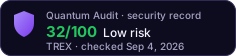
How is this score calculated? → Medium Risk
Executive SummaryAI Copilot

A comprehensive security audit could not be performed as the source code for the contract at 0xb12456b5ca0993be1be6b2f76504d38b1dc91111 was not provided. The analysis is based solely on the provided metadata, and no specific vulnerabilities could be identified.

3 Informational
! Early-stage analysis. This token has limited on-chain history (1d old). New tokens carry elevated risk — data may change rapidly. Always verify independently before investing.
Volume 24h
$676.2100
Liquidity
$16.4K
Price
$0.0001886
Token Age
1d
Top 10 Holders
74.3%

Security Findings

Info

Missing Source Code for Comprehensive Audit

I-01The source code for the contract at address 0xb124…1111 was not provided for this audit. A comprehensive security assessment, including detailed analysis of architecture, code security, access control, economic models, and upgradeability, cannot be performed without the full source code.
IssueThe source code for the contract at address was not provided for this audit. A comprehensive security assessment, including detailed analysis of architecture, code security, access control, economic models, and upgradeability, cannot be performed without the full source code.
FixAlways provide the complete and verified source code for all contracts intended for audit. Ensure the provided source code matches the deployed bytecode.
StatusUnresolved
Info

Recommendation for Comprehensive Testing

I-02Even with well-written code, smart contracts can harbor subtle bugs. Comprehensive testing is a critical step in identifying and mitigating potential vulnerabilities before deployment. This includes unit tests, integration tests, and property-based/fuzz testing.
IssueEven with well-written code, smart contracts can harbor subtle bugs. Comprehensive testing is a critical step in identifying and mitigating potential vulnerabilities before deployment. This includes unit tests, integration tests, and property-based/fuzz testing.
FixImplement a robust testing suite covering all critical functions and edge cases. Utilize tools for fuzz testing and property-based testing to explore unexpected states and inputs.
StatusUnresolved
Info

Consideration of Formal Verification

I-03For highly critical smart contracts, especially those managing significant value or complex logic, formal verification can provide a higher degree of assurance than traditional testing methods. It mathematically proves the correctness of the code against a set of specifications.
IssueFor highly critical smart contracts, especially those managing significant value or complex logic, formal verification can provide a higher degree of assurance than traditional testing methods. It mathematically proves the correctness of the code against a set of specifications.
FixConsider applying formal verification techniques to critical components of the smart contract system to mathematically prove desired security properties and invariants.
StatusUnresolved

Category Ratings

TechnicalLow10/10

Due to the absence of source code, a detailed technical analysis of the contract's architecture, code security, and access control mechanisms (7.1, 7.2, 7.3) could not be conducted. Therefore, no specific technical strengths or weaknesses can be identified.

GovernanceHigh2/10

Without the contract's source code, it is impossible to assess potential economic vulnerabilities (7.4), governance mechanisms (7.5), or external dependencies (7.6). No specific economic or governance risks can be identified at this time.

UpgradesMedium6/10

The upgradeability status and associated risks (7.7) cannot be determined without access to the contract's source code. Operational aspects (7.8) also remain unassessable.

Security Checklist

Contract VerifiedPass
Ownership Renounced?
No Mint FunctionPass
Liquidity LockedFail
Not a ProxyPass

Holder Composition

10.4% in wallets63.9% in contracts
Effective Concentration36.0%

Share held by contracts — treasury, vesting, bridge or staking — is discounted against share held by wallets when the score is computed: a contract cannot decide to sell the way an anonymous holder can, though it can still be drained or voted to sell. Effective concentration is the figure the risk score is actually calculated from.

Liquidity Depth

The risk score reads depth across every pair. The volume figure and the volume-to-liquidity ratio elsewhere on this page describe only the pair this audit analysed, so the two are not directly comparable.

LP Distribution

Top-1 Unlocked Holder35.9%
Top-3 Unlocked73.0%

Key Addresses

Deployer
0xe7a6…bfc9
Unlocked LP Held By
0x02f4…30b50xc5b6…07740xe0dd…f3df0x72b5…5a230x05f6…d904

No privileged address appears among these holders: the unlocked liquidity sits with independent providers, not with the deployer.

What Raised This Score

  • Ownership status UNKNOWN (owner could not be resolved)
  • Top-10 concentration > 30% (74.3% total → 36.0% effective; 10.4% in EOAs, 63.9% in contracts — moderate)
  • Liquidity not locked, but no owner/deployer address holds LP — market-depth risk, not rug risk
  • Liquidity < $50k ($16,439 across 1 pairs — thin market)
  • Token age < 7 days (early, volatile)

Each factor is an on-chain fact recorded at the time of this analysis. The score is computed from them by a deterministic function, so the same contract returns the same score for anyone who runs the audit. How scores are computed

Related Audits

BitVault Signal (BV7X)Medium RiskOpenAIMedium RiskOWBMedium RiskFlowerMedium RiskJerry the goat (JERRY)Medium RiskCoinbase Man (BRIAN)Medium Risk

Would You Like a More Detailed Audit of Google T-REX?

This token is brand new. Run a deeper AI-powered analysis of the contract code — free and instant.

Get Detailed Audit