The LaptopOFT contract implements an Omnichain Fungible Token (OFT) using LayerZero v2 and OpenZeppelin's Ownable2Step for ownership management. The token has a fixed total supply minted once on the Base chain. The audit identified a high-severity risk related to the centralized control over critical LayerZero configurations, which could impact cross-chain functionality. Dependencies on the external LayerZero endpoint and the security of the initial recipient address are also noted.
On-chain security analysis — is it a scam or legit?
Is Hunter Biden's Laptop Safe?
Not verified
This record has not gone through deep verification and is not being monitored. The score is a dated snapshot — the token’s risk can change at any time.Own this token? Put it under verification →The LaptopOFT contract implements an Omnichain Fungible Token (OFT) using LayerZero v2 and OpenZeppelin's Ownable2Step for ownership management.
Read the full analysis- Ownership not renounced — Multisig
- Top-10 concentration > 30%
- Liquidity not locked, but no owner/deployer address holds LP — market-depth risk, not rug risk
Exact factors
- Ownership NOT renounced — Multisig (2-of-3)
- Top-10 concentration > 30% (95.3% total → 40.5% effective; 4.0% in EOAs, 91.4% in contracts — moderate)
- Liquidity not locked, but no owner/deployer address holds LP — market-depth risk, not rug risk
Security Checklist
as of audit · Sep 12Holders
as of audit · Sep 12, 2026- Contractstreasury, vesting, bridge, staking91.4%
- Walletsanonymous holders, free to sell4.0%
- Everyone elsethe rest of the supply4.7%
How holder types affect the score
Share held by contracts — treasury, vesting, bridge or staking — is discounted against share held by wallets when the score is computed: a contract cannot decide to sell the way an anonymous holder can, though it can still be drained or voted to sell. Effective concentration is the figure the risk score is actually calculated from.
Holder balances as recorded by the audit of Sep 12, 2026
Liquidity
as of audit · Sep 12- AerodromeUSDCAnalysed$1.57M92.1%
- AerodromeAAPLc$37.4K2.2%
- Uniswap v4USDC$36.9K2.2%
- Uniswap v3USDC$27.8K1.6%
- Uniswap v4ETH$22.9K1.3%
- AerodromeUSDC$2.8K0.2%
Show 4 more pairs
The 20 remaining pairs hold $1.2K between them and are not listed.
The LP tokens of the analysed pool are not locked or burned, so whoever holds them can withdraw that liquidity.
0xcce2…1e770xf949…02980x06e0…8fb40x0ce3…289c0xd537…9ce70xad75…29f70x847d…11290x4591…57510x49f6…c73b0xc526…d923No privileged address appears among these holders: the unlocked liquidity sits with independent providers, not with the deployer.
Security Findings
MediumCentralized Control over Critical LayerZero Configurations
Not confirmed by static analysis (the model's own reading of the source).M-01
Issue
Not confirmed by static analysis (the model's own reading of the source). The LaptopOFT contract inherits from OFT, which exposes several owner-controlled functions to configure LayerZero parameters (e.g., setTrustedRemote, setMinDstGas, setDelegate, setPrecrime, setOracle, setFeeManager). These functions are critical for the correct and secure operation of cross-chain transfers. A compromised owner key could lead to a denial of service for cross-chain functionality, incorrect fee calculations, or even potential loss of funds if setTrustedRemote is manipulated to a malicious endpoint, redirecting tokens to an attacker-controlled contract.
Fix
Implement robust multi-signature control for the owner address to prevent a single point of failure. Consider adding a time-lock to critical configuration changes (e.g., setTrustedRemote, setDelegate) to allow for community review or emergency intervention before changes take effect. Regularly review and audit the security practices surrounding the owner's private keys.
Status
Unresolved
LowDependency on External LayerZero Endpoint Security and Liveness
Not confirmed by static analysis (the model's own reading of the source).L-01
Issue
Not confirmed by static analysis (the model's own reading of the source). The LaptopOFT contract's core cross-chain functionality relies entirely on the security and operational integrity of the LayerZero Endpoint (_lzEndpoint) provided during deployment. Any vulnerabilities, misconfigurations, or liveness issues within the LayerZero protocol or the specific endpoint contract could directly impact the LaptopOFT token's ability to transfer across chains, leading to a denial of service for users attempting cross-chain operations.
Fix
Acknowledge this inherent dependency and monitor the LayerZero protocol's security posture and operational status. Ensure the _lzEndpoint address used during deployment is the official and verified LayerZero endpoint for the respective chain. Implement monitoring for LayerZero endpoint events and status.
Status
Unresolved
InfoFixed Total Supply and Initial Minting Design
Not confirmed by static analysis (the model's own reading of the source).I-01
Issue
Not confirmed by static analysis (the model's own reading of the source). The contract is designed with a fixed TOTAL_SUPPLY of 1,000,000,000 tokens, which are minted entirely to a single _initialRecipient address only on the BASE_CHAIN_ID during construction. This design choice prevents further inflation or arbitrary minting by the contract owner or any other entity, providing a predictable supply schedule. However, it also means that if the _initialRecipient address is incorrect or compromised at the time of deployment, the entire token supply could be misallocated.
Fix
Ensure the _initialRecipient address is thoroughly vetted, secure, and correct prior to deployment, as this is the sole opportunity for initial token distribution. This design is generally considered a positive security characteristic for fixed-supply tokens.
Status
Unresolved
Analysis
AI Copilotas of audit · Sep 12The contract architecture (7.1) leverages the well-audited LayerZero OFT standard and OpenZeppelin's Ownable2Step, providing a robust foundation for an omnichain token. Code security (7.2) is enhanced by using Solidity 0.8.22, which includes checked arithmetic, and a fixed total supply preventing inflation. However, access control (7.3) for LayerZero configurations remains highly centralized, with the owner having the ability to set critical parameters like trusted remotes and gas limits. The contract's functionality is heavily reliant on the external LayerZero endpoint (7.6), introducing a dependency risk.
Economically (7.4), the fixed total supply and single initial minting event provide predictability and prevent arbitrary inflation. However, the governance (7.5) model is highly centralized, with a single owner (initially a delegate) controlling all critical LayerZero configurations. This centralized control, while using a two-step transfer mechanism, poses a significant risk if the owner's key is compromised, potentially leading to a denial of service for cross-chain transfers or incorrect fee calculations.
The LaptopOFT contract is not designed as an upgradeable proxy (7.7). It is a standard implementation contract, meaning its logic cannot be changed after deployment. This eliminates risks associated with upgrade mechanisms, such as proxy misconfigurations or upgradeability backdoor vulnerabilities.
It is strongly recommended to secure the contract's owner address with a robust multi-signature wallet and implement strict operational security procedures.
Consider introducing a time-lock mechanism for critical LayerZero configuration changes to provide a window for intervention if a malicious or erroneous transaction is initiated. Thoroughly verify all external addresses, especially the LayerZero endpoint and the initial recipient, before deployment.
Contract & Record
Free for any token on the record. It links to this page and always shows the current score and the date it was checked.
- Sep 12, 202619Low
Score changes are recorded as dated snapshots — history is append-only and cannot be edited.
Frequently Asked Questions
What is the LAPTOP contract address?
The Hunter Biden's Laptop (LAPTOP) contract on Base is 0xb095274743941e953c746f9c228da9c18bb6ec29. Compare it with the address the project itself publishes before trading: other contracts can carry the same name and ticker.
Is Hunter Biden's Laptop a scam?
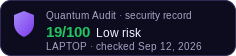
Quantum Audit's risk score for Hunter Biden's Laptop is 19/100 (Low risk) as of Sep 12, 2026, computed by a deterministic function from on-chain facts — Contract verified: Verified; Ownership: Retained; Mint: No mint; Liquidity lock: Not locked; Upgradeability: Fixed code; Honeypot: None found; Buy / sell tax: 0% / 0%. A score is a dated snapshot of those facts, not a guarantee; each one is listed on this page.
Is LAPTOP liquidity locked?
Liquidity lock: Not locked (as of Sep 12, 2026). Total DEX liquidity: $1.71M.
Who holds LAPTOP?
As of Sep 12, 2026, the 10 largest holders own 95.3% of the supply. The Holders section on this page shows who they are by holder type.
Would You Like a More Detailed Audit of Hunter Biden's Laptop?
Our AI-powered scanner gives you a deeper, real-time smart contract analysis — free, with every scoring factor shown.
Get Detailed Audit Is this your token? Add your links and get it Verified