Quantum Audit Logo
Base · Smart Contract Security · Updated Jul 24, 2026

Is BitVault Signal Safe? BV7X

On-chain security analysis — is it a scam or legit?

Contract 0xd88f…d8dc DexScreener ↗
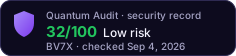
Medium Risk How is this score calculated? →
Volume 24h
$6.8K
Liquidity
$349.4K
Price
$0.000006596
Token Age
3mo
Top 10 Holders
72.8%

Security Checklist

Contract VerifiedPass
Ownership RenouncedPass
No Mint FunctionPass
Liquidity LockedFail
Not a ProxyPass

Audit History

Jul 2332

Every audit run adds a dated snapshot — history is append-only and cannot be edited.

Audit Summary

The ClankerToken contract implements an ERC20 token with extensions for burning, permits, and voting, leveraging battle-tested OpenZeppelin libraries. It includes custom logic for cross-chain minting/burning via a Superchain Token Bridge and administrative control over metadata. Key findings include centralized administrative control, a critical dependency on the external Superchain Token Bridge for supply management, and a potentially misleading `maxSupply_` parameter.

Final Recommendation: It is recommended to implement robust security measures for the `_admin` address, such as a multi-signature wallet, to mitigate the risks associated with centralized control. Thoroughly audit and monitor the `SUPERCHAIN_TOKEN_BRIDGE` contract, as its security is paramount to the integrity of the token's cross-chain supply. Additionally, enhance documentation to clearly articulate the role of `maxSupply_` and the overall token supply mechanism across chains, ensuring transparency for users and integrators.

Category Ratings

TechnicalLow
9/10

The contract demonstrates strong technical foundations by inheriting from well-audited OpenZeppelin ERC20 extensions (ERC20Burnable, ERC20Permit, ERC20Votes), which minimizes common code-level vulnerabilities (7.2 Code Security). Cross-chain minting and burning functions are correctly restricted to

GovernanceMedium
5/10

The contract's economic model relies on a fixed initial supply on a specific chain, with subsequent supply adjustments managed by the `SUPERCHAIN_TOKEN_BRIDGE` for cross-chain transfers (7.4 Economic). Governance is centralized, with an `_admin` role capable of updating token metadata and trans

UpgradesLow
9/10

The ClankerToken contract is implemented as a standard, non-upgradeable ERC20 token (7.7 Upgrades). It does not utilize any proxy patterns, meaning its logic cannot be modified post-deployment. This eliminates risks associated with upgradeability, such as proxy misconfigurations or upgrade path vuln

LP Distribution

Top-1 Unlocked Holder100.0%
Top-3 Unlocked100.0%

What Raised This Score

Each factor is an on-chain fact recorded at the time of this analysis. The score is computed from them by a deterministic function, so the same contract returns the same score for anyone who runs the audit. How scores are computed

Security Findings

1 High 1 Medium 1 Low 1 Info
H-01HighUnresolved

Centralized Control of Metadata and Admin Role

The `_admin` address has significant control over the token's mutable properties. It can update the `_image`, `_metadata`, and `_context` strings, which are critical for how the token is represented in interfaces and external systems. Furthermore, the `_admin` can transfer its own role to any other address via `updateAdmin()`. A compromise of this single `_admin` address could lead to unauthorized changes to the token's public representation and a complete loss of administrative control.

Recommendation: Consider implementing a multi-signature wallet for the `_admin` role to require multiple approvals for sensitive operations like `updateAdmin()`, `updateImage()`, and `updateMetadata()`. Alternatively, introduce a time-lock mechanism for such critical changes to provide a window for detection and intervention.
M-01MediumUnresolved

Critical Reliance on External Superchain Token Bridge for Supply Management

The `crosschainMint()` and `crosschainBurn()` functions are essential for managing the token's supply across different chains. These functions are exclusively callable by the `Predeploys.SUPERCHAIN_TOKEN_BRIDGE` address. The security and integrity of the token's total supply are therefore entirely dependent on the security, correct configuration, and operational robustness of this external bridge contract. Any vulnerability or compromise within the `SUPERCHAIN_TOKEN_BRIDGE` could directly lead to unauthorized minting or burning of ClankerToken, severely impacting its economic stability.

Recommendation: Ensure that the `SUPERCHAIN_TOKEN_BRIDGE` contract is subject to rigorous security audits, continuous monitoring, and robust operational security practices. Document the critical dependency on this bridge and its implications for the token's supply model. Consider establishing clear emergency procedures in case of a bridge compromise.
L-01LowUnresolved

Misleading `maxSupply_` Parameter in Constructor

The `maxSupply_` parameter in the constructor is used to mint the initial supply only if `block.chainid == initialSupplyChainId_`. However, the `crosschainMint()` function allows the `SUPERCHAIN_TOKEN_BRIDGE` to mint additional tokens at any time. This means that `maxSupply_` does not represent a global maximum supply for the token across all chains, but rather the initial supply on a specific chain. This could be misleading to users, exchanges, or protocols that might interpret `maxSupply_` as a hard cap on the total token supply.

Recommendation: Clarify in the contract's NatSpec documentation and external project documentation that `maxSupply_` refers specifically to the initial supply minted on the designated chain, and that the total supply can increase through cross-chain minting operations. Consider renaming the parameter to `initialChainSupply_` or similar for better clarity.
I-01InformationalUnresolved

Single-Use `verify()` Function

The `verify()` function can only be called once by the `_originalAdmin` to set the `_verified` flag to `true`. Once set, it cannot be changed. While this is the intended design, the specific purpose and implications of this `_verified` flag for the token's functionality, ecosystem integration, or future operations are not explicitly detailed within the contract's code comments.

Recommendation: Add comprehensive NatSpec documentation to the `verify()` function and the `_verified` state variable, explaining its purpose, what 'verified' status signifies, and any external systems or processes that rely on this flag. This will improve clarity for future developers and integrators.

Would You Like a More Detailed Audit of BitVault Signal?

Our AI-powered scanner gives you a deeper, real-time smart contract analysis — free, no signup required.

Get Detailed Audit
Run Free Audit →