Audit before you promote
Paste a contract on any of the six networks: findings and a 0–100 score in under a minute, private to your account.
Start free auditFreeto start



Quantum Audit reads a token’s contract, cross-checks it against on-chain data and gives it a risk score from 0 to 100. Free, in under a minute.


 ETH, BSC, POL, BASE, ARB and SOL
From the first deploy to the public record
Audit it while you build, look it up before you buy, put it on the record once it’s live. One engine, the same score at every step.
Paste a contract on any of the six networks: findings and a 0–100 score in under a minute, private to your account.
The public dashboard keeps a dated record for every token it has checked: the score, the findings and what drove the number.
A Verified badge kept current for 12 months, your site, X and Telegram on the page, and a share card for your posts.
Methodology
LLM-powered analysis surfaces the findings. A separate, deterministic function computes the 0–100 score from on-chain facts, so the same contract gets the same score on every run.
Verified Solidity or SPL source, read for 20+ vulnerability classes. Every finding is graded and explained.
Ownership, liquidity, holders and trading rules from on-chain data, weighed the same way every time. Not by the model.
The method is public: documented on its own page and mirrored on GitHub.
Ask me anything about crypto and smart contracts
Reason through attack paths, decode findings from your audit report, and pressure-test contract logic — in plain English, before you deploy.
Start a conversation
Ask anything about smart contracts, audits, or vulnerabilities.
For token teams · Founder plan
When holders ask whether the token is a rug, point them to a record they can check for themselves, not a screenshot.
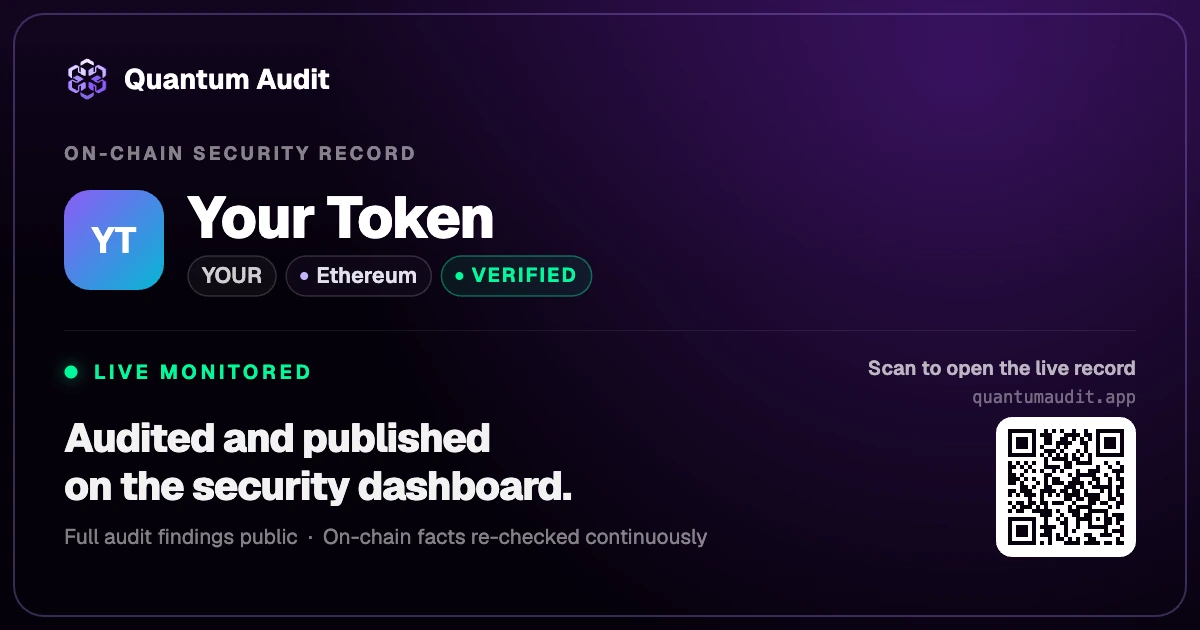
Quantum Audit is an automated security platform for smart contracts and crypto tokens. One analysis engine runs across two public surfaces: an on-demand audit tool that reads any contract address on Ethereum, BNB Smart Chain, Polygon, Base, Arbitrum or Solana, and a dashboard where finished audits are kept as dated, verifiable security records. A report you run for yourself and a record anyone can read are the same analysis produced the same way — not two different products.
Every analysis separates two things that are often conflated. LLM-powered analysis reads the contract source where it is verified and surfaces severity-graded findings; a deterministic, fact-weighted function then computes the risk score, so the same contract produces the same score on every run no matter who submits it. Each contributing factor is recorded in a published breakdown, and the full method is documented on the methodology page. Published audits are also mirrored as an open corpus on GitHub, so the methodology can be checked against the on-chain facts rather than taken on trust.
Quantum Audit is an automated smart-contract security platform for crypto tokens. It analyses a contract's on-chain state and, where the source code is verified, the source itself — returning severity-graded findings and a deterministic risk score. It operates two public surfaces: an audit tool that runs on any contract address you paste, and a dashboard that holds published audits as dated, verifiable security records.
Two things, from one engine. You can run an audit of any contract address on Ethereum, BNB Smart Chain, Polygon, Base, Arbitrum or Solana and get a report in under a minute — findings, a risk score, an executive summary and a downloadable PDF. And you can read audits already published on the public dashboard without an account. A Pro subscription adds extended reasoning for complex contracts, and token owners can put their own token on that dashboard with the Founder plan.
Three audiences, and the result is identical for all of them: a developer screening a contract during a build, a founder who needs to show a community that a token's on-chain facts hold up, and someone researching a token before buying. Same contract, same score, regardless of who requested the audit — which is precisely what makes a published record worth showing to anyone.
In two stages, deliberately kept apart. LLM-powered analysis surfaces the findings; a separate deterministic, fact-weighted function computes the score from 0 to 100. The score is not an AI verdict — it is reproducible, and every factor that moved it is published in a breakdown alongside the result. The complete method is documented on the methodology page.
Running an audit is free on the free tier, and reading anything already published on the dashboard is free and needs no account at all. A Pro subscription adds Deep Research for complex contracts. Token owners can put their own token on the public record with the Founder plan — $149 for 12 months. Either way the money pays for the work — audits, deep research runs, verification and keeping a record current — never for a score or a position.
Most free on-chain scanners match known risk signatures in bytecode and transaction history. Quantum Audit adds source-level analysis wherever a contract is verified, and separates the narrative findings from the number: the score comes from a deterministic function whose inputs are published, not from a model's opinion. Firms offering weeks-long manual review answer a different question again, and remain the right call for protocols handling significant value. These approaches are complementary rather than substitutes.
Published audits live on the public dashboard, each on its own page carrying the full findings, the risk score and its breakdown, and the date the token was last verified. Every published audit is also mirrored as an open record on GitHub, so anyone can check the methodology against the underlying on-chain facts.
