
Quantum Audit Logo

Is Zypher Token Safe?

On-chain security analysis — is it a scam or legit?

Is this your token? Publish your own audit on this page →

Zypher Token POP
0xa3cf…8fe6
BNB Chain Not verifiedLast checked 3d ago 1 audit on record
How is this score calculated? → Critical Risk
Executive SummaryAI Copilot

The Zypher Network Token contract is an ERC-20 compliant token built upon battle-tested OpenZeppelin libraries, including Ownable2Step, Pausable, and ERC20Burnable. The contract initializes with a fixed total supply minted to the deployer, who also assumes ownership. While the technical implementation is robust, the centralized control over critical functions and the initial token supply introduces operational and economic risks. External data regarding TVL, balance, deployment, and transaction count was not provided for this analysis.
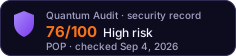

1 High1 Medium2 Informational
Volume 24h
$3.09M
Liquidity
$463.7K
Price
$0.001505
Token Age
10mo
Top 10 Holders
89.7%

Security Findings

High

Centralized Control Over Critical Functions and Initial Supply

H-01The contract owner has significant centralized control. The entire initial token supply is minted to the owner's address during deployment. Furthermore, the owner possesses the exclusive ability to pause and unpause all token transfers, effectively halting the token's utility. This level of control, while common in initial token deployments, presents a single point of authority that could be misused or compromised, impacting all token holders (7.3 Access Control, 7.4 Economic, 7.8 Operations).
IssueThe contract owner has significant centralized control. The entire initial token supply is minted to the owner's address during deployment. Furthermore, the owner possesses the exclusive ability to pause and unpause all token transfers, effectively halting the token's utility. This level of control, while common in initial token deployments, presents a single point of authority that could be misused or compromised, impacting all token holders (7.3 Access Control, 7.4 Economic, 7.8 Operations).
FixImplement a multi-signature wallet for the owner address to distribute control over critical functions like pausing and ownership transfers. Consider a timelock mechanism for sensitive operations to provide a delay for community review. For future iterations, explore mechanisms to progressively decentralize control over the token supply or critical functions.
StatusUnresolved
Medium

Single Point of Failure for Owner Key

M-01The contract relies on a single external account (the owner) for all administrative actions, including pausing transfers and transferring ownership. If the private key for this owner account is compromised, lost, or becomes inaccessible, all owner-restricted functionalities could be exploited or become permanently unavailable. While `Ownable2Step` mitigates accidental transfers, it does not address the fundamental risk of a single point of failure (7.3 Access Control, 7.8 Operations).
IssueThe contract relies on a single external account (the owner) for all administrative actions, including pausing transfers and transferring ownership. If the private key for this owner account is compromised, lost, or becomes inaccessible, all owner-restricted functionalities could be exploited or become permanently unavailable. While `Ownable2Step` mitigates accidental transfers, it does not address the fundamental risk of a single point of failure (7.3 Access Control, 7.8 Operations).
FixSecure the owner's private key with industry best practices, such as a hardware wallet. For enhanced security and resilience, transition ownership to a multi-signature wallet (e.g., Gnosis Safe) requiring multiple approvals for sensitive transactions.
StatusUnresolved
Info

Non-Upgradeability of Contract Logic

I-01The Zypher Network Token contract is deployed directly and does not utilize a proxy pattern, meaning its logic is immutable once deployed. This design choice implies that no future bug fixes, feature enhancements, or protocol adjustments can be made to the existing contract. Any necessary changes would require deploying an entirely new contract and migrating users, which can be a complex and disruptive process (7.7 Upgrades).
IssueThe Zypher Network Token contract is deployed directly and does not utilize a proxy pattern, meaning its logic is immutable once deployed. This design choice implies that no future bug fixes, feature enhancements, or protocol adjustments can be made to the existing contract. Any necessary changes would require deploying an entirely new contract and migrating users, which can be a complex and disruptive process (7.7 Upgrades).
FixThis is a design decision. If future upgradeability is desired, consider implementing a proxy pattern (e.g., UUPS or Transparent) in future contract deployments. For this contract, ensure thorough testing and auditing to minimize the need for future changes.
StatusUnresolved
Info

Reliance on OpenZeppelin Libraries

I-02The contract heavily relies on OpenZeppelin's standard libraries (ERC20, Ownable2Step, Pausable, ERC20Burnable). While these libraries are widely used and thoroughly audited, any undiscovered vulnerability within these external dependencies could potentially affect the Zypher Network Token contract. This is an inherent aspect of building on established frameworks (7.6 External).
IssueThe contract heavily relies on OpenZeppelin's standard libraries (ERC20, Ownable2Step, Pausable, ERC20Burnable). While these libraries are widely used and thoroughly audited, any undiscovered vulnerability within these external dependencies could potentially affect the Zypher Network Token contract. This is an inherent aspect of building on established frameworks (7.6 External).
FixRegularly monitor OpenZeppelin's security advisories and updates. While direct action on this contract is limited, staying informed about potential vulnerabilities in dependencies is crucial for overall protocol security.
StatusUnresolved

Category Ratings

TechnicalMedium6/10

The technical implementation of the Zypher Network Token contract is strong, leveraging well-audited OpenZeppelin libraries (7.2 Code Security). It inherits from ERC20, ERC20Burnable, Ownable2Step, and Pausable, ensuring standard and secure token functionalities. The use of Ownable2Step for ownership transfers (7.3 Access Control) enhances security by requiring a two-step process, mitigating accidental transfers. The contract includes a pausing mechanism (7.8 Operations) controlled by the owner, allowing for emergency halts of transfers. No reentrancy, integer overflow/underflow, or other common technical vulnerabilities were identified.

GovernanceHigh1/10

The contract exhibits a high degree of centralized control (7.4 Economic, 7.5 Governance). The initial owner receives the entire token supply upon deployment and retains the power to pause all token transfers via the `pause()` function. While `Ownable2Step` provides a safer mechanism for transferring ownership, the owner's single point of control over critical operations like pausing introduces a significant operational risk. The economic model is a standard fixed-supply token with burning capabilities, but the initial distribution is fully centralized to the owner.

UpgradesMedium5/10

The Zypher Network Token contract is not designed to be upgradeable (7.7 Upgrades). It is deployed as a standard, non-proxy contract, meaning its logic cannot be modified post-deployment. Any future changes or bug fixes would necessitate deploying an entirely new contract and migrating users, which is a common design choice for simple token contracts.

Security Checklist

Contract VerifiedPass
Ownership RenouncedFail
No Mint FunctionFail
Liquidity LockedFail
Not a ProxyPass

Holder Composition

3.0% in wallets86.7% in contracts
Effective Concentration37.7%

Share held by contracts — treasury, vesting, bridge or staking — is discounted against share held by wallets when the score is computed: a contract cannot decide to sell the way an anonymous holder can, though it can still be drained or voted to sell. Effective concentration is the figure the risk score is actually calculated from.

Liquidity Depth

The risk score reads depth across every pair. The volume figure and the volume-to-liquidity ratio elsewhere on this page describe only the pair this audit analysed, so the two are not directly comparable.

LP Distribution

Top-1 Unlocked Holder98.9%
Top-3 Unlocked99.8%

Key Addresses

Deployer
0x8beb…1987
Unlocked LP Held By
0x1663…441c0x7820…8ef30x894a…40130xe679…75d40xccfd…00bf

A privileged address — the deployer, the owner, or the token contract itself — is among these holders, so that party can withdraw liquidity.

What Raised This Score

  • Ownership NOT renounced — Multisig (2-of-3)
  • Mintable supply, but capped at 0.0%/year
  • Top-10 concentration > 30% (89.7% total → 37.7% effective; 3.0% in EOAs, 86.7% in contracts — moderate)
  • Liquidity NOT locked (owner can withdraw — rug-pull risk)
  • LP top1 unlocked holder = 98.9% (exit-liquidity risk)
  • LP top3 unlocked holders = 99.8% (exit-liquidity risk)
  • 1 High finding(s) from audit
  • 1 Medium finding(s) from audit

Each factor is an on-chain fact recorded at the time of this analysis. The score is computed from them by a deterministic function, so the same contract returns the same score for anyone who runs the audit. How scores are computed

Related Audits

STBL_Token - STBL Governance Token (STBL)Critical RiskTartSwap (TART)Critical RiskSpaceX (SPCXB)Critical RiskLorenzo Governance Token (BANK)Critical RiskVenusCoinCritical RiskBedrock (BR)Critical Risk

Would You Like a More Detailed Audit of Zypher Token?

Our AI-powered scanner gives you a deeper, real-time smart contract analysis — free, with every scoring factor shown.

Get Detailed Audit