
Quantum Audit Logo

Is Lorenzo Governance Token Safe?

On-chain security analysis — is it a scam or legit?

Is this your token? Publish your own audit on this page →

Lorenzo Governance Token BANK
0x3aee…f2bf
BNB Chain Not verifiedLast checked 3d ago 1 audit on record
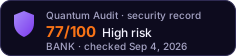
How is this score calculated? → Critical Risk
Executive SummaryAI Copilot

The BankToken contract is an ERC20-compliant token with a fixed maximum supply, inheriting from OpenZeppelin's battle-tested ERC20 and ERC20Capped implementations. The primary security consideration is the centralized minting authority, `tgeContract`, which holds exclusive power to mint new tokens up to the defined cap. While the contract's technical implementation is robust, the security of the `tgeContract` is paramount to the overall integrity of the token supply.
1 High2 Informational
Volume 24h
$15.0K
Liquidity
$55.0K
Price
$0.03544
Token Age
1y
Top 10 Holders
93.1%

Security Findings

High

Centralized Minting Authority

H-01The `mint` function in the `BankToken` contract is restricted to `tgeContract` via `require(msg.sender == tgeContract, "Only TGE contract")`. This design centralizes the power to mint new tokens up to the `MAX_SUPPLY` in a single external address. If the `tgeContract` address is compromised, an attacker could mint the remaining supply, leading to severe token devaluation and economic instability for the protocol. While the `tgeContract` is immutable, its operational security is critical.
IssueThe `mint` function in the `BankToken` contract is restricted to `tgeContract` via `require(msg.sender == tgeContract, "Only TGE contract")`. This design centralizes the power to mint new tokens up to the `MAX_SUPPLY` in a single external address. If the `tgeContract` address is compromised, an attacker could mint the remaining supply, leading to severe token devaluation and economic instability for the protocol. While the `tgeContract` is immutable, its operational security is critical.
FixImplement robust security measures for the `tgeContract` address. This could include using a multi-signature wallet (e.g., Gnosis Safe), a time-lock mechanism for minting operations, or a decentralized autonomous organization (DAO) for governance over minting. Ensure the private keys controlling the `tgeContract` are stored securely and follow best practices for operational security.
StatusUnresolved
Info

Use of OpenZeppelin Standards

I-01The `BankToken` contract inherits from OpenZeppelin's `ERC20` and `ERC20Capped` contracts. These libraries are widely used, thoroughly audited, and considered industry standards for secure token implementations. This significantly reduces the risk of common vulnerabilities associated with custom token logic.
IssueThe `BankToken` contract inherits from OpenZeppelin's `ERC20` and `ERC20Capped` contracts. These libraries are widely used, thoroughly audited, and considered industry standards for secure token implementations. This significantly reduces the risk of common vulnerabilities associated with custom token logic.
FixContinue to leverage battle-tested libraries for core functionalities. Regularly monitor OpenZeppelin's security advisories and updates to ensure the project benefits from ongoing security improvements.
StatusResolved
Info

Immutability of TGE Contract Address

I-02The `tgeContract` address, which controls the minting function, is declared as `immutable`. This ensures that the designated minting authority cannot be changed after the contract's deployment. This design choice provides certainty regarding the minting controller and prevents potential malicious reassignments.
IssueThe `tgeContract` address, which controls the minting function, is declared as `immutable`. This ensures that the designated minting authority cannot be changed after the contract's deployment. This design choice provides certainty regarding the minting controller and prevents potential malicious reassignments.
FixThis is a good security practice for critical addresses that should not change. Ensure the initial deployment correctly sets the intended `tgeContract` address, as it cannot be modified later.
StatusResolved

Category Ratings

TechnicalMedium6/10

The contract leverages OpenZeppelin's robust ERC20 and ERC20Capped implementations, ensuring adherence to established standards and mitigating common vulnerabilities (7.2 Code Security). Solidity 0.8.x's default checked arithmetic, combined with carefully placed `unchecked` blocks for safe operations, prevents integer overflows/underflows. Access control for the `mint` function is strictly enforced by checking `msg.sender` against the `tgeContract` address (7.3 Access Control). No reentrancy vectors were identified due to the absence of external calls to untrusted contracts.

GovernanceHigh1/10

The token design includes a fixed `MAX_SUPPLY` of 2.1 billion tokens, enforced by the `ERC20Capped` base contract (7.4 Economic). The `tgeContract` holds exclusive power to mint tokens up to this cap, representing a significant centralization of control over the token supply (7.5 Governance). While this is an explicit design choice, the security of the `tgeContract` is a single point of failure for token inflation. There are no on-chain governance mechanisms within this contract itself.

UpgradesHigh3/10

The BankToken contract is not designed to be upgradeable (7.7 Upgrades). This eliminates risks associated with proxy patterns, upgradeability logic, and potential upgrade path vulnerabilities. The `tgeContract` address is set as `immutable`, ensuring it cannot be changed post-deployment.

Security Checklist

Contract VerifiedPass
Ownership RenouncedFail
No Mint FunctionFail
Liquidity LockedFail
Not a ProxyPass

Holder Composition

56.2% in wallets36.9% in contracts
Effective Concentration70.9%

Share held by contracts — treasury, vesting, bridge or staking — is discounted against share held by wallets when the score is computed: a contract cannot decide to sell the way an anonymous holder can, though it can still be drained or voted to sell. Effective concentration is the figure the risk score is actually calculated from.

Liquidity Depth

The risk score reads depth across every pair. The volume figure and the volume-to-liquidity ratio elsewhere on this page describe only the pair this audit analysed, so the two are not directly comparable.

LP Distribution

Top-1 Unlocked Holder99.5%
Top-3 Unlocked100.0%

Key Addresses

Deployer
0x18d3…7491
Unlocked LP Held By
0x48c8…fc8f0x0564…5448

No privileged address appears among these holders: the unlocked liquidity sits with independent providers, not with the deployer.

What Raised This Score

  • Ownership NOT renounced (admin/mint authority retained)
  • Mintable supply, nominal cap 73%/year — effectively unbounded
  • Top-10 concentration > 70% (93.1% total → 70.9% effective; 56.2% in EOAs, 36.9% in contracts — extreme)
  • Liquidity not locked, but no owner/deployer address holds LP — market-depth risk, not rug risk
  • LP top1 unlocked holder = 99.5% (independent LP — depth risk, pool = 99% of DEX liquidity)
  • LP top3 unlocked holders = 100.0% (independent LP — depth risk, pool = 99% of DEX liquidity)
  • 1 High finding(s) from audit

Each factor is an on-chain fact recorded at the time of this analysis. The score is computed from them by a deterministic function, so the same contract returns the same score for anyone who runs the audit. How scores are computed

Related Audits

SpaceX (SPCXB)Critical RiskVenusCoinCritical RiskBedrock (BR)Critical RiskCysic Token (CYS)Critical RiskBased Token (BASED)Critical RiskZypher Token (POP)Critical Risk

Would You Like a More Detailed Audit of Lorenzo Governance Token?

Our AI-powered scanner gives you a deeper, real-time smart contract analysis — free, with every scoring factor shown.

Get Detailed Audit