
Quantum Audit Logo

Is TartSwap Safe?

On-chain security analysis — is it a scam or legit?

Is this your token? Publish your own audit on this page →

TartSwap TART
0x7ab8…0314
BNB Chain Not verifiedLast checked 3d ago 1 audit on record
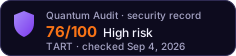
How is this score calculated? → Critical Risk
Executive SummaryAI Copilot

A security audit was conducted on the provided partial source code for the TartToken contract. Due to the incomplete nature of the provided source, a comprehensive security assessment of the core token logic and its interactions is not possible. The audit identifies critical risks associated with the inability to review the full contract implementation, alongside potential high and medium risks common to token contracts interacting with external DeFi protocols.

1 Critical1 High2 Medium1 Low
Volume 24h
$97.0K
Liquidity
$228.9K
Price
$0.000318
Token Age
8d
Top 10 Holders
82.0%

Security Findings

Critical

Incomplete Source Code Provided

C-01Only a partial source code snippet for the `TartToken` contract was provided, consisting primarily of interfaces and a utility library. The core implementation of the `TartToken` contract itself is missing. This prevents a comprehensive security audit, making it impossible to identify vulnerabilities related to the token's logic, state management, access control, or interactions with other contracts (7.1 Architecture, 7.2 Code Security).
IssueOnly a partial source code snippet for the `TartToken` contract was provided, consisting primarily of interfaces and a utility library. The core implementation of the `TartToken` contract itself is missing. This prevents a comprehensive security audit, making it impossible to identify vulnerabilities related to the token's logic, state management, access control, or interactions with other contracts (7.1 Architecture, 7.2 Code Security).
FixProvide the complete and verifiable source code for the `TartToken` contract, including all imported libraries and dependencies, to allow for a thorough security assessment.
StatusUnresolved
High

Potential for Reentrancy and External Call Vulnerabilities

H-01Given the inclusion of Uniswap V2 router interfaces, it is highly probable that the `TartToken` contract interacts with external DeFi protocols for liquidity provision or swapping. Without the full contract implementation, it is impossible to verify if these external calls are properly guarded against reentrancy attacks or other unexpected behaviors from untrusted contracts (7.2 Code Security, 7.6 External).
IssueGiven the inclusion of Uniswap V2 router interfaces, it is highly probable that the `TartToken` contract interacts with external DeFi protocols for liquidity provision or swapping. Without the full contract implementation, it is impossible to verify if these external calls are properly guarded against reentrancy attacks or other unexpected behaviors from untrusted contracts (7.2 Code Security, 7.6 External).
FixEnsure that all external calls are made after state changes (Checks-Effects-Interactions pattern) and consider using reentrancy guards for functions that interact with external contracts and modify critical state variables.
StatusUnresolved
Medium

Undetermined Access Control Mechanisms

M-01The full contract logic for `TartToken` is unavailable, making it impossible to determine what administrative functions exist (e.g., setting fees, pausing transfers, blacklisting) and how their access is controlled. Improper or overly centralized access control could lead to unauthorized critical operations, single points of failure, or governance risks (7.3 Access Control, 7.5 Governance).
IssueThe full contract logic for `TartToken` is unavailable, making it impossible to determine what administrative functions exist (e.g., setting fees, pausing transfers, blacklisting) and how their access is controlled. Improper or overly centralized access control could lead to unauthorized critical operations, single points of failure, or governance risks (7.3 Access Control, 7.5 Governance).
FixClearly define and implement robust access control for all sensitive functions, preferably using a multi-signature wallet or a well-tested access control library. Document all privileged roles and their associated permissions.
StatusUnresolved
Medium

Unverified Tokenomics and DEX Compatibility

M-02Custom token logic, such as fee-on-transfer mechanisms, reflections, or burning, can lead to unexpected behavior or break compatibility with standard DeFi protocols like Uniswap. Without the full `TartToken` implementation, its specific tokenomics and their impact on external integrations (e.g., `swapExactTokensForTokensSupportingFeeOnTransferTokens`) cannot be assessed, potentially leading to lost funds or failed transactions (7.4 Economic, 7.6 External).
IssueCustom token logic, such as fee-on-transfer mechanisms, reflections, or burning, can lead to unexpected behavior or break compatibility with standard DeFi protocols like Uniswap. Without the full `TartToken` implementation, its specific tokenomics and their impact on external integrations (e.g., `swapExactTokensForTokensSupportingFeeOnTransferTokens`) cannot be assessed, potentially leading to lost funds or failed transactions (7.4 Economic, 7.6 External).
FixIf custom tokenomics are implemented, thoroughly test their compatibility with all intended external protocols, especially DEXes. Consider using established patterns for fee-on-transfer tokens that account for DEX liquidity pools.
StatusUnresolved
Low

Lack of Emergency Pause Functionality

L-01Many DeFi protocols include a mechanism to pause critical operations (e.g., transfers, swaps) in emergencies, such as severe bugs, exploits, or market manipulation. The absence of the full contract prevents verification of such a safety feature, which could leave the protocol vulnerable to cascading failures without a quick mitigation strategy (7.8 Operations).
IssueMany DeFi protocols include a mechanism to pause critical operations (e.g., transfers, swaps) in emergencies, such as severe bugs, exploits, or market manipulation. The absence of the full contract prevents verification of such a safety feature, which could leave the protocol vulnerable to cascading failures without a quick mitigation strategy (7.8 Operations).
FixConsider implementing a well-designed pause mechanism, controlled by a trusted entity (e.g., a multi-sig wallet), to allow for emergency halts of critical contract functionalities. Ensure the pause mechanism itself is secure and cannot be abused.
StatusUnresolved

Category Ratings

TechnicalMedium6/10

The provided code snippet includes standard Uniswap V2 interfaces and a robust `Address` utility library, which correctly handles low-level calls (7.2 Code Security). However, the core `TartToken` contract implementation is missing, preventing any meaningful technical assessment of its logic, state transitions, or external interactions (7.1 Architecture). Without the full code, potential vulnerabilities like reentrancy, arithmetic errors, or improper event emissions cannot be verified (7.2 Code Security).

GovernanceHigh3/10

Without the full `TartToken` contract, the economic model and governance structure (7.5 Governance) cannot be fully evaluated. There is an inherent risk of centralization if the owner () retains extensive control over critical parameters like fees, minting, or pausing (7.3 Access Control). Custom tokenomics, such as fee-on-transfer mechanisms, could introduce unexpected behavior or compatibility issues with external DeFi protocols like Uniswap (7.4 Economic).

UpgradesMedium6/10

The provided contract does not appear to implement any upgradeability pattern (7.7 Upgrades). It is a standard, non-upgradeable contract, which eliminates upgrade-specific risks but means any future changes would require a new deployment and migration.

Security Checklist

Contract VerifiedPass
Ownership RenouncedFail
No Mint FunctionPass
Liquidity LockedPass
Not a ProxyPass
HoneypotNoneBuy Tax0.1%Sell Tax0.1%

Holder Composition

22.0% in wallets60.0% in contracts
Effective Concentration46.0%

Share held by contracts — treasury, vesting, bridge or staking — is discounted against share held by wallets when the score is computed: a contract cannot decide to sell the way an anonymous holder can, though it can still be drained or voted to sell. Effective concentration is the figure the risk score is actually calculated from.

Liquidity Depth

The risk score reads depth across every pair. The volume figure and the volume-to-liquidity ratio elsewhere on this page describe only the pair this audit analysed, so the two are not directly comparable.

LP Distribution

LP Burned13.0%
LP Locked95.7% · Null Address, OnlyMoons Lock
Top-1 Unlocked Holder3.6%

Key Addresses

Deployer
0x6ab8…e352
Unlocked LP Held By
0x4f6e…f3160x591d…8a740x0ed9…97060xc8f0…99e20x778a…1e8e0x09eb…81b60xd8df…26080xfe49…4f3d

No privileged address appears among these holders: the unlocked liquidity sits with independent providers, not with the deployer.

What Raised This Score

  • Ownership NOT renounced — owner is an EOA (single private key)
  • Top-10 concentration > 30% (82.0% total → 46.0% effective; 22.0% in EOAs, 60.0% in contracts — moderate)
  • Token age < 30 days (still settling)
  • 1 Critical finding(s) from audit
  • 1 High finding(s) from audit
  • 2 Medium finding(s) from audit
  • 1 Low finding(s) from audit

Each factor is an on-chain fact recorded at the time of this analysis. The score is computed from them by a deterministic function, so the same contract returns the same score for anyone who runs the audit. How scores are computed

Related Audits

Zypher Token (POP)Critical RiskSTBL_Token - STBL Governance Token (STBL)Critical RiskSpaceX (SPCXB)Critical RiskLorenzo Governance Token (BANK)Critical RiskVenusCoinCritical RiskBedrock (BR)Critical Risk

Would You Like a More Detailed Audit of TartSwap?

Our AI-powered scanner gives you a deeper, real-time smart contract analysis — free, with every scoring factor shown.

Get Detailed Audit