
Quantum Audit Logo

Is STBL_Token - STBL Governance Token Safe?

On-chain security analysis — is it a scam or legit?

Is this your token? Publish your own audit on this page →

STBL_Token - STBL Governance Token STBL
0x8ded…79e3
BNB Chain Not verifiedLast checked 3d ago 1 audit on record
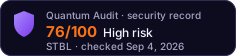
How is this score calculated? → Critical Risk
Executive SummaryAI Copilot

The STBL_Token contract is an upgradeable ERC-20 token utilizing OpenZeppelin's battle-tested libraries for access control, pausing, and UUPS upgradeability. The technical implementation is robust, showing no critical code-level vulnerabilities like reentrancy or integer overflows. However, the contract exhibits a high degree of centralization, with the DEFAULT_ADMIN_ROLE holding significant power over critical functions such as role management, contract upgrades, and token supply manipulation (via MINTER_ROLE and BRIDGE_ROLE). This centralization, while common for initial deployments, introduces a single point of failure and elevates the overall risk to Medium.

1 High1 Medium1 Low
Volume 24h
$912.1K
Liquidity
$1.74M
Price
$0.02558
Token Age
11mo
Top 10 Holders
79.5%

Security Findings

High

Centralized Control Over Critical Functions

H-01The `DEFAULT_ADMIN_ROLE` in the `STBL_Token` contract possesses extensive control over critical functions. This role can grant/revoke all other roles (`MINTER_ROLE`, `BRIDGE_ROLE`, `PAUSE_ROLE`, `UPGRADER_ROLE`), initiate contract upgrades, and update the trusted forwarder. The `MINTER_ROLE` and `BRIDGE_ROLE` can mint and burn tokens up to the `MAX_CAP`. This high degree of centralization introduces a single point of failure; if the address holding the `DEFAULT_ADMIN_ROLE` is compromised, an attacker could gain full control over the token's supply, upgrade its logic to malicious code, or pause all operations.
IssueThe `DEFAULT_ADMIN_ROLE` in the `STBL_Token` contract possesses extensive control over critical functions. This role can grant/revoke all other roles (`MINTER_ROLE`, `BRIDGE_ROLE`, `PAUSE_ROLE`, `UPGRADER_ROLE`), initiate contract upgrades, and update the trusted forwarder. The `MINTER_ROLE` and `BRIDGE_ROLE` can mint and burn tokens up to the `MAX_CAP`. This high degree of centralization introduces a single point of failure; if the address holding the `DEFAULT_ADMIN_ROLE` is compromised, an attacker could gain full control over the token's supply, upgrade its logic to malicious code, or pause all operations.
FixImplement a robust multi-signature wallet (e.g., Gnosis Safe) to control the `DEFAULT_ADMIN_ROLE` and other critical roles. For highly sensitive operations like upgrades or role management, consider adding a time-lock mechanism to allow for community review or emergency response before execution. Clearly document the operational procedures and security measures for managing these privileged roles.
StatusUnresolved
Medium

Redundant Role Grant in Initialization

M-01The `initialize()` function calls `_grantRole(DEFAULT_ADMIN_ROLE, _msgSender());` twice. While this redundancy does not introduce a functional vulnerability or error, it indicates a minor oversight in the code and could potentially lead to confusion or slight gas inefficiency if the `_grantRole` function had side effects beyond state modification.
IssueThe `initialize()` function calls `_grantRole(DEFAULT_ADMIN_ROLE, _msgSender());` twice. While this redundancy does not introduce a functional vulnerability or error, it indicates a minor oversight in the code and could potentially lead to confusion or slight gas inefficiency if the `_grantRole` function had side effects beyond state modification.
FixRemove the duplicate call to `_grantRole(DEFAULT_ADMIN_ROLE, _msgSender());` from the `initialize()` function. Ensure that each role grant is performed only once to maintain code clarity and efficiency.
StatusUnresolved
Low

Unnecessary SafeERC20 Usage for Self-Transfer

L-01In the `burn` and `bridgeBurn` functions, `IERC20(address(this)).safeTransferFrom(_from, address(this), _amt);` is used. While `SafeERC20` is generally good practice for interacting with external ERC-20 tokens, using `safeTransferFrom` to transfer tokens to `address(this)` (the token contract itself) is not strictly necessary for security. The contract is interacting with its own token balance, and a direct `_transfer` or `_approve` followed by `_transferFrom` would suffice without the `SafeERC20` wrapper, as the contract's own `_transfer` logic is trusted.
IssueIn the `burn` and `bridgeBurn` functions, `IERC20(address(this)).safeTransferFrom(_from, address(this), _amt);` is used. While `SafeERC20` is generally good practice for interacting with external ERC-20 tokens, using `safeTransferFrom` to transfer tokens to `address(this)` (the token contract itself) is not strictly necessary for security. The contract is interacting with its own token balance, and a direct `_transfer` or `_approve` followed by `_transferFrom` would suffice without the `SafeERC20` wrapper, as the contract's own `_transfer` logic is trusted.
FixConsider simplifying the `burn` and `bridgeBurn` functions by directly calling `_transfer` or `_transferFrom` if the intent is to move tokens within the contract's own context, rather than using `SafeERC20` for self-transfers. This would slightly reduce gas costs and improve readability without compromising security. Alternatively, keep the current implementation as it is harmless.
StatusUnresolved

Category Ratings

TechnicalMedium6/10

The STBL_Token contract leverages battle-tested OpenZeppelin libraries for its core ERC-20 functionality, access control (7.3), pausing, and UUPS upgradeability (7.7). The code demonstrates good security practices, including the use of Solidity 0.8.x to prevent integer overflows/underflows and no apparent reentrancy vulnerabilities (7.2). The implementation of ERC2771Context for meta-transactions is correctly handled. A minor redundancy exists where `_grantRole(DEFAULT_ADMIN_ROLE, _msgSender());` is called twice in the `initialize()` function (M-01), and `SafeERC20` is used for self-transfers which is technically unnecessary but harmless (L-01).

GovernanceHigh1/10

The contract implements a `MAX_CAP` to limit total token supply, and distinct roles (`MINTER_ROLE`, `BRIDGE_ROLE`, `PAUSE_ROLE`) are used for specific actions, providing granular control (7.4). The `PAUSE_ROLE` offers an emergency stop mechanism for transfers. However, the contract exhibits high centralization (7.5), with the `DEFAULT_ADMIN_ROLE` possessing extensive power over all other roles, contract upgrades, and the trusted forwarder (H-01). This concentration of power means a compromise of the `DEFAULT_ADMIN_ROLE` could lead to significant economic or operational risks, including arbitrary minting/burning if the `MINTER_ROLE` is granted to a malicious actor.

UpgradesHigh1/10

The contract correctly implements the UUPS upgradeability pattern using OpenZeppelin's `UUPSUpgradeable` module (7.7). The `_authorizeUpgrade` function is properly overridden and protected by the `UPGRADER_ROLE`, ensuring only authorized entities can initiate upgrades. An event `ContractUpgraded` is emitted for transparency. However, the `UPGRADER_ROLE` itself is controlled by the `DEFAULT_ADMIN_ROLE`, meaning the security of upgrades ultimately depends on the security of the `DEFAULT_ADMIN_ROLE` (H-01).

Security Checklist

Contract VerifiedPass
Ownership Renounced?
No Mint FunctionFail
Liquidity LockedFail
Not a ProxyFail

Proxy Upgrade Controls

Proxy TypeEip1967 Uups
ImplementationVerified source

Holder Composition

56.0% in wallets23.5% in contracts
Effective Concentration65.4%

Share held by contracts — treasury, vesting, bridge or staking — is discounted against share held by wallets when the score is computed: a contract cannot decide to sell the way an anonymous holder can, though it can still be drained or voted to sell. Effective concentration is the figure the risk score is actually calculated from.

Liquidity Depth

Show 3 more pairsShow less

The risk score reads depth across every pair. The volume figure and the volume-to-liquidity ratio elsewhere on this page describe only the pair this audit analysed, so the two are not directly comparable.

LP Distribution

Top-1 Unlocked Holder100.0%
Top-3 Unlocked100.0%

Key Addresses

Deployer
0x94be…59a5
Unlocked LP Held By
0xad6d…62710xde51…a29f0x5eea…26530x5b2d…38b9

No privileged address appears among these holders: the unlocked liquidity sits with independent providers, not with the deployer.

What Raised This Score

  • Ownership status UNKNOWN (owner could not be resolved)
  • Mintable supply — no cap found, dilution unbounded
  • Proxy contract (upgradeable — admin can replace logic)
  • Top-10 concentration > 50% (79.5% total → 65.4% effective; 56.0% in EOAs, 23.5% in contracts — heavy)
  • Liquidity not locked, but no owner/deployer address holds LP — market-depth risk, not rug risk
  • LP top1 unlocked holder = 100.0% (independent LP — depth risk, pool = 98% of DEX liquidity)
  • LP top3 unlocked holders = 100.0% (independent LP — depth risk, pool = 98% of DEX liquidity)
  • 1 High finding(s) from audit
  • 1 Medium finding(s) from audit
  • 1 Low finding(s) from audit

Each factor is an on-chain fact recorded at the time of this analysis. The score is computed from them by a deterministic function, so the same contract returns the same score for anyone who runs the audit. How scores are computed

Related Audits

Zypher Token (POP)Critical RiskTartSwap (TART)Critical RiskSpaceX (SPCXB)Critical RiskLorenzo Governance Token (BANK)Critical RiskVenusCoinCritical RiskBedrock (BR)Critical Risk

Would You Like a More Detailed Audit of STBL_Token - STBL Governance Token?

Our AI-powered scanner gives you a deeper, real-time smart contract analysis — free, with every scoring factor shown.

Get Detailed Audit