
The LaunchToken contract is a standard ERC-20 implementation with no additional privileged functions or complex logic. The code follows OpenZeppelin standards, ensuring robust compliance with token transfer expectations. No administrative backdoors or centralized control mechanisms were identified in the static analysis.
Early-stage security check — honeypot & rug-pull analysis
Is yeti a Scam?
Not verified
This record has not gone through deep verification and is not being monitored. The score is a dated snapshot — the token’s risk can change at any time.Own this token? Put it under verification →The LaunchToken contract is a standard ERC-20 implementation with no additional privileged functions or complex logic.
Read the full analysis- Liquidity not locked
- Liquidity < $50k
- Top-10 concentration > 30%
Exact factors
- Liquidity NOT locked (100% of the pool) — held by independent providers — market-depth risk
- Liquidity < $50k ($11,432 across 1 pairs — thin market)
- Top-10 concentration > 30% (67.1% total → 34.4% effective; 12.6% in EOAs, 54.5% in contracts)
Each factor is an on-chain fact recorded at the time of this analysis. The score is computed from them by a deterministic function, so the same contract returns the same score for anyone who runs the audit. How scores are computed
Security Checklist
as of audit · Nov 16Holders
as of audit · Nov 16, 2026- Contractstreasury, vesting, bridge, staking54.5%
- Walletsanonymous holders, free to sell12.6%
- Everyone else88 holders32.9%
How holder types affect the score
Share held by contracts — treasury, vesting, bridge or staking — is discounted against share held by wallets when the score is computed: a contract cannot decide to sell the way an anonymous holder can, though it can still be drained or voted to sell. Effective concentration is the figure the risk score is actually calculated from.
Holder balances as recorded by the audit of Nov 16, 2026
Liquidity
as of audit · Nov 16The risk score reads depth across every pair.
The LP tokens of the analysed pool are not locked or burned, so whoever holds them can withdraw that liquidity.
0xa6f3…e168No privileged address appears among these holders: the unlocked liquidity sits with independent providers, not with the deployer.
Security Findings
MediumLiquidity not locked
0.0% of the pool's LP is burned or time-locked. 100.0% is held, unlocked, by 1 address(es) other than the owner/deployer. One of them — a wallet, 0xa6f3…e168 — holds 100.0% and can remove that share at once; who controls it is not visible on-chain, so it is not treated as an independent provider. Some pools are concentrated-liquidity (V3/V4) positions; shares above are by position as GoPlus reports them.QA-LIQUIDITY
Issue
0.0% of the pool's LP is burned or time-locked. 100.0% is held, unlocked, by 1 address(es) other than the owner/deployer. One of them — a wallet, 0xa6f3…e168 — holds 100.0% and can remove that share at once; who controls it is not visible on-chain, so it is not treated as an independent provider. Some pools are concentrated-liquidity (V3/V4) positions; shares above are by position as GoPlus reports them.
Fix
Check the lock's end date and beneficiary on the locker's own page before relying on it.
Status
Acknowledged
InfoNo issues identified in the reviewed source
The verified source code was reviewed and no issue rising to Informational severity or above was identified. This is a statement about the code that was read, not a guarantee: the review covers the published source only. Fact-layer checks (mint capability, holder concentration) were applied separately and feed the risk score.I-01
Issue
The verified source code was reviewed and no issue rising to Informational severity or above was identified. This is a statement about the code that was read, not a guarantee: the review covers the published source only. Fact-layer checks (mint capability, holder concentration) were applied separately and feed the risk score.
Fix
Re-check after any contract upgrade or ownership change, both of which can alter behaviour without changing this page.
Status
Acknowledged
InfoWho holds the supply
The ten largest holders own 67.1% of supply. What remains: 12.6% in wallets, 54.5% in other contracts. 98 holders in total.QA-HOLDERS
Issue
The ten largest holders own 67.1% of supply. What remains: 12.6% in wallets, 54.5% in other contracts. 98 holders in total.
Fix
Watch the largest wallets that are not exchanges, pools or locks — those are the ones that can move the price.
Status
Acknowledged
InfoNot listed by any independent source
98 holders. Not listed by CoinGecko or any exchange GoPlus tracks. Nothing independent confirms who is behind this token, so every power its contract grants is scored at face value.QA-IDENTITY
Issue
98 holders. Not listed by CoinGecko or any exchange GoPlus tracks. Nothing independent confirms who is behind this token, so every power its contract grants is scored at face value.
Fix
Match the contract address against the project's official channels before trading.
Status
Acknowledged
InfoThe market for this token
Liquidity $11K (DexScreener, all pools). 24h trading volume $70K (DexScreener, all pools).QA-MARKET
Issue
Liquidity $11K (DexScreener, all pools). 24h trading volume $70K (DexScreener, all pools).
Fix
Size any position to the liquidity and daily volume shown — they set how much you can sell and at what price.
Status
Acknowledged
InfoAsset class: Project token
A token issued by a project for use, governance or fundraising. Scored on its contract and market facts. The class itself adds no points; the contract and market facts decide the score. Basis: no class-specific evidence. Tokenomics — Supply: fixed — the contract has no mint function. Control: an owner that could not be resolved. Code: not upgradeable (no proxy). Fees: no buy or sell tax. Market: $11K of DEX liquidity across 1 pools. Launch: under a day of market history.QA-PROFILE
Issue
A token issued by a project for use, governance or fundraising. Scored on its contract and market facts. The class itself adds no points; the contract and market facts decide the score. Basis: no class-specific evidence. Tokenomics — Supply: fixed — the contract has no mint function. Control: an owner that could not be resolved. Code: not upgradeable (no proxy). Fees: no buy or sell tax. Market: $11K of DEX liquidity across 1 pools. Launch: under a day of market history.
Fix
Check the project's own documentation for what the token is used for; this report covers what the contract allows.
Status
Acknowledged
InfoRecently launched — less than a day of market history
The token's oldest DEX pool is less than a day old. Age is not part of the risk score — a new token is not a risky one by default — but a short history means fewer trades and holder changes behind the facts in this report.QA-RECENT
Issue
The token's oldest DEX pool is less than a day old. Age is not part of the risk score — a new token is not a risky one by default — but a short history means fewer trades and holder changes behind the facts in this report.
Fix
Re-check ownership, liquidity and holder distribution as the token matures; those are the facts that move early.
Status
Acknowledged
Analysis
AI Copilotas of audit · Nov 16The architecture follows a standard ERC-20 pattern (7.1 Architecture) utilizing OpenZeppelin libraries (7.2 Code Security). The implementation is free of custom logic, which minimizes the attack surface for reentrancy or integer overflows (7.2 Code Security). There are no access control modifiers (7.3 Access Control) or external dependencies (7.6 External) that could introduce unexpected behavior. The code is clean and adheres to modern Solidity best practices.
The contract lacks governance (7.5 Governance) or economic parameters (7.4 Economic) as it is a simple token. There are no minting or burning functions that could impact the token supply (7.4 Economic). The token operates purely as a standard asset without external dependencies (7.6 External). Operations (7.8 Operations) are limited to standard transfers.
The contract is not a proxy (7.7 Upgrades) and is therefore immutable. This eliminates risks associated with logic upgrades or proxy storage collisions. No upgrade paths exist, ensuring the contract code remains constant throughout its lifecycle (7.7 Upgrades).
The contract is secure and follows standard industry practices for ERC-20 tokens.
No further action is required as there are no identified vulnerabilities or centralized risks.
Contract & Record
Free for any token on the record. It links to this page and always shows the current score and the date it was checked.
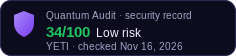
- Nov 16, 202634Low
Score changes are recorded as dated snapshots — history is append-only and cannot be edited.
Frequently Asked Questions
What is the YETI contract address?
The yeti contract on Ethereum is 0x5aa940850933f42e583792c470b171d411f52483. Compare it with the address the project itself publishes before trading: other contracts can carry the same name and ticker.
Is yeti a scam?
Quantum Audit's risk score for yeti is 34/100 (Low risk) as of Nov 16, 2026, computed by a deterministic function from on-chain facts — Contract verified: Verified; Mint: No mint; Liquidity lock: Not locked; Upgradeability: Fixed code; Honeypot: None found; Buy / sell tax: 0% / 0%. A score is a dated snapshot of those facts, not a guarantee; each one is listed on this page.
Is YETI liquidity locked?
Liquidity lock: Not locked (as of Nov 16, 2026). Total DEX liquidity: $11.4K.
Who holds YETI?
As of Nov 16, 2026, the 10 largest holders own 67.1% of the supply across 98 holders. The Holders section on this page shows who they are by holder type.
Would You Like a More Detailed Audit of yeti?
This token is brand new. Run a deeper AI-powered analysis of the contract code — free and instant.
Get Detailed Audit Is this your token? Add your links and get it Verified