
Quantum Audit Logo
Ethereum · Smart Contract Security · Updated Jul 24, 2026

Is RaveDAO Safe? RAVE

On-chain security analysis — is it a scam or legit?

Contract 0x1720…db97 DexScreener ↗
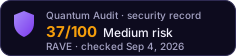
Medium Risk How is this score calculated? →
Volume 24h
$26.6K
Liquidity
$253.8K
Price
$0.2909
Token Age
6mo
Top 10 Holders
97.6%

Security Checklist

Contract VerifiedPass
Ownership RenouncedFail
No Mint FunctionPass
Liquidity LockedFail
Not a ProxyPass

Audit History

Jul 2337

Every audit run adds a dated snapshot — history is append-only and cannot be edited.

Audit Summary

The RaveToken contract is an ERC-20 token built upon OpenZeppelin's Ownable and LayerZero's OFT (Omnichain Fungible Token) standards. The contract facilitates cross-chain transfers via LayerZero and includes a basic burn function. The codebase is concise and leverages well-audited external libraries, contributing to high technical security. However, the system exhibits centralized control by the owner over critical LayerZero configurations and lacks an emergency pause mechanism, which introduces medium-level governance and operational risks. The overall security is heavily reliant on the integrity of the LayerZero protocol.
Final Recommendation: It is recommended to implement an emergency pause mechanism to allow the owner or a designated multisig to halt critical operations in case of an exploit or vulnerability. Consider deploying the contract with a robust multisig wallet as the owner to enhance security and decentralize control over critical LayerZero configurations. Additionally, establish clear operational procedures for managing LayerZero parameters and for handling potential incidents.

Category Ratings

TechnicalLow
8/10

The technical architecture (7.1 Architecture) of RaveToken is straightforward, extending battle-tested ERC-20, Ownable, and LayerZero OFT contracts. The custom code (7.2 Code Security) is minimal, primarily consisting of a constructor for initialization and a simple `burn` function, which reduces th

GovernanceMedium
4/10

The economic model (7.4 Economic) is simple, based on an ERC-20 token with cross-chain capabilities. Governance (7.5 Governance) is centralized, with a single owner address controlling critical LayerZero configurations such as trusted remotes and delegate settings (7.8 Operations). This centralizati

UpgradesLow
7/10

The RaveToken contract is not designed with upgradeability (7.7 Upgrades) in mind. It is a standard implementation contract, meaning there are no proxy-related risks or complexities associated with upgrades. Any future changes would require a new deployment and token migration.

LP Distribution

Top-1 Unlocked Holder100.0%
Top-3 Unlocked100.0%

What Raised This Score

Each factor is an on-chain fact recorded at the time of this analysis. The score is computed from them by a deterministic function, so the same contract returns the same score for anyone who runs the audit. How scores are computed

Security Findings

2 Low 2 Info
L-01LowUnresolved

Lack of Emergency Pause Mechanism

The contract lacks an emergency pause mechanism. In the event of a critical vulnerability, an exploit, or a severe issue with the LayerZero protocol, there is no function available to the owner or any authorized entity to temporarily halt token transfers or cross-chain operations. This could prevent the project from mitigating ongoing losses or preventing further damage.

Recommendation: Implement a `Pausable` mechanism (e.g., from OpenZeppelin) that allows the owner or a designated governance entity to pause and unpause critical functions, such as `transfer`, `transferFrom`, `sendFrom`, and `_debit` (for cross-chain transfers). This provides a crucial safety switch for incident response.
L-02LowUnresolved

No Mechanism for Recovering Accidentally Sent Tokens

The contract does not include a function to recover accidentally sent ERC-20 tokens (other than RaveToken itself) or native currency (ETH/MATIC/BNB) that might be mistakenly sent to the contract address. Any such assets sent to the contract would become permanently locked and inaccessible.

Recommendation: Add an `onlyOwner` function to allow the recovery of arbitrary ERC-20 tokens and native currency. This function should enable the owner to transfer specified tokens or native currency from the contract to a designated address. Care should be taken to prevent the recovery of the contract's own RaveTokens if they are intended to be held by the contract for specific purposes.
I-01InformationalUnresolved

Centralized Control by Owner

The contract utilizes the OpenZeppelin `Ownable` pattern, granting a single address (the owner) exclusive control over critical functions. Specifically, the owner can configure LayerZero parameters such as `setDelegate`, `setTrustedRemote`, and `setEnforcedOptions`. This centralization introduces a single point of failure, where a compromise of the owner's private key could lead to unauthorized control over the token's cross-chain functionality.

Recommendation: Consider using a robust multisig wallet (e.g., Gnosis Safe) as the owner to distribute control and reduce the risk associated with a single point of failure. For highly sensitive operations, explore integrating a more decentralized governance mechanism if feasible for the project's scope.
I-02InformationalUnresolved

Reliance on LayerZero Security

The RaveToken contract's core functionality for cross-chain transfers is entirely dependent on the LayerZero protocol and its endpoint. The security and operational integrity of the token across different chains are directly tied to the security of LayerZero's infrastructure, including its relayer network and oracle services. Any vulnerability or compromise within LayerZero could directly impact the RaveToken's cross-chain value transfer and integrity.

Recommendation: Acknowledge and monitor the security posture of the LayerZero protocol. Stay updated on LayerZero's security announcements, audits, and any reported vulnerabilities. Implement robust monitoring for LayerZero-related events and potential anomalies in cross-chain transfers.

Frequently Asked Questions

Is RaveDAO a scam?

Based on the provided data, RaveDAO exhibits several characteristics commonly associated with high-risk projects. The unrenounced contract ownership, extreme token centralization (97.3% in top 10 holders), and unlocked liquidity are significant red flags that can indicate a heightened potential for malicious actions or severe market manipulation. These factors contribute to its critical risk score of 71/100.

Is RaveDAO safe to buy?

Investing in RaveDAO carries significant risk, reflected by its critical risk score of 71/100. Key safety concerns include the unrenounced contract ownership, allowing potential future alterations by the deployer, and the highly concentrated token supply that enables substantial market control by a few large holders. Additionally, the lack of locked liquidity means the project is vulnerable to liquidity withdrawals, posing a substantial risk to investor funds.

Has RaveDAO been audited?

The RaveDAO contract has been verified on Etherscan, which means its code is publicly available and matches the deployed bytecode. However, contract verification is not the same as a professional security audit. An audit involves a thorough review by cybersecurity experts to identify vulnerabilities, and there is no information provided to suggest RaveDAO has undergone such a process.

Would You Like a More Detailed Audit of RaveDAO?

Our AI-powered scanner gives you a deeper, real-time smart contract analysis — free, no signup required.

Get Detailed Audit
Run Free Audit →