Quantum Audit Logo
Ethereum · Smart Contract Security · Updated Jul 24, 2026

Is Octra Safe? OCT

On-chain security analysis — is it a scam or legit?

Contract 0x4647…6e80 DexScreener ↗
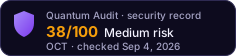
Medium Risk How is this score calculated? →
Volume 24h
$26.9K
Liquidity
$648.1K
Price
$0.02127
Token Age
1mo
Top 10 Holders
47.9%

Security Checklist

Contract VerifiedPass
Ownership RenouncedUnknown
No Mint FunctionPass
Liquidity LockedFail
Not a ProxyPass

Audit History

Jul 2333

Every audit run adds a dated snapshot — history is append-only and cannot be edited.

Audit Summary

The WrappedOCT contract is an ERC20 token with bridging and pausing capabilities, built upon battle-tested OpenZeppelin libraries. The audit identified a Medium risk related to centralized control over critical functions, where a single compromised address could impact token supply and operations. Minor issues include non-standard decimal precision and immutable supply cap. The contract's architecture is straightforward and does not employ upgradeability patterns.

Final Recommendation: To mitigate the identified risks, it is strongly recommended to implement multi-signature wallets for all critical roles, including `DEFAULT_ADMIN_ROLE`, `BRIDGE_ROLE`, and `PAUSER_ROLE`. This distributes control and significantly reduces the impact of a single private key compromise. Additionally, ensure all external systems interacting with WrappedOCT are fully aware of and correctly handle its 6-decimal precision to prevent integration issues.

Category Ratings

TechnicalLow
10/10

The contract leverages well-audited OpenZeppelin libraries for ERC20, AccessControl, and Pausable functionalities (7.2 Code Security). It implements clear checks for zero addresses and amounts in `bridgeMint` and `bridgeBurn`, and enforces a `MAX_SUPPLY` limit to prevent unbounded minting (7.1 Archi

GovernanceHigh
3/10

The contract exhibits centralized control over key functions (7.3 Access Control, 7.5 Governance). The `DEFAULT_ADMIN_ROLE` (deployer) can manage all roles, including the `BRIDGE_ROLE` which controls token minting and burning, and the `PAUSER_ROLE` which can halt all transfers. While a `MAX_SUPPLY`

UpgradesMedium
6/10

The WrappedOCT contract is not designed with an upgradeability pattern (7.7 Upgrades). It is a standard, immutable contract deployment. This eliminates risks associated with upgrade proxies, such as storage collisions or faulty upgrade logic, but also means the contract's logic cannot be modifi

LP Distribution

Top-1 Unlocked Holder100.0%
Top-3 Unlocked100.0%

What Raised This Score

Each factor is an on-chain fact recorded at the time of this analysis. The score is computed from them by a deterministic function, so the same contract returns the same score for anyone who runs the audit. How scores are computed

Security Findings

1 Medium 1 Low 1 Info
M-01MediumUnresolved

Centralized Control Over Token Supply and Operations

The `WrappedOCT` contract grants significant power to specific roles, particularly the `DEFAULT_ADMIN_ROLE`, `BRIDGE_ROLE`, and `PAUSER_ROLE`. The `DEFAULT_ADMIN_ROLE` (initially the deployer) has the ability to grant and revoke any role, effectively controlling all administrative functions. The `BRIDGE_ROLE` can mint new tokens up to the `MAX_SUPPLY` and burn existing tokens, directly impacting the token's supply. The `PAUSER_ROLE` can unilaterally pause all token transfers. This high degree of centralization means that a compromise of any of these key addresses could lead to unauthorized minting, burning, or a complete halt of token operations, posing a significant risk to the protocol's…

Recommendation: Implement multi-signature wallets (e.g., Gnosis Safe) for the `DEFAULT_ADMIN_ROLE`, `BRIDGE_ROLE`, and `PAUSER_ROLE`. This requires multiple independent approvals for critical actions, distributing control and significantly reducing the risk associated with a single point of failure. Consider adding time-locks for highly sensitive operations to allow for community review or emergency intervention.
L-01LowUnresolved

Non-Standard ERC20 Decimals

The `WrappedOCT` contract overrides the default ERC20 `decimals()` function to return 6, instead of the commonly used 18. While this is an explicit design choice and not a vulnerability in itself, it deviates from the widely adopted ERC20 standard. This non-standard decimal precision can lead to compatibility issues, incorrect display of token balances, or miscalculations when integrating with exchanges, wallets, or DeFi protocols that implicitly assume 18 decimals without proper handling.

Recommendation: Ensure all off-chain systems, front-end applications, and integrated smart contracts are explicitly aware of and correctly handle the 6-decimal precision of the `WrappedOCT` token. Thoroughly test all integrations to confirm that token values are displayed and processed accurately to prevent user confusion or financial discrepancies.
I-01InformationalUnresolved

Immutable MAX_SUPPLY Constant

The `MAX_SUPPLY` for the `WrappedOCT` token is defined as a `public constant` with a value of `1_000_000_000 * 1e6`. This means the maximum total supply of the token is hardcoded into the contract and cannot be altered after deployment. While providing predictability and transparency regarding the token's supply cap, this design choice removes any flexibility to adjust the maximum supply in the future, even if unforeseen circumstances or protocol evolution might warrant such a change.

Recommendation: Acknowledge that the `MAX_SUPPLY` is immutable. If future flexibility for supply cap adjustments is ever considered necessary, a different design pattern involving a state variable managed by a governance or admin role would be required. However, such a change would introduce its own set of governance and security considerations.

Frequently Asked Questions

Is Octra a scam?

Based on the provided data, Octra exhibits characteristics that mitigate common scam risks. Its contract is verified, ownership is renounced, and no mint function exists, preventing arbitrary token creation or owner control. While these factors significantly reduce the likelihood of specific developer-led rug pulls, they do not eliminate all potential market risks. Investors should consider all aspects.

Is Octra safe to buy?

While Octra has a low risk score of 18/100 and positive attributes like a verified, renounced contract without a mint function, two key factors warrant caution. The liquidity is not locked, posing a risk to market stability if withdrawn. Furthermore, the top 10 holders control 46.3% of the supply, indicating potential for significant market impact.

Has Octra been audited?

The data states Octra's contract is "verified," meaning its code is publicly available and matches the deployed version on the blockchain. This enhances transparency. However, contract verification is distinct from a full, independent security audit conducted by specialized firms, which involves a deeper, more comprehensive vulnerability assessment.

Would You Like a More Detailed Audit of Octra?

Our AI-powered scanner gives you a deeper, real-time smart contract analysis — free, no signup required.

Get Detailed Audit
Run Free Audit →