
Quantum Audit Logo

Is Identity.md Safe?

On-chain security analysis — is it a scam or legit?

Is this your token? Publish your own audit on this page →

Identity.md IMD
0xd34a…63b7
Ethereum Not verifiedLast checked 3d ago 1 audit on record
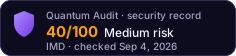
How is this score calculated? → Medium Risk
Executive SummaryAI Copilot

The BridgedFP contract is an Omnichain Fungible Token (OFT) implementation utilizing LayerZero and OpenZeppelin's Ownable. It allows the owner to update the token's name and symbol. The contract's custom logic is minimal and appears robust, but the centralized control over metadata introduces a medium-level risk. No critical or high-severity vulnerabilities were identified.

1 Medium1 Informational
Volume 24h
$1.68M
Liquidity
$1.59M
Price
$3.5000
Token Age
7mo
Top 10 Holders
52.9%

Security Findings

Medium

Centralized Control Over Token Metadata

M-01The `BridgedFP` contract allows the `onlyOwner` to update the token's `_updatableName` and `_updatableSymbol` via the `updateName`, `updateSymbol`, and `updateNameAndSymbol` functions. While this provides flexibility for branding or corrections, it introduces a single point of control. A compromised owner key or a malicious owner could change the token's name and symbol to something misleading, potentially causing confusion among users, facilitating phishing attempts, or damaging the project's reputation.
IssueThe `BridgedFP` contract allows the `onlyOwner` to update the token's `_updatableName` and `_updatableSymbol` via the `updateName`, `updateSymbol`, and `updateNameAndSymbol` functions. While this provides flexibility for branding or corrections, it introduces a single point of control. A compromised owner key or a malicious owner could change the token's name and symbol to something misleading, potentially causing confusion among users, facilitating phishing attempts, or damaging the project's reputation.
FixImplement robust security practices for the owner's private key, such as using a multi-signature wallet (e.g., Gnosis Safe) for the `_delegate` address. Consider whether the ability to change the name and symbol is strictly necessary post-deployment. If not, these functions could be removed or made immutable after an initial setup period. If dynamic updates are required, ensure clear communication channels are established to inform users of any changes.
StatusUnresolved
Info

Reliance on External Contracts

I-01The `BridgedFP` contract inherits significant functionality from external, widely-used libraries: `@openzeppelin/contracts/access/Ownable.sol` and `@layerzerolabs/oft-evm/contracts/OFT.sol`. While these libraries are generally considered secure and well-audited, any vulnerability discovered within them could directly impact the security and functionality of the `BridgedFP` contract. This represents a standard dependency risk.
IssueThe `BridgedFP` contract inherits significant functionality from external, widely-used libraries: `@openzeppelin/contracts/access/Ownable.sol` and `@layerzerolabs/oft-evm/contracts/OFT.sol`. While these libraries are generally considered secure and well-audited, any vulnerability discovered within them could directly impact the security and functionality of the `BridgedFP` contract. This represents a standard dependency risk.
FixEnsure that all external dependencies are kept up-to-date with their latest secure versions. Regularly monitor security advisories and audits related to OpenZeppelin Contracts and LayerZero's OFT library. While direct control over these external contracts is limited, awareness of their security posture is crucial.
StatusUnresolved

Category Ratings

TechnicalLow8/10

The contract demonstrates good technical architecture (7.1) by extending well-audited libraries like LayerZero's OFT and OpenZeppelin's Ownable. Code security (7.2) is generally strong, with appropriate string length checks in `updateName` and `updateSymbol`. However, the centralized control over token metadata via `onlyOwner` functions (7.3) presents a technical risk, as a compromised owner key could lead to misleading token information. The reliance on external contracts (7.6) is a standard practice but introduces dependency risks.

GovernanceHigh3/10

The economic model (7.4) is primarily inherited from the LayerZero OFT standard, which handles cross-chain token transfers. The governance model (7.5) is highly centralized, with a single owner address controlling the ability to update the token's name and symbol. While this allows for flexibility in branding or corrections, it introduces a single point of failure. A compromised owner key could lead to malicious or misleading changes to the token's identity, potentially impacting user trust and creating confusion.

UpgradesMedium6/10

The BridgedFP contract is not designed as an upgradeable proxy (7.7). This means its logic is immutable once deployed, eliminating risks associated with upgrade mechanisms like proxy misconfigurations or faulty upgrade implementations. However, it also implies that any discovered critical vulnerabilities would necessitate a new contract deployment and token migration.

Security Checklist

Contract VerifiedPass
Ownership RenouncedFail
No Mint FunctionPass
Liquidity LockedFail
Not a ProxyPass

Holder Composition

5.8% in wallets47.1% in contracts
Effective Concentration24.6%

Share held by contracts — treasury, vesting, bridge or staking — is discounted against share held by wallets when the score is computed: a contract cannot decide to sell the way an anonymous holder can, though it can still be drained or voted to sell. Effective concentration is the figure the risk score is actually calculated from.

Liquidity Depth

Show 2 more pairsShow less

The risk score reads depth across every pair. The volume figure and the volume-to-liquidity ratio elsewhere on this page describe only the pair this audit analysed, so the two are not directly comparable.

LP Distribution

Top-1 Unlocked Holder85.7%
Top-3 Unlocked99.3%

Key Addresses

Deployer
0x047f…54b7
Unlocked LP Held By
0xc657…08080x0a72…65de0xe171…daa50xf768…8dad0x536f…5eee0x51f1…2189

No privileged address appears among these holders: the unlocked liquidity sits with independent providers, not with the deployer.

What Raised This Score

  • Ownership NOT renounced — owner is an EOA (single private key)
  • Top-10 concentration > 20% (52.9% total → 24.6% effective; 5.8% in EOAs, 47.1% in contracts — mild)
  • Liquidity not locked, but no owner/deployer address holds LP — market-depth risk, not rug risk
  • LP top1 unlocked holder = 85.7% (independent LP — depth risk, pool = 84% of DEX liquidity)
  • LP top3 unlocked holders = 99.3% (independent LP — depth risk, pool = 84% of DEX liquidity)
  • 1 Medium finding(s) from audit

Each factor is an on-chain fact recorded at the time of this analysis. The score is computed from them by a deterministic function, so the same contract returns the same score for anyone who runs the audit. How scores are computed

Related Audits

Artificial Superintelligence Alliance (FET)Medium RiskOndoMedium RiskRequest Token (REQ)Medium RiskHighstreet token (HIGH)Medium RiskOutBurnMedium RiskChainlink (LINK)Medium Risk

Would You Like a More Detailed Audit of Identity.md?

Our AI-powered scanner gives you a deeper, real-time smart contract analysis — free, with every scoring factor shown.

Get Detailed Audit