
Quantum Audit Logo

Is toby Safe?

On-chain security analysis — is it a scam or legit?

toby TOBY
0xb8d9…e56e
Base Not verifiedLast checked 3d ago 1 audit on record
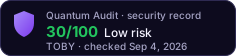
How is this score calculated? → Medium Risk
Executive SummaryAI Copilot

The toby token contract is a custom ERC20 implementation with owner-controlled functionalities. A critical vulnerability was identified in the access control mechanism, utilizing `tx.origin` instead of `msg.sender`, which exposes owner-restricted functions to phishing attacks. Additionally, the `transferFrom` function exhibits incorrect logic, and an unused state variable was found. The contract includes a token recovery mechanism for ERC20 tokens.

1 Critical1 High1 Low1 Informational
Volume 24h
$14.9K
Liquidity
$209.2K
Price
$0.0000000126
Token Age
2y
Top 10 Holders
23.0%

Security Findings

Critical

`tx.origin` for Access Control

C-01The `onlyOwner` modifier in the `Ownable` contract uses `tx.origin` instead of `msg.sender` for access control. This is a critical vulnerability as it makes all owner-restricted functions susceptible to phishing attacks. If the legitimate owner interacts with a malicious contract, that contract can then call owner-restricted functions (e.g., `transferOwnership`, `renounceOwnership`, `recoverERC20`) on the `toby` token contract, as `tx.origin` would still resolve to the legitimate owner's address.
IssueThe `onlyOwner` modifier in the `Ownable` contract uses `tx.origin` instead of `msg.sender` for access control. This is a critical vulnerability as it makes all owner-restricted functions susceptible to phishing attacks. If the legitimate owner interacts with a malicious contract, that contract can then call owner-restricted functions (e.g., `transferOwnership`, `renounceOwnership`, `recoverERC20`) on the `toby` token contract, as `tx.origin` would still resolve to the legitimate owner's address.
FixReplace `tx.origin` with `msg.sender` in the `onlyOwner` modifier. The `msg.sender` variable always refers to the immediate caller of the function, providing a secure and standard way to implement access control.
StatusUnresolved
High

Incorrect `transferFrom` Logic

H-01The `transferFrom` function executes the token transfer (`_transfer`) before checking if the allowance is sufficient and updating it. Specifically, `_transfer(sender, recipient, amount)` is called first, followed by `require(currentAllowance >= amount, "ERC20: transfer amount exceeds allowance")`. If the allowance is insufficient, the `_transfer` operation will still occur (if the sender has enough balance), but the transaction will then revert due to the subsequent `require` statement. This leads to wasted gas and non-standard ERC20 behavior, potentially causing issues for integrations expecting the allowance check to precede the transfer.
IssueThe `transferFrom` function executes the token transfer (`_transfer`) before checking if the allowance is sufficient and updating it. Specifically, `_transfer(sender, recipient, amount)` is called first, followed by `require(currentAllowance >= amount, "ERC20: transfer amount exceeds allowance")`. If the allowance is insufficient, the `_transfer` operation will still occur (if the sender has enough balance), but the transaction will then revert due to the subsequent `require` statement. This leads to wasted gas and non-standard ERC20 behavior, potentially causing issues for integrations expecting the allowance check to precede the transfer.
FixReorder the operations within `transferFrom`. The allowance check (`require(currentAllowance >= amount)`) should occur before `_transfer(sender, recipient, amount)`. The correct sequence is: check allowance, perform transfer, then update allowance.
StatusUnresolved
Low

Unused State Variable `Optimization`

L-01The public state variable `Optimization` is declared and initialized with a large `uint256` value but is never read or used within any of the contract's functions. This adds unnecessary storage cost to the contract and can be misleading to developers or auditors regarding its purpose.
IssueThe public state variable `Optimization` is declared and initialized with a large `uint256` value but is never read or used within any of the contract's functions. This adds unnecessary storage cost to the contract and can be misleading to developers or auditors regarding its purpose.
FixRemove the `Optimization` variable if it serves no functional purpose. If it is intended for future use, consider adding comments to explain its role or making it internal if it's not meant for external interaction.
StatusUnresolved
Info

Custom ERC20 Implementation

I-01The contract utilizes a custom implementation of the ERC20 standard rather than leveraging battle-tested and widely audited libraries such as OpenZeppelin Contracts. While the current implementation largely adheres to the standard, custom code carries a higher inherent risk of introducing subtle bugs, edge cases, or non-compliance issues that might have been addressed in more mature libraries.
IssueThe contract utilizes a custom implementation of the ERC20 standard rather than leveraging battle-tested and widely audited libraries such as OpenZeppelin Contracts. While the current implementation largely adheres to the standard, custom code carries a higher inherent risk of introducing subtle bugs, edge cases, or non-compliance issues that might have been addressed in more mature libraries.
FixConsider migrating to OpenZeppelin's ERC20 implementation for enhanced security, reliability, and maintainability. If a custom implementation is deemed necessary, ensure comprehensive unit testing, formal verification, and thorough security audits are conducted to mitigate potential risks.
StatusUnresolved

Category Ratings

TechnicalLow7/10

The contract implements a custom ERC20 token with standard functionalities like transfer, approve, mint, and burn (7.2 Code Security). It includes a useful `TokenRecover` mechanism allowing the owner to retrieve accidentally sent ERC20 tokens (7.8 Operations). However, a critical `tx.origin` vulnerability in the `onlyOwner` modifier compromises all owner-restricted functions (7.3 Access Control). The `transferFrom` function has incorrect logic, performing the transfer before checking allowance, leading to gas waste and non-standard behavior (7.2 Code Security). An unused state variable also adds minor technical debt.

GovernanceMedium4/10

The contract represents a simple ERC20 token with no complex economic models or governance mechanisms (7.4 Economic, 7.5 Governance). The initial supply is minted to a specified token owner during deployment. The owner has control over token recovery and ownership transfer, which is standard for a basic token contract. No fees are imposed on token transfers.

UpgradesMedium6/10

The contract is not designed to be upgradeable (7.7 Upgrades). It does not implement any proxy patterns, meaning its logic is immutable once deployed. This simplifies the architecture but requires careful initial deployment.

Security Checklist

Contract VerifiedPass
Ownership RenouncedFail
No Mint FunctionPass
Liquidity LockedPass
Not a ProxyPass

Holder Composition

20.4% in wallets2.6% in contracts
Effective Concentration21.5%

Share held by contracts — treasury, vesting, bridge or staking — is discounted against share held by wallets when the score is computed: a contract cannot decide to sell the way an anonymous holder can, though it can still be drained or voted to sell. Effective concentration is the figure the risk score is actually calculated from.

Liquidity Depth

Show 4 more pairsShow less

The 11 remaining pairs hold $172 between them and are not listed.

The risk score reads depth across every pair. The volume figure and the volume-to-liquidity ratio elsewhere on this page describe only the pair this audit analysed, so the two are not directly comparable.

LP Distribution

LP Burned99.7% · ≈ permanent lock
LP Locked99.7%

Key Addresses

Deployer
0xbcad…4c0c
Unlocked LP Held By
0xe7aa…bf760xa266…40cf0x2515…fbc00x538c…4d970x0444…e33a0x12c9…da4a0x5ffc…85b10xc027…64870x34b2…93e6

No privileged address appears among these holders: the unlocked liquidity sits with independent providers, not with the deployer.

What Raised This Score

  • Ownership NOT renounced — owner is an EOA (single private key)
  • Top-10 concentration > 20% (23.0% total → 21.5% effective; 20.4% in EOAs, 2.6% in contracts — mild)
  • 1 Critical finding(s) from audit
  • 1 High finding(s) from audit
  • 1 Low finding(s) from audit

Each factor is an on-chain fact recorded at the time of this analysis. The score is computed from them by a deterministic function, so the same contract returns the same score for anyone who runs the audit. How scores are computed

Related Audits

Coinbase Man (BRIAN)Medium RiskO1 Doll (O1DOLL)Medium RiskMoonbaseMedium RiskJerry the goat (JERRY)Medium RiskPORTALMedium RiskBaselineMedium Risk

Would You Like a More Detailed Audit of toby?

Our AI-powered scanner gives you a deeper, real-time smart contract analysis — free, with every scoring factor shown.

Get Detailed Audit