This audit was conducted without access to the smart contract's source code. Therefore, a comprehensive security analysis could not be performed. The provided contract address is on the Base network, but without verified source code, no specific vulnerabilities or architectural details can be identified or assessed. All risk levels and findings are marked as N/A due to this limitation.
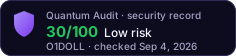
On-chain security analysis — is it a scam or legit?
Is O1 Doll Safe?
Not verified
This record has not gone through deep verification and is not being monitored. The score is a dated snapshot — the token’s risk can change at any time.Own this token? Put it under verification →This audit was conducted without access to the smart contract's source code.
Read the full analysis- Ownership status UNKNOWN
- Mint capability UNKNOWN
- Liquidity not locked, but no owner/deployer address holds LP — market-depth risk, not rug risk
- LP top1 unlocked holder = 82.2%
- LP top3 unlocked holders = 96.0%
- Token age < 30 days
Exact factors
- Ownership status UNKNOWN (owner could not be resolved)
- Mint capability UNKNOWN (implementation ABI unreadable)
- Liquidity not locked, but no owner/deployer address holds LP — market-depth risk, not rug risk
- LP top1 unlocked holder = 82.2% (independent LP — depth risk, pool = 100% of DEX liquidity)
- LP top3 unlocked holders = 96.0% (independent LP — depth risk, pool = 100% of DEX liquidity)
- Token age < 30 days (still settling)
Each factor is an on-chain fact recorded at the time of this analysis. The score is computed from them by a deterministic function, so the same contract returns the same score for anyone who runs the audit. How scores are computed
Security Checklist
as of audit · Sep 4Holders
as of audit · Sep 4, 2026- Contractstreasury, vesting, bridge, staking17.3%
- Walletsanonymous holders, free to sell4.6%
- Everyone elsethe rest of the supply78.1%
How holder types affect the score
Share held by contracts — treasury, vesting, bridge or staking — is discounted against share held by wallets when the score is computed: a contract cannot decide to sell the way an anonymous holder can, though it can still be drained or voted to sell. Effective concentration is the figure the risk score is actually calculated from.
Holder balances as recorded by the audit of Sep 4, 2026
Liquidity
as of audit · Sep 4The risk score reads depth across every pair.
The LP tokens of the analysed pool are not locked or burned, so whoever holds them can withdraw that liquidity.
0x02f4…30b50x85f9…ea620x6393…af8f0xbc78…f26dNo privileged address appears among these holders: the unlocked liquidity sits with independent providers, not with the deployer.
Security Findings
InfoNo issues identified in the reviewed source
The verified source code was reviewed and no issue rising to Informational severity or above was identified. This is a statement about the code that was read, not a guarantee: the review covers the published source only. Fact-layer checks (holder concentration) were applied separately and feed the risk score.I-01
Issue
The verified source code was reviewed and no issue rising to Informational severity or above was identified. This is a statement about the code that was read, not a guarantee: the review covers the published source only. Fact-layer checks (holder concentration) were applied separately and feed the risk score.
Fix
Re-check after any contract upgrade or ownership change, both of which can alter behaviour without changing this page.
Status
Acknowledged
Analysis
AI Copilotas of audit · Sep 4Due to the absence of source code, a technical assessment of the contract's architecture (7.1), code security (7.2), and access control mechanisms (7.3) could not be performed. Without visibility into the implementation, it is impossible to identify common vulnerabilities such as reentrancy, integer overflows, or improper authorization checks. Therefore, no strengths or issues can be reported in this section.
An evaluation of the contract's economic model (7.4), governance structure (7.5), and interactions with external protocols (7.6) is not possible without the underlying source code. Key aspects like tokenomics, fee structures, oracle dependencies, or administrative privileges cannot be analyzed. Consequently, no specific economic or governance risks can be identified.
The upgradeability (7.7) and operational aspects (7.8) of the contract cannot be determined without access to its source code. It is unknown if the contract utilizes a proxy pattern (e.g., UUPS, Transparent) or if it is immutable. Therefore, potential risks related to upgrade paths, administrative multi-sigs, or emergency pause functions cannot be assessed.
It is strongly recommended that the source code for the contract at be verified on a block explorer (e.g., Basescan).
Verifying the source code allows for transparency, community review, and enables proper security audits to identify and mitigate potential vulnerabilities. Without verified source code, users interact with the contract at a significantly increased risk.
Contract & Record
Free for any token on the record. It links to this page and always shows the current score and the date it was checked.
- Aug 31, 202630Low
Score changes are recorded as dated snapshots — history is append-only and cannot be edited.
Would You Like a More Detailed Audit of O1 Doll?
Our AI-powered scanner gives you a deeper, real-time smart contract analysis — free, with every scoring factor shown.
Get Detailed Audit Is this your token? Publish your own audit on this page