
Quantum Audit Logo

Is Moonbase a Scam?

Early-stage security check — honeypot & rug-pull analysis

Moonbase MOONBASE
0xb200…c001
Base Not verifiedLast checked 1d ago 1 audit on record New Launch · 1d old
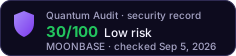
How is this score calculated? → Medium Risk
Executive SummaryAI Copilot

This report is based on a request for a security audit. However, no contract source code was provided for analysis. Therefore, a comprehensive security assessment of the contract's specific implementation could not be performed. The findings below are general best practices and an acknowledgment of the missing source code.
4 Informational
! Early-stage analysis. This token has limited on-chain history (1d old). New tokens carry elevated risk — data may change rapidly. Always verify independently before investing.
Volume 24h
$1.31M
Liquidity
$131.4K
Price
$0.001199
Token Age
1d
Top 10 Holders
8.3%

Security Findings

Info

No Contract Source Code Provided

I-01The audit could not proceed with a detailed analysis as no Solidity source code was provided for the contract at address 0xb200…c001. A comprehensive security assessment requires full access to the contract's implementation details.
IssueThe audit could not proceed with a detailed analysis as no Solidity source code was provided for the contract at address . A comprehensive security assessment requires full access to the contract's implementation details.
FixProvide the complete and verified Solidity source code for the contract to enable a thorough security audit. Ensure the provided code matches the deployed bytecode.
StatusUnresolved
Info

Implement Robust Access Control

I-02Effective access control (7.3 Access Control) is fundamental for smart contract security, preventing unauthorized actions and protecting critical functions. Without proper restrictions, malicious actors or unintended operations could compromise the contract's integrity or assets.
IssueEffective access control (7.3 Access Control) is fundamental for smart contract security, preventing unauthorized actions and protecting critical functions. Without proper restrictions, malicious actors or unintended operations could compromise the contract's integrity or assets.
FixEnsure all sensitive functions, such as administrative controls, parameter changes, or asset transfers, are protected by robust access control mechanisms. Utilize established patterns like Ownable, role-based access control (RBAC), or multi-signature wallets for critical operations.
StatusUnresolved
Info

Conduct Comprehensive Testing

I-03Thorough testing is crucial for identifying and mitigating vulnerabilities before deployment. This includes unit tests, integration tests, and property-based testing to cover various scenarios and edge cases, ensuring the contract behaves as expected under all conditions.
IssueThorough testing is crucial for identifying and mitigating vulnerabilities before deployment. This includes unit tests, integration tests, and property-based testing to cover various scenarios and edge cases, ensuring the contract behaves as expected under all conditions.
FixDevelop a comprehensive test suite covering all functions, potential attack vectors, and expected user interactions. Utilize tools like Hardhat, Foundry, and fuzzing frameworks to maximize test coverage and identify subtle bugs or vulnerabilities.
StatusUnresolved
Info

Plan for Secure Upgradeability

I-04For long-lived protocols, a secure and well-managed upgradeability strategy (7.7 Upgrades) is essential. Improperly implemented upgrade mechanisms can introduce critical vulnerabilities, centralize control, or lead to unexpected state corruption.
IssueFor long-lived protocols, a secure and well-managed upgradeability strategy (7.7 Upgrades) is essential. Improperly implemented upgrade mechanisms can introduce critical vulnerabilities, centralize control, or lead to unexpected state corruption.
FixIf upgradeability is desired, implement a battle-tested proxy pattern (e.g., UUPS or Transparent Proxy) with secure access control for upgrade functions, preferably via a multi-signature wallet or decentralized governance. Ensure upgrade logic is thoroughly tested and audited.
StatusUnresolved

Category Ratings

TechnicalLow10/10

Without access to the contract's source code, a detailed technical assessment (7.1 Architecture, 7.2 Code Security) cannot be conducted. General strengths would typically include adherence to established ERC standards and use of battle-tested libraries. Potential issues could involve reentrancy, integer overflows, or logic errors if not properly handled. Robust access control (7.3 Access Control) is crucial for any contract, and its implementation would be a key area of review.

GovernanceHigh2/10

An economic and governance review (7.4 Economic, 7.5 Governance) typically assesses tokenomics, incentive mechanisms, and decision-making processes. Strengths would include transparent governance models and well-defined economic parameters. Potential issues might arise from centralized control, lack of community input, or unforeseen economic attack vectors. External dependencies (7.6 External) like oracles or other protocols would also be scrutinized for their impact on economic stability.

UpgradesMedium6/10

The upgradeability strategy (7.7 Upgrades) is a critical aspect for long-term protocol health. Strengths include well-implemented proxy patterns (e.g., UUPS) with secure upgrade paths and multi-signature control. Potential issues could involve insecure upgrade mechanisms, lack of proper access control for upgrades, or insufficient testing of upgrade logic. Operational aspects (7.8 Operations) related to pausing, emergency shutdowns, and administrative key management are also vital for safe upgrades.

Security Checklist

Contract VerifiedPass
Ownership Renounced?
No Mint Function?
Liquidity LockedFail
Not a ProxyPass
HoneypotNoneBuy Tax0.0%Sell Tax0.0%

Holder Composition

0.0% in wallets8.3% in contracts
Effective Concentration3.3%

Share held by contracts — treasury, vesting, bridge or staking — is discounted against share held by wallets when the score is computed: a contract cannot decide to sell the way an anonymous holder can, though it can still be drained or voted to sell. Effective concentration is the figure the risk score is actually calculated from.

Liquidity Depth

Show 4 more pairsShow less

The risk score reads depth across every pair. The volume figure and the volume-to-liquidity ratio elsewhere on this page describe only the pair this audit analysed, so the two are not directly comparable.

LP Distribution

Top-1 Unlocked Holder50.3%
Top-3 Unlocked83.7%

Key Addresses

Unlocked LP Held By
0xdfc3…f2840x1642…95b90xad22…6ec60x1690…1c150x96d0…2d690x02f4…30b50x3864…6d03

No privileged address appears among these holders: the unlocked liquidity sits with independent providers, not with the deployer.

What Raised This Score

  • Ownership status UNKNOWN (owner could not be resolved)
  • Mint capability UNKNOWN (implementation ABI unreadable)
  • Liquidity not locked, but no owner/deployer address holds LP — market-depth risk, not rug risk
  • LP top1 unlocked holder = 50.3% (independent LP — depth risk, pool = 98% of DEX liquidity)
  • LP top3 unlocked holders = 83.7% (independent LP — depth risk, pool = 98% of DEX liquidity)
  • Token age < 7 days (early, volatile)

Each factor is an on-chain fact recorded at the time of this analysis. The score is computed from them by a deterministic function, so the same contract returns the same score for anyone who runs the audit. How scores are computed

Related Audits

Coinbase Man (BRIAN)Medium RisktobyMedium RiskO1 Doll (O1DOLL)Medium RiskJerry the goat (JERRY)Medium RiskPORTALMedium RiskBaselineMedium Risk

Would You Like a More Detailed Audit of Moonbase?

This token is brand new. Run a deeper AI-powered analysis of the contract code — free and instant.

Get Detailed Audit