
The SKELLY token is a standard ERC-20 implementation. The audit identified critical issues regarding return value consistency and insecure authorization patterns. While the core token logic follows standard patterns, the implementation of custom transfer rules and authorization logic introduces significant risks to token holders.

Early-stage security check — honeypot & rug-pull analysis
Is SKELLY a Scam?
Not verified
This record has not gone through deep verification and is not being monitored. The score is a dated snapshot — the token’s risk can change at any time.Own this token? Put it under verification →The SKELLY token is a standard ERC-20 implementation. The audit identified critical issues regarding return value consistency and insecure authorization patterns.
Read the full analysis- Code: Inconsistent Return Values in Transfer Functions
- Code: Insecure Use of tx.origin for Authorization
Exact factors
- Code: Inconsistent Return Values in Transfer Functions (High, static analysis)
- Code: Insecure Use of tx.origin for Authorization (Medium, static analysis)
Each factor is an on-chain fact recorded at the time of this analysis. The score is computed from them by a deterministic function, so the same contract returns the same score for anyone who runs the audit. How scores are computed
Security Checklist
as of audit · Oct 31Holders
as of audit · Oct 31, 2026- Contractstreasury, vesting, bridge, staking9.1%
- Walletsanonymous holders, free to sell12.7%
- Everyone else361 holders78.2%
How holder types affect the score
Share held by contracts — treasury, vesting, bridge or staking — is discounted against share held by wallets when the score is computed: a contract cannot decide to sell the way an anonymous holder can, though it can still be drained or voted to sell. Effective concentration is the figure the risk score is actually calculated from.
Holder balances as recorded by the audit of Oct 31, 2026
Liquidity
as of audit · Oct 31The risk score reads depth across every pair.
The LP tokens of the analysed pool are locked or burned.
Security Findings
HighInconsistent Return Values in Transfer Functions
The _transfer, transfer, and transferFrom functions do not correctly handle return values, which can cause integrations with other DeFi protocols to fail or misinterpret the success of a transaction.CD-01
Issue
The _transfer, transfer, and transferFrom functions do not correctly handle return values, which can cause integrations with other DeFi protocols to fail or misinterpret the success of a transaction.
Fix
Ensure all transfer functions explicitly return a boolean value as required by the ERC-20 standard to maintain compatibility with external contracts.
Status
Unresolved
MediumInsecure Use of tx.origin for Authorization
The returnTx function uses tx.origin to determine authorization or rules. This is dangerous because a malicious contract can trick an authorized user into calling it, effectively bypassing intended security checks.CD-02
Issue
The returnTx function uses tx.origin to determine authorization or rules. This is dangerous because a malicious contract can trick an authorized user into calling it, effectively bypassing intended security checks.
Fix
Replace tx.origin with msg.sender to ensure that only the immediate caller is authorized to perform sensitive actions.
Status
Unresolved
InfoWho holds the supply
The ten largest holders own 21.8% of supply. What remains: 12.7% in wallets, 9.1% in other contracts. 371 holders in total.QA-HOLDERS
Issue
The ten largest holders own 21.8% of supply. What remains: 12.7% in wallets, 9.1% in other contracts. 371 holders in total.
Fix
Watch the largest wallets that are not exchanges, pools or locks — those are the ones that can move the price.
Status
Acknowledged
InfoNot listed by any independent source
371 holders. Not listed by CoinGecko or any exchange GoPlus tracks. Nothing independent confirms who is behind this token, so every power its contract grants is scored at face value.QA-IDENTITY
Issue
371 holders. Not listed by CoinGecko or any exchange GoPlus tracks. Nothing independent confirms who is behind this token, so every power its contract grants is scored at face value.
Fix
Match the contract address against the project's official channels before trading.
Status
Acknowledged
InfoLiquidity burned — cannot be withdrawn
100.0% of the pool's LP is burned or time-locked. 100.0% of the LP tokens were sent to a burn address — that liquidity can never be withdrawn by anyone. Some pools are concentrated-liquidity (V3/V4) positions; shares above are by position as GoPlus reports them.QA-LIQUIDITY
Issue
100.0% of the pool's LP is burned or time-locked. 100.0% of the LP tokens were sent to a burn address — that liquidity can never be withdrawn by anyone. Some pools are concentrated-liquidity (V3/V4) positions; shares above are by position as GoPlus reports them.
Fix
Check the lock's end date and beneficiary on the locker's own page before relying on it.
Status
Acknowledged
InfoThe market for this token
Liquidity $51K (DexScreener, all pools). 24h trading volume $345K (DexScreener, all pools).QA-MARKET
Issue
Liquidity $51K (DexScreener, all pools). 24h trading volume $345K (DexScreener, all pools).
Fix
Size any position to the liquidity and daily volume shown — they set how much you can sell and at what price.
Status
Acknowledged
InfoAsset class: Project token
A token issued by a project for use, governance or fundraising. Scored on its contract and market facts. The class itself adds no points; the contract and market facts decide the score. Basis: no class-specific evidence. Tokenomics — Supply: fixed — the contract has no mint function. Control: an owner that could not be resolved. Code: not upgradeable (no proxy). Fees: no buy or sell tax. Market: $51K of DEX liquidity across 2 pools. Launch: under a day of market history.QA-PROFILE
Issue
A token issued by a project for use, governance or fundraising. Scored on its contract and market facts. The class itself adds no points; the contract and market facts decide the score. Basis: no class-specific evidence. Tokenomics — Supply: fixed — the contract has no mint function. Control: an owner that could not be resolved. Code: not upgradeable (no proxy). Fees: no buy or sell tax. Market: $51K of DEX liquidity across 2 pools. Launch: under a day of market history.
Fix
Check the project's own documentation for what the token is used for; this report covers what the contract allows.
Status
Acknowledged
InfoRecently launched — less than a day of market history
The token's oldest DEX pool is less than a day old. Age is not part of the risk score — a new token is not a risky one by default — but a short history means fewer trades and holder changes behind the facts in this report.QA-RECENT
Issue
The token's oldest DEX pool is less than a day old. Age is not part of the risk score — a new token is not a risky one by default — but a short history means fewer trades and holder changes behind the facts in this report.
Fix
Re-check ownership, liquidity and holder distribution as the token matures; those are the facts that move early.
Status
Acknowledged
Analysis
AI Copilotas of audit · Oct 31The contract utilizes standard OpenZeppelin-like ERC-20 structures for core functionality. Code quality is generally high, adhering to modern Solidity standards. However, the logic in the transfer path fails to return expected values, and the use of tx.origin creates potential security gaps. These issues impact 7.1 Architecture and 7.2 Code Security.
The token lacks centralized administrative controls, which limits 7.5 Governance risks. Economic parameters are static, reducing 7.4 Economic risk. However, the reliance on tx.origin for rules could lead to unexpected behavior in complex DeFi interactions.
The contract is not upgradeable, eliminating 7.7 Upgrades risk. The architecture is immutable, ensuring that the current logic remains fixed for the lifetime of the contract.
The development team should immediately refactor the transfer functions to ensure consistent boolean return values to maintain compatibility with standard DeFi protocols.
Furthermore, replace all instances of tx.origin with msg.sender to prevent potential authorization bypasses via malicious intermediary contracts. Users should exercise caution when interacting with this token in complex smart contract environments until these issues are addressed. A formal verification of the transfer path is recommended after the suggested refactoring.
Contract & Record
Free for any token on the record. It links to this page and always shows the current score and the date it was checked.
- Oct 31, 202634Low
Score changes are recorded as dated snapshots — history is append-only and cannot be edited.
Frequently Asked Questions
What is the SKELLY contract address?
The SKELLY contract on Ethereum is 0xfedcb1513b389b1c4d243f85c56557e86de0905f. Compare it with the address the project itself publishes before trading: other contracts can carry the same name and ticker.
Is SKELLY a scam?
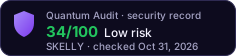
Quantum Audit's risk score for SKELLY is 34/100 (Low risk) as of Oct 31, 2026, computed by a deterministic function from on-chain facts — Contract verified: Verified; Mint: No mint; Liquidity lock: Locked; Upgradeability: Fixed code; Honeypot: None found; Buy / sell tax: 0% / 0%. A score is a dated snapshot of those facts, not a guarantee; each one is listed on this page.
Is SKELLY liquidity locked?
Liquidity lock: Locked (as of Oct 31, 2026). Total DEX liquidity: $50.8K.
Who holds SKELLY?
As of Oct 31, 2026, the 10 largest holders own 21.8% of the supply across 371 holders. The Holders section on this page shows who they are by holder type.
Would You Like a More Detailed Audit of SKELLY?
This token is brand new. Run a deeper AI-powered analysis of the contract code — free and instant.
Get Detailed Audit Is this your token? Add your links and get it Verified