
Early-stage security check — honeypot & rug-pull analysis
Is this your token? Publish your own audit on this page →
0x5265…8143
This audit focused on the `ERC1967Proxy` contract, which utilizes the UUPS upgradeable proxy pattern. A critical finding is the unverified source code for the implementation contract, preventing a full security assessment of the system's core logic. This significantly elevates the overall risk, as the actual behavior and security of the protocol's functionality cannot be confirmed. Further review of the implementation is essential.
Share held by contracts — treasury, vesting, bridge or staking — is discounted against share held by wallets when the score is computed: a contract cannot decide to sell the way an anonymous holder can, though it can still be drained or voted to sell. Effective concentration is the figure the risk score is actually calculated from.
The risk score reads depth across every pair. The volume figure and the volume-to-liquidity ratio elsewhere on this page describe only the pair this audit analysed, so the two are not directly comparable.
0x6c15…76490xb5a6…b002No privileged address appears among these holders: the unlocked liquidity sits with independent providers, not with the deployer.
Each factor is an on-chain fact recorded at the time of this analysis. The score is computed from them by a deterministic function, so the same contract returns the same score for anyone who runs the audit. How scores are computed
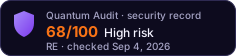
Based on the available data, labeling RE definitively as a "scam" is not possible, but it carries a high-risk score of 59/100. While contract ownership is renounced and no mint function exists, the extreme concentration of 98.3% of tokens in the top 10 wallets and unlocked liquidity are significant red flags often associated with projects that could lead to investor losses.
RE is not considered safe to buy, evidenced by its high-risk score of 59/100. The primary concerns include the very high concentration of 98.3% of the supply among the top 10 holders, which poses a significant manipulation risk. Additionally, the liquidity is not locked, meaning it could be removed by providers, potentially leading to a sharp price collapse and leaving investors unable to sell.
The RE contract is verified, meaning its deployed bytecode matches the publicly available source code. However, "contract verified" is not the same as undergoing a full security audit by an independent firm. Verification enhances transparency but does not guarantee the absence of vulnerabilities or protect against economic risks, especially given the project's high-risk score.
This token is brand new. Run a deeper AI-powered analysis of the contract code — free and instant.
Get Detailed Audit