

Quantum Audit Logo

Is Chain Safe?

On-chain security analysis — is it a scam or legit?

Is this your token? Publish your own audit on this page →

Chain XCN
0xa2cd…fb18
Ethereum Not verifiedLast checked 3d ago 1 audit on record
Executive SummaryAI Copilot

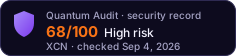
The audit of the Chain token contract identified a Medium overall risk level. The contract implements a standard ERC20 token with a unique minting mechanism tied to burning a base token. Key findings include an unrestricted minting function, which allows any user to mint new tokens, and the initial supply being held by the contract itself without a clear distribution mechanism.

1 High1 Medium1 Low2 Informational
Volume 24h
$104.9K
Liquidity
$734.1K
Price
$0.0036
Token Age
4y
Top 10 Holders
74.2%

Security Findings

High

Unrestricted Minting Function

H-01The `mint` function in `ERC20Mintable` (and thus `Chain`) is declared as `public` but lacks the `onlyMinter` modifier. This allows any user to call the `mint` function and create new `Chain` tokens by burning the specified `MINT_BASE_TOKEN`. While this might be an intended design for a public burn-to-mint mechanism, it deviates from the typical use of an inherited `MinterRole` and could lead to uncontrolled supply inflation if the `MINT_BASE_TOKEN` is easily acquired or if the intention was for minting to be restricted to specific roles. This is an access control flaw (7.3 Access Control).
IssueThe `mint` function in `ERC20Mintable` (and thus `Chain`) is declared as `public` but lacks the `onlyMinter` modifier. This allows any user to call the `mint` function and create new `Chain` tokens by burning the specified `MINT_BASE_TOKEN`. While this might be an intended design for a public burn-to-mint mechanism, it deviates from the typical use of an inherited `MinterRole` and could lead to uncontrolled supply inflation if the `MINT_BASE_TOKEN` is easily acquired or if the intention was for minting to be restricted to specific roles. This is an access control flaw (7.3 Access Control).
FixClarify the intended access control for the `mint` function. If minting should be restricted to designated minters, apply the `onlyMinter` modifier to the `mint` function. If it is intended to be publicly accessible, document this design choice clearly and ensure the economic implications of an open minting mechanism are fully understood.
StatusUnresolved
Medium

Initial Supply Held by Contract Address

M-01The `Chain` contract's constructor mints the `INITIAL_SUPPLY` (21.5 billion tokens) directly to `address(this)`. This means the contract itself holds a substantial amount of its own token. The provided code does not include any explicit mechanism or function for managing, distributing, or transferring this initial supply from the contract address. This poses an operational risk (7.8 Operations) as the tokens could become locked, inaccessible, or their distribution could be unclear, potentially leading to governance or economic issues (7.4 Economic).
IssueThe `Chain` contract's constructor mints the `INITIAL_SUPPLY` (21.5 billion tokens) directly to `address(this)`. This means the contract itself holds a substantial amount of its own token. The provided code does not include any explicit mechanism or function for managing, distributing, or transferring this initial supply from the contract address. This poses an operational risk (7.8 Operations) as the tokens could become locked, inaccessible, or their distribution could be unclear, potentially leading to governance or economic issues (7.4 Economic).
FixImplement a clear and secure mechanism for the management and distribution of the `INITIAL_SUPPLY`. This could involve transferring the tokens to a designated treasury, a multi-signature wallet, or a vesting contract during deployment, or providing a controlled function for an authorized entity to withdraw and distribute them.
StatusUnresolved
Low

Outdated Solidity Compiler Version

L-01The contract is compiled with Solidity version 0.5.16. While `SafeMath` libraries are used to mitigate integer overflow/underflow issues, this version is significantly older than current stable releases (e.g., 0.8.x). Newer compiler versions offer built-in overflow/underflow checks, gas optimizations, improved security features, and better tooling support (7.2 Code Security).
IssueThe contract is compiled with Solidity version 0.5.16. While `SafeMath` libraries are used to mitigate integer overflow/underflow issues, this version is significantly older than current stable releases (e.g., 0.8.x). Newer compiler versions offer built-in overflow/underflow checks, gas optimizations, improved security features, and better tooling support (7.2 Code Security).
FixConsider upgrading the Solidity compiler to a more recent version (e.g., 0.8.x). This would allow for the removal of explicit `SafeMath` calls (as arithmetic operations would revert on overflow/underflow by default), potentially reducing gas costs and improving code readability. Thorough testing would be required after any compiler upgrade.
StatusUnresolved
Info

Hardcoded External Token Address

I-01The `MINT_BASE` token address (0x41C3…3Ca9) is hardcoded as a `public constant` in the `Chain` contract. This creates a strong, immutable dependency on a specific external contract (7.6 External). Any future issues with the `MINT_BASE` token (e.g., rug pull, pause functionality, upgrade issues, or deprecation) could directly impact the `Chain` token's minting mechanism and overall functionality, without any possibility for the `Chain` contract to adapt.
IssueThe `MINT_BASE` token address () is hardcoded as a `public constant` in the `Chain` contract. This creates a strong, immutable dependency on a specific external contract (7.6 External). Any future issues with the `MINT_BASE` token (e.g., rug pull, pause functionality, upgrade issues, or deprecation) could directly impact the `Chain` token's minting mechanism and overall functionality, without any possibility for the `Chain` contract to adapt.
FixWhile hardcoding constants can simplify deployment, consider making critical external dependencies, like the `MINT_BASE` token address, configurable via a constructor argument or an owner-controlled setter function. This would provide flexibility to update the dependency if the `MINT_BASE` token's address changes or if a different base token needs to be used in the future.
StatusUnresolved
Info

ERC20 Allowance Race Condition

I-02The standard ERC20 `approve` function is susceptible to a known front-running vulnerability. If a user calls `approve(spender, newAmount)` while a `spender` is simultaneously trying to spend the `oldAmount`, a malicious actor could front-run the `approve` transaction to spend the `oldAmount` before `newAmount` is set, and then spend `newAmount` after it's set, effectively spending more than intended (7.2 Code Security). While `increaseAllowance` and `decreaseAllowance` functions are provided, the core `approve` function still exists.
IssueThe standard ERC20 `approve` function is susceptible to a known front-running vulnerability. If a user calls `approve(spender, newAmount)` while a `spender` is simultaneously trying to spend the `oldAmount`, a malicious actor could front-run the `approve` transaction to spend the `oldAmount` before `newAmount` is set, and then spend `newAmount` after it's set, effectively spending more than intended (7.2 Code Security). While `increaseAllowance` and `decreaseAllowance` functions are provided, the core `approve` function still exists.
FixEducate users to use `increaseAllowance` and `decreaseAllowance` instead of directly calling `approve` when modifying an existing allowance. For new allowances, `approve` is generally safe. While this is a known ERC20 limitation, ensuring users are aware of the safer alternatives is important.
StatusUnresolved

Category Ratings

TechnicalMedium6/10

The contract leverages standard ERC20 patterns and `SafeMath` libraries for robust arithmetic operations, mitigating common integer vulnerabilities (7.2 Code Security). Role-based access control is implemented for minter management, enhancing security for administrative functions (7.3 Access Control). However, the `mint` function lacks access control, allowing any user to mint tokens by burning the base token, which could lead to unintended supply inflation (7.3 Access Control). The use of Solidity 0.5.16 is an older compiler version (7.2 Code Security).

GovernanceHigh1/10

The economic model features a fixed `MAX_SUPPLY` and a burn-to-mint mechanism with a 1:1000 ratio, creating a clear supply cap and a deflationary pressure on the base token (7.4 Economic). The `MinterRole` provides a decentralized way for existing minters to add or remove other minters (7.5 Governance). A significant operational concern is that the `INITIAL_SUPPLY` is minted directly to the contract address, with no explicit mechanism for its distribution or management (7.8 Operations). Additionally, the `MINT_BASE` token address is hardcoded, creating a strong external dependency (7.6 External).

UpgradesHigh3/10

The contract is not designed with an upgrade mechanism, such as a proxy pattern. This simplifies the architecture by removing upgrade-related complexities and risks (7.7 Upgrades). However, it means that any discovered vulnerabilities or desired feature changes would require a new deployment and migration, which can be a complex and costly process (7.7 Upgrades).

Security Checklist

Contract VerifiedPass
Ownership Renounced?
No Mint FunctionFail
Liquidity LockedFail
Not a ProxyPass
HoneypotNoneBuy Tax0.0%Sell Tax0.0%

Holder Composition

45.0% in wallets29.2% in contracts
Effective Concentration56.7%

Share held by contracts — treasury, vesting, bridge or staking — is discounted against share held by wallets when the score is computed: a contract cannot decide to sell the way an anonymous holder can, though it can still be drained or voted to sell. Effective concentration is the figure the risk score is actually calculated from.

Liquidity Depth

The risk score reads depth across every pair. The volume figure and the volume-to-liquidity ratio elsewhere on this page describe only the pair this audit analysed, so the two are not directly comparable.

LP Distribution

Top-1 Unlocked Holder93.3%
Top-3 Unlocked94.6%

Key Addresses

Deployer
0xe864…6d73
Unlocked LP Held By
0x3fa6…92160xf9d0…795d0x103c…fc0f0xbfa9…c03a0x0000…8a900xcdd8…1c000x128a…ca410xbc25…43850xe242…d7690x6c4e…a326

No privileged address appears among these holders: the unlocked liquidity sits with independent providers, not with the deployer.

What Raised This Score

  • Ownership status UNKNOWN (owner could not be resolved)
  • Mintable supply — no cap found, dilution unbounded
  • Top-10 concentration > 50% (74.2% total → 56.7% effective; 45.0% in EOAs, 29.2% in contracts — heavy)
  • Liquidity not locked, but no owner/deployer address holds LP — market-depth risk, not rug risk
  • LP top1 unlocked holder = 93.3% (independent LP — depth risk, pool = 95% of DEX liquidity)
  • LP top3 unlocked holders = 94.6% (independent LP — depth risk, pool = 95% of DEX liquidity)
  • 1 High finding(s) from audit
  • 1 Medium finding(s) from audit
  • 1 Low finding(s) from audit

Each factor is an on-chain fact recorded at the time of this analysis. The score is computed from them by a deterministic function, so the same contract returns the same score for anyone who runs the audit. How scores are computed

Related Audits

REHigh RiskZamaHigh RiskUNICURVEHigh RiskGram (prev. Toncoin) (GRAM)High RiskDIAToken (DIA)High RiskTERAFABHigh Risk

Would You Like a More Detailed Audit of Chain?

Our AI-powered scanner gives you a deeper, real-time smart contract analysis — free, with every scoring factor shown.

Get Detailed Audit