
Quantum Audit Logo

Is TRIA Safe?

On-chain security analysis — is it a scam or legit?

Is this your token? Publish your own audit on this page →

TRIA TRIA
0x228b…a369
Ethereum Not verifiedLast checked 3d ago 1 audit on record
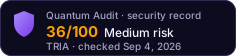
How is this score calculated? → Medium Risk
Executive SummaryAI Copilot

The TriaToken contract implements a standard ERC20 token with additional features for permit functionality and owner-controlled withdrawal of accidentally sent ETH or ERC20 tokens. The contract utilizes well-audited OpenZeppelin libraries and incorporates reentrancy protection for withdrawal functions. While the design is robust, some aspects like centralized withdrawal control and immutability are noted as design considerations.

1 Low3 Informational
Volume 24h
$19.0K
Liquidity
$148.0K
Price
$0.004455
Token Age
7mo
Top 10 Holders
87.6%

Security Findings

Low

Centralized Control Over Accidental Funds

L-01The `Withdrawable` abstract contract, implemented by `TriaToken`, grants the contract owner (via `onlyAuthorizer` and `_authorizeWithdraw()`) sole authority to withdraw any ETH or ERC20 tokens accidentally sent to the `TriaToken` contract. While this is a common and often necessary pattern for recovering funds, it represents a centralized point of control for these specific operations. The security of these funds relies entirely on the integrity of the owner's address.
IssueThe `Withdrawable` abstract contract, implemented by `TriaToken`, grants the contract owner (via `onlyAuthorizer` and `_authorizeWithdraw()`) sole authority to withdraw any ETH or ERC20 tokens accidentally sent to the `TriaToken` contract. While this is a common and often necessary pattern for recovering funds, it represents a centralized point of control for these specific operations. The security of these funds relies entirely on the integrity of the owner's address.
FixEnsure the contract owner's address is a highly secure entity, such as a well-managed multisignature wallet, to mitigate the risks associated with centralized control. The prefill data indicates the owner is a multisig, which is a good practice.
StatusUnresolved
Info

Immutability and Lack of Upgradeability

I-01The `TriaToken` contract is not designed with upgradeability features (e.g., proxy pattern). This means that once deployed, its logic cannot be modified. Any discovered vulnerabilities or desired feature enhancements would necessitate a new contract deployment and a potentially complex and costly migration process for token holders.
IssueThe `TriaToken` contract is not designed with upgradeability features (e.g., proxy pattern). This means that once deployed, its logic cannot be modified. Any discovered vulnerabilities or desired feature enhancements would necessitate a new contract deployment and a potentially complex and costly migration process for token holders.
FixThis is a design choice. If future flexibility or bug-fixing capabilities are desired, consider implementing an upgradeable proxy pattern (e.g., UUPS or Transparent Proxy) in future iterations. For this immutable contract, thorough testing is paramount before deployment.
StatusUnresolved
Info

Hardcoded Initial Token Supply

I-02The initial total supply of 10,000,000,000 TRIA tokens (10 billion * 1e18) is hardcoded in the constructor of the `TriaToken` contract. This design choice fixes the token's maximum supply from deployment and prevents any future adjustments to the supply without redeploying the contract.
IssueThe initial total supply of 10,000,000,000 TRIA tokens (10 billion * 1e18) is hardcoded in the constructor of the `TriaToken` contract. This design choice fixes the token's maximum supply from deployment and prevents any future adjustments to the supply without redeploying the contract.
FixThis is a deliberate design decision for a fixed-supply token. If future flexibility in token supply (e.g., dynamic minting/burning based on governance) is ever desired, it would require a new contract deployment. For the current design, no change is needed.
StatusUnresolved
Info

Reliance on External OpenZeppelin Libraries

I-03The contract heavily relies on external, well-audited OpenZeppelin libraries, including `ERC20`, `ERC20Permit`, `Ownable`, `SafeERC20`, and `ReentrancyGuard`. While these libraries are industry standards and have undergone extensive audits, any future vulnerabilities discovered within these external dependencies could potentially impact the security of the `TriaToken` contract.
IssueThe contract heavily relies on external, well-audited OpenZeppelin libraries, including `ERC20`, `ERC20Permit`, `Ownable`, `SafeERC20`, and `ReentrancyGuard`. While these libraries are industry standards and have undergone extensive audits, any future vulnerabilities discovered within these external dependencies could potentially impact the security of the `TriaToken` contract.
FixRegularly monitor security announcements and updates from OpenZeppelin. While direct action on the deployed contract is not possible, staying informed is crucial for understanding potential ecosystem-wide risks.
StatusUnresolved

Category Ratings

TechnicalLow8/10

The technical architecture (7.1 Architecture) is sound, leveraging standard ERC20, ERC20Permit, and Ownable patterns. Code security (7.2 Code Security) is enhanced by the use of OpenZeppelin's SafeERC20 for token transfers and ReentrancyGuard for withdrawal functions, preventing common attack vectors. Access control (7.3 Access Control) for withdrawals is centralized to the contract owner, which is a multisig, mitigating single-point-of-failure risks. External dependencies (7.6 External) are limited to battle-tested OpenZeppelin contracts.

GovernanceMedium4/10

The economic model (7.4 Economic) is straightforward with a fixed initial supply of 10 billion tokens, minted to a specified treasury address. Governance (7.5 Governance) is managed through an `Ownable` pattern, where the owner is a multisig, enhancing security and decentralization of control over critical functions like fund withdrawals. There are no complex tokenomics or fee structures, simplifying economic analysis.

UpgradesLow7/10

The contract is not designed as an upgradeable proxy (7.7 Upgrades), meaning its logic is immutable once deployed. This eliminates upgrade-related risks such as proxy storage collisions or logic errors during upgrades. However, it also means that any future bug fixes or feature enhancements would require a new deployment and token migration.

Security Checklist

Contract VerifiedPass
Ownership RenouncedFail
No Mint FunctionPass
Liquidity LockedFail
Not a ProxyPass
HoneypotNoneBuy Tax0.0%Sell Tax0.0%

Holder Composition

6.1% in wallets81.5% in contracts
Effective Concentration38.7%

Share held by contracts — treasury, vesting, bridge or staking — is discounted against share held by wallets when the score is computed: a contract cannot decide to sell the way an anonymous holder can, though it can still be drained or voted to sell. Effective concentration is the figure the risk score is actually calculated from.

Liquidity Depth

The risk score reads depth across every pair. The volume figure and the volume-to-liquidity ratio elsewhere on this page describe only the pair this audit analysed, so the two are not directly comparable.

LP Distribution

Top-1 Unlocked Holder100.0%
Top-3 Unlocked100.0%

Key Addresses

Deployer
0x4c49…f80c
Unlocked LP Held By
0x0e09…c2190x8ba4…63b40x0b8a…9377

No privileged address appears among these holders: the unlocked liquidity sits with independent providers, not with the deployer.

What Raised This Score

  • Ownership NOT renounced — Multisig (3-of-4)
  • Top-10 concentration > 30% (87.6% total → 38.7% effective; 6.1% in EOAs, 81.5% in contracts — moderate)
  • Liquidity not locked, but no owner/deployer address holds LP — market-depth risk, not rug risk
  • LP top1 unlocked holder = 100.0% (independent LP — depth risk)
  • LP top3 unlocked holders = 100.0% (independent LP — depth risk)
  • 1 Low finding(s) from audit

Each factor is an on-chain fact recorded at the time of this analysis. The score is computed from them by a deterministic function, so the same contract returns the same score for anyone who runs the audit. How scores are computed

Related Audits

SPX6900 (SPX)Medium RiskDimitra Token (DMTR)Medium RiskRaveDAO (RAVE)Medium RiskLO0PMedium RiskOctra (OCT)Medium RiskProgrammable (V4)Medium Risk

Would You Like a More Detailed Audit of TRIA?

Our AI-powered scanner gives you a deeper, real-time smart contract analysis — free, with every scoring factor shown.

Get Detailed Audit