
Quantum Audit Logo

Is ZigCoin Safe?

On-chain security analysis — is it a scam or legit?

Is this your token? Publish your own audit on this page →

ZigCoin ZIG
0xb261…4f01
Ethereum Not verifiedLast checked 3d ago 1 audit on record
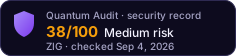
How is this score calculated? → Medium Risk
Executive SummaryAI Copilot

The ZigCoin contract is a standard ERC-20 token implementation utilizing SafeMath for arithmetic operations. The primary risk identified is the centralized distribution of the entire token supply to the deployer at creation. The contract is not upgradeable and lacks advanced features like pausing or role-based access control, which simplifies its attack surface but also limits emergency response capabilities.

1 Medium3 Informational
Volume 24h
$92.4K
Liquidity
$117.7K
Price
$0.04148
Token Age
4y
Top 10 Holders
73.6%

Security Findings

Medium

Centralized Initial Token Supply

M-01The entire supply of 2,000,000,000 ZIG tokens is minted to the `msg.sender` (the contract deployer) in the constructor. This centralizes the initial control of all tokens to a single address.
IssueThe entire supply of 2,000,000,000 ZIG tokens is minted to the `msg.sender` (the contract deployer) in the constructor. This centralizes the initial control of all tokens to a single address.
FixWhile a common pattern for new tokens, it is recommended to manage this large initial supply with robust security practices, such as a multi-signature wallet, to reduce the risk of a single point of failure or compromise. Transparency regarding the distribution plan for these tokens is also advised.
StatusUnresolved
Info

Fixed Token Supply

I-01The contract implements a fixed total supply of tokens, with no external functions for additional minting or burning after the initial deployment. The `_mint` and `_burn` functions are internal and not exposed.
IssueThe contract implements a fixed total supply of tokens, with no external functions for additional minting or burning after the initial deployment. The `_mint` and `_burn` functions are internal and not exposed.
FixThis is a design choice that ensures a predictable token supply. Ensure this fixed supply model aligns with the project's long-term economic strategy and communicate this clearly to the community.
StatusUnresolved
Info

Older Solidity Version Used

I-02The contract is compiled with Solidity version `^0.7.6`. While this version is functional, newer Solidity versions (e.g., 0.8.x) include additional safety checks by default (like arithmetic overflow/underflow checks) and performance improvements.
IssueThe contract is compiled with Solidity version `^0.7.6`. While this version is functional, newer Solidity versions (e.g., 0.8.x) include additional safety checks by default (like arithmetic overflow/underflow checks) and performance improvements.
FixConsider upgrading to a more recent Solidity version (e.g., 0.8.x) for future contract deployments to benefit from enhanced compiler optimizations and built-in security features. If upgrading, ensure thorough testing as syntax and behavior might differ slightly.
StatusUnresolved
Info

Lack of Emergency Pause/Blacklist Functionality

I-03The ZigCoin contract is a basic ERC-20 implementation and does not include any mechanisms for pausing transfers or blacklisting malicious addresses. This means that in the event of a critical vulnerability or exploit, there is no built-in way to halt operations or freeze compromised accounts.
IssueThe ZigCoin contract is a basic ERC-20 implementation and does not include any mechanisms for pausing transfers or blacklisting malicious addresses. This means that in the event of a critical vulnerability or exploit, there is no built-in way to halt operations or freeze compromised accounts.
FixFor simple, immutable tokens, this design choice reduces complexity and centralization. However, for more complex protocols or those handling significant value, consider if a limited, multi-sig controlled pause or blacklist mechanism might be beneficial for emergency response, carefully weighing the trade-offs with centralization.
StatusUnresolved

Category Ratings

TechnicalLow8/10

The technical architecture (7.1) is a straightforward ERC-20 token, inheriting from a custom ERC20 implementation that includes SafeMath. Code security (7.2) is robust for arithmetic operations due to the diligent use of SafeMath, mitigating common integer overflow/underflow vulnerabilities. Access control (7.3) is minimal, limited to standard ERC-20 approval mechanisms, with no privileged roles beyond the initial deployer receiving all tokens. External interactions (7.6) are limited to standard token transfers, and operational complexity (7.8) is low, reducing the attack surface. The use of Solidity 0.7.6 is an older version, but does not introduce specific vulnerabilities for this simple contract.

GovernanceHigh3/10

The economic model (7.4) of ZigCoin involves a fixed total supply, with all tokens minted to the deployer's address during contract creation. This design choice centralizes the initial distribution, giving the deployer significant control over the token's initial liquidity and market dynamics. There are no governance mechanisms (7.5) implemented within the contract, meaning no on-chain voting or community-driven changes are possible. The absence of features like pausing or blacklisting, while simplifying the contract, also means there's no emergency response mechanism for potential exploits or malicious activity involving token holders.

UpgradesLow7/10

The ZigCoin contract is not designed with upgradeability (7.7) in mind, meaning it is immutable once deployed. This eliminates all risks associated with upgrade mechanisms, such as proxy implementation bugs, upgrade path vulnerabilities, or administrative key compromises. While this provides immutability and predictability, it also means that any discovered bugs or desired feature enhancements cannot be implemented without deploying a new contract.

Security Checklist

Contract VerifiedPass
Ownership Renounced?
No Mint FunctionPass
Liquidity LockedPass
Not a ProxyPass

Holder Composition

17.1% in wallets56.4% in contracts
Effective Concentration39.7%

Share held by contracts — treasury, vesting, bridge or staking — is discounted against share held by wallets when the score is computed: a contract cannot decide to sell the way an anonymous holder can, though it can still be drained or voted to sell. Effective concentration is the figure the risk score is actually calculated from.

Liquidity Depth

The risk score reads depth across every pair. The volume figure and the volume-to-liquidity ratio elsewhere on this page describe only the pair this audit analysed, so the two are not directly comparable.

LP Distribution

Top-1 Unlocked Holder99.8%
Top-3 Unlocked100.0%

Key Addresses

Deployer
0x3bcd…41f6
Unlocked LP Held By
0x98a8…a71b0x466a…9b5b0xbb0c…70d80x1f2f…f387

No privileged address appears among these holders: the unlocked liquidity sits with independent providers, not with the deployer.

What Raised This Score

  • Ownership status UNKNOWN (owner could not be resolved)
  • Top-10 concentration > 30% (73.6% total → 39.7% effective; 17.1% in EOAs, 56.4% in contracts — moderate)
  • LP top1 unlocked holder = 99.8% (independent LP — depth risk, pool = 95% of DEX liquidity)
  • LP top3 unlocked holders = 100.0% (independent LP — depth risk, pool = 95% of DEX liquidity)
  • LP claimed locked but only 0.0% actually locked
  • 1 Medium finding(s) from audit

Each factor is an on-chain fact recorded at the time of this analysis. The score is computed from them by a deterministic function, so the same contract returns the same score for anyone who runs the audit. How scores are computed

Related Audits

Octra (OCT)Medium RiskProgrammable (V4)Medium RiskChainlink (LINK)Medium RiskKiteMedium RiskRaveDAO (RAVE)Medium RiskLO0PMedium Risk

Would You Like a More Detailed Audit of ZigCoin?

Our AI-powered scanner gives you a deeper, real-time smart contract analysis — free, with every scoring factor shown.

Get Detailed Audit