
Quantum Audit Logo

Is Pikachu Safe?

On-chain security analysis — is it a scam or legit?

Is this your token? Publish your own audit on this page →

Pikachu PIKACHU
0xe09f…86bf
Ethereum Not verifiedLast checked 3d ago 1 audit on record
Executive SummaryAI Copilot

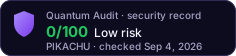
The PikachuToken contract implements a standard ERC-20 token with basic functionalities including transfer, approval, and burning. It utilizes the SafeMath library to prevent integer overflow/underflow vulnerabilities. The contract is designed for immutability with no administrative roles or upgrade mechanisms. The overall risk level is assessed as Low due to its simplicity and robust use of SafeMath, though the use of an older Solidity compiler version is noted.

3 Informational
Volume 24h
$2.5K
Liquidity
$104.3K
Price
$0.0000000036
Token Age
5y
Top 10 Holders
54.9%

Security Findings

Info

Use of Older Solidity Compiler Version

I-01The contract is compiled with `pragma solidity ^0.5.0`. While SafeMath is used to mitigate integer overflow/underflow, newer Solidity versions (e.8.x) include built-in overflow/underflow checks, making SafeMath redundant and potentially reducing gas costs. Newer compilers also offer various security improvements and optimizations.
IssueThe contract is compiled with `pragma solidity ^0.5.0`. While SafeMath is used to mitigate integer overflow/underflow, newer Solidity versions (e.8.x) include built-in overflow/underflow checks, making SafeMath redundant and potentially reducing gas costs. Newer compilers also offer various security improvements and optimizations.
FixConsider using a more recent and actively maintained Solidity compiler version (e.g., `^0.8.0`) for new deployments. This would allow for the removal of the SafeMath library, simplifying the code and leveraging the compiler's native safety features.
StatusUnresolved
Info

Lack of Administrative Control and Upgradeability

I-02The PikachuToken contract does not implement any administrative roles (e.g., `Ownable`, `AccessControl`) or upgradeability patterns (e.g., UUPS, Transparent Proxies). This means that after deployment, no entity can pause transfers, mint additional tokens, modify contract parameters, or fix potential bugs. This design choice ensures immutability and decentralization but removes any flexibility for future management or emergency responses.
IssueThe PikachuToken contract does not implement any administrative roles (e.g., `Ownable`, `AccessControl`) or upgradeability patterns (e.g., UUPS, Transparent Proxies). This means that after deployment, no entity can pause transfers, mint additional tokens, modify contract parameters, or fix potential bugs. This design choice ensures immutability and decentralization but removes any flexibility for future management or emergency responses.
FixConfirm that the project's long-term vision aligns with a fully immutable and decentralized token. If future administrative actions (e.g., pausing, minting, burning, parameter changes) or bug fixes are ever anticipated, a robust access control and/or upgradeability mechanism should be integrated into the design.
StatusUnresolved
Info

Payable Constructor with ETH Transfer

I-03The contract's constructor is declared `payable` and immediately transfers any received `msg.value` to a `feeReceiver` address. While this functionality is explicit, it is an unusual pattern for a standard ERC-20 token constructor, which typically focuses solely on token initialization. This could potentially lead to confusion for deployers or unintended ETH transfers if not fully understood.
IssueThe contract's constructor is declared `payable` and immediately transfers any received `msg.value` to a `feeReceiver` address. While this functionality is explicit, it is an unusual pattern for a standard ERC-20 token constructor, which typically focuses solely on token initialization. This could potentially lead to confusion for deployers or unintended ETH transfers if not fully understood.
FixEnsure that the purpose of the `payable` constructor and the immediate ETH transfer to `feeReceiver` is clearly documented and communicated to anyone deploying or interacting with the contract. If this functionality is not strictly necessary for the token's core purpose, consider removing the `payable` keyword and the ETH transfer logic from the constructor.
StatusUnresolved

Category Ratings

TechnicalLow10/10

The technical architecture (7.1) of PikachuToken is straightforward, adhering to the ERC-20 standard. Code security (7.2) is enhanced by the consistent use of the SafeMath library, effectively mitigating integer overflow and underflow risks in all arithmetic operations. Access control (7.3) is minimal, with no administrative roles, ensuring a decentralized and immutable token. However, the contract is compiled with Solidity ^0.5.0, an older version, which, while functional with SafeMath, lacks some security features and optimizations present in newer compilers.

GovernanceMedium6/10

The economic model (7.4) of PikachuToken is simple, representing a fixed-supply token after initial minting in the constructor. There are no complex economic mechanisms such as staking, lending, or rebase functions. Governance (7.5) is entirely absent, meaning there are no owner-controlled functions, multisig, or DAO structures for post-deployment management. This design choice implies a fully decentralized and immutable token, which eliminates governance-related attack vectors but also removes any possibility for future administrative intervention.

UpgradesLow7/10

The PikachuToken contract is not designed with any upgradeability mechanisms (7.7). It is a standard, non-proxy implementation, meaning its logic is immutable once deployed. This eliminates all risks associated with upgradeability, such as proxy implementation vulnerabilities or governance failures during upgrades. However, it also means that any discovered bugs or desired feature changes cannot be implemented without deploying a new contract.

Security Checklist

Contract VerifiedPass
Ownership Renounced?
No Mint FunctionPass
Liquidity LockedPass
Not a ProxyPass

Holder Composition

12.3% in wallets42.7% in contracts
Effective Concentration29.3%

Share held by contracts — treasury, vesting, bridge or staking — is discounted against share held by wallets when the score is computed: a contract cannot decide to sell the way an anonymous holder can, though it can still be drained or voted to sell. Effective concentration is the figure the risk score is actually calculated from.

Liquidity Depth

The risk score reads depth across every pair. The volume figure and the volume-to-liquidity ratio elsewhere on this page describe only the pair this audit analysed, so the two are not directly comparable.

LP Distribution

LP Burned99.9% · ≈ permanent lock
LP Locked99.9%

Key Addresses

Deployer
0x54f7…5ff0
Unlocked LP Held By
0x424c…d4070x8751…19d20xf4af…136f0x1ca4…40c70x2b25…64820xce97…56f30xe851…b19e0x0720…4b740x7c0a…7a75

No privileged address appears among these holders: the unlocked liquidity sits with independent providers, not with the deployer.

What Raised This Score

  • Ownership status UNKNOWN (owner could not be resolved)
  • Top-10 concentration > 20% (54.9% total → 29.3% effective; 12.3% in EOAs, 42.7% in contracts — mild)

Each factor is an on-chain fact recorded at the time of this analysis. The score is computed from them by a deterministic function, so the same contract returns the same score for anyone who runs the audit. How scores are computed

Related Audits

AsteroidLow RiskAmerica Pac (PAC)Low RiskJerry The Turtle By Matt Furie (JYAI)Low RiskNon-Playable Coin (NPC)Low RiskYee Token (YEE)Low RiskpepeCoinLow Risk

Would You Like a More Detailed Audit of Pikachu?

Our AI-powered scanner gives you a deeper, real-time smart contract analysis — free, with every scoring factor shown.

Get Detailed Audit