
Quantum Audit Logo
Ethereum · Smart Contract Security · Updated Jul 24, 2026

Is Asteroid Safe? ASTEROID

On-chain security analysis — is it a scam or legit?

Contract 0xaff2…d044 DexScreener ↗
Volume 24h
$66.3K
Liquidity
$204.4K
Price
$0.001412
Token Age
1y
Top 10 Holders
26.0%

Security Checklist

Contract VerifiedPass
Ownership RenouncedPass
No Mint FunctionPass
Liquidity LockedPass
Not a ProxyPass

Audit History

Jul 2261Jul 230

Every audit run adds a dated snapshot — history is append-only and cannot be edited.

Audit Summary

The audit of the ASTEROID token contract (0xaff2565091e7207191dbe340b8528d02fa78d044) was conducted on an incomplete source code snippet. A critical economic vulnerability was identified: the project's liquidity pool is currently unlocked, posing a significant rug pull risk. Technical aspects of the provided code snippet appear standard, utilizing SafeMath for arithmetic, though this is redundant in Solidity 0.8+.
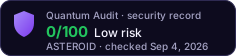

Final Recommendation: It is critically important to lock the liquidity pool immediately using a reputable third-party service or by burning the LP tokens to prevent a potential rug pull. A complete and verified source code should be provided for a thorough security audit to identify any hidden vulnerabilities or centralized control mechanisms. Additionally, consider removing redundant SafeMath usage for minor gas optimizations and be aware of the standard ERC20 `approve` race condition.

Category Ratings

TechnicalLow
8/10

The contract implements a standard ERC20 token using Solidity 0.8.17 and includes interfaces for Uniswap V2. The use of `SafeMath` for arithmetic operations ensures protection against integer overflows/underflows (7.2 Code Security), although this is redundant in Solidity versions 0.8.0 and higher.

GovernanceLow
9/10

A critical economic risk has been identified: the liquidity pool for the ASTEROID token is currently unlocked (7.4 Economic). This allows the liquidity provider to withdraw all funds, potentially leading to a complete loss for token holders. Without the full code, it's unclear if there are othe

UpgradesLow
9/10

The contract is not designed as an upgradeable proxy, as indicated by `is_proxy: false` in the pre-analysis (7.7 Upgrades). This means the contract's logic cannot be modified after deployment. While this eliminates upgrade-related risks, it also means any discovered vulnerabilities or desired f

LP Distribution

LP Burned100.0% · ≈ permanent lock
LP Locked100.0% · Null Address

What Raised This Score

Each factor is an on-chain fact recorded at the time of this analysis. The score is computed from them by a deterministic function, so the same contract returns the same score for anyone who runs the audit. How scores are computed

Security Findings

1 Critical 3 Info
C-01CriticalUnresolved

Unlocked Liquidity Pool

The pre-analysis indicates the liquidity pool for the ASTEROID token is currently unlocked. This means that the deployer or liquidity provider can remove the entire liquidity at any time, potentially leading to a 'rug pull' and rendering the token worthless for other holders. This poses a severe economic risk to all token holders.

Recommendation: Implement a robust liquidity locking mechanism (e.g., using a reputable third-party locker like UniCrypt, Pinksale, or by sending LP tokens to a burn address or a time-locked contract) immediately after adding initial liquidity. This action is paramount for investor confidence and project legitimacy.
I-01InformationalUnresolved

Incomplete Code Provided

The provided contract source code was truncated, specifically the `ERC20` contract implementation after the `decimals()` function. Critical functions like `_mint`, `_transfer`, `_approve`, and any custom logic (e.g., tax mechanisms, blacklisting, owner-controlled functions) are not visible. This significantly limits the scope and depth of the security assessment.

Recommendation: Provide the complete and verified source code for a comprehensive security audit. The current assessment is limited by the available information, and hidden vulnerabilities or centralized control mechanisms cannot be ruled out.
I-02InformationalUnresolved

Redundant SafeMath Usage

The contract uses the `SafeMath` library for arithmetic operations. While `SafeMath` prevents integer overflow/underflow, it is redundant in Solidity versions 0.8.0 and higher (the contract uses `^0.8.17`) because the compiler automatically includes overflow/underflow checks for all arithmetic operations by default. Using `SafeMath` in 0.8+ can slightly increase gas costs without providing additional security benefits.

Recommendation: Consider removing the `SafeMath` library and relying on Solidity's native overflow/underflow checks for cleaner code and minor gas optimization. This will not compromise security in Solidity 0.8+.
I-03InformationalUnresolved

ERC20 `approve` Race Condition

The standard ERC20 `approve` function is susceptible to a known race condition. If a user increases an allowance from `X` to `Y` and a malicious actor front-runs this transaction by spending `X` tokens, the subsequent `approve(Y)` transaction might allow the malicious actor to spend `Y` *additional* tokens, effectively spending `X + Y` instead of just `Y`.

Recommendation: Users should be advised to first set the allowance to zero (`approve(spender, 0)`) before setting a new non-zero allowance. Developers can consider implementing `increaseAllowance` and `decreaseAllowance` functions (as in OpenZeppelin's ERC20) to mitigate this risk for users.

Would You Like a More Detailed Audit of Asteroid?

Our AI-powered scanner gives you a deeper, real-time smart contract analysis — free, no signup required.

Get Detailed Audit
Run Free Audit →