
Quantum Audit Logo

Is PeiPei Safe?

On-chain security analysis — is it a scam or legit?

Is this your token? Publish your own audit on this page →

PeiPei PEIPEI
0x3ffe…5790
Ethereum Not verifiedLast checked 2d ago 1 audit on record
Executive SummaryAI Copilot

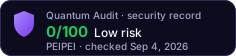
The audit of the provided ERC20 token contract reveals a well-structured implementation adhering to the ERC20 standard, utilizing SafeMath for arithmetic safety. The contract includes internal minting and burning functions, which are not publicly exposed by the ERC20 contract itself. A significant limitation is the truncation of the `Ownable` contract, preventing a full assessment of its access control mechanisms. However, the prefill data indicates that ownership has been renounced, which, if accurate, mitigates centralized control risks. Overall, the contract presents a Low risk profile.

2 Low3 Informational
Volume 24h
$34.9K
Liquidity
$639.2K
Price
$0.0000000067
Token Age
2y
Top 10 Holders
39.9%

Security Findings

Low

Incomplete `Ownable` Contract Provided

L-01The provided source code for the `Ownable` contract is truncated. This prevents a full security assessment of its implementation, including verification of standard access control patterns, potential owner-controlled functions, and the impact of the `ownership_renounced: true` prefill information. Without the complete code, it's impossible to confirm the exact privileges of the owner or the implications of ownership renunciation.
IssueThe provided source code for the `Ownable` contract is truncated. This prevents a full security assessment of its implementation, including verification of standard access control patterns, potential owner-controlled functions, and the impact of the `ownership_renounced: true` prefill information. Without the complete code, it's impossible to confirm the exact privileges of the owner or the implications of ownership renunciation.
FixProvide the complete and verified source code for all inherited contracts, especially `Ownable`, to allow for a comprehensive security audit of access control mechanisms (7.3 Access Control) and governance implications (7.5 Governance).
StatusUnresolved
Low

Missing NatSpec Documentation

L-02Several functions within the contract, particularly internal and private helper functions, lack comprehensive NatSpec documentation. This can hinder understanding of the contract's logic, especially for future maintainers or auditors, and may lead to misinterpretations or errors during upgrades or integrations.
IssueSeveral functions within the contract, particularly internal and private helper functions, lack comprehensive NatSpec documentation. This can hinder understanding of the contract's logic, especially for future maintainers or auditors, and may lead to misinterpretations or errors during upgrades or integrations.
FixAdd detailed NatSpec comments for all functions, especially those that are public, external, or implement complex logic. This includes `@param`, `@return`, and `@notice` tags to clearly describe their purpose, parameters, and return values.
StatusUnresolved
Info

Use of SafeMath Library

I-01The contract correctly utilizes the SafeMath library for all arithmetic operations (addition, subtraction, multiplication, division, modulo). This effectively prevents integer overflow and underflow vulnerabilities (7.2 Code Security), which are common pitfalls in Solidity development.
IssueThe contract correctly utilizes the SafeMath library for all arithmetic operations (addition, subtraction, multiplication, division, modulo). This effectively prevents integer overflow and underflow vulnerabilities (7.2 Code Security), which are common pitfalls in Solidity development.
FixMaintain the consistent use of SafeMath or Solidity's native checked arithmetic (available in Solidity 0.8.0 and above) for all arithmetic operations to ensure robust handling of numerical values.
StatusResolved
Info

Adherence to ERC20 Standard

I-02The contract implements the ERC20 standard correctly, including all required functions (`totalSupply`, `balanceOf`, `transfer`, `allowance`, `approve`, `transferFrom`) and events (`Transfer`, `Approval`). This ensures compatibility with various DeFi protocols and wallets (7.6 External).
IssueThe contract implements the ERC20 standard correctly, including all required functions (`totalSupply`, `balanceOf`, `transfer`, `allowance`, `approve`, `transferFrom`) and events (`Transfer`, `Approval`). This ensures compatibility with various DeFi protocols and wallets (7.6 External).
FixContinue to adhere strictly to established ERC standards to maintain broad compatibility and interoperability within the EVM ecosystem.
StatusResolved
Info

Internal Mint/Burn Functions

I-03The `_mint` and `_burn` functions are declared as `internal virtual`. This design choice means that the ERC20 contract itself does not expose public minting or burning capabilities. Any such functionality would need to be explicitly implemented in a derived contract, allowing for controlled inflation/deflation mechanisms (7.4 Economic).
IssueThe `_mint` and `_burn` functions are declared as `internal virtual`. This design choice means that the ERC20 contract itself does not expose public minting or burning capabilities. Any such functionality would need to be explicitly implemented in a derived contract, allowing for controlled inflation/deflation mechanisms (7.4 Economic).
FixIf public minting or burning is intended in a derived contract, ensure that these functions are protected by appropriate access control mechanisms (e.g., only callable by a trusted role or governance) to prevent unauthorized token supply manipulation.
StatusResolved

Category Ratings

TechnicalLow10/10

The contract demonstrates good technical architecture (7.1 Architecture) by implementing the ERC20 standard and utilizing the SafeMath library, which prevents common integer overflow/underflow vulnerabilities (7.2 Code Security). The code is generally clear and follows common Solidity patterns. However, the `Ownable` contract is truncated, which limits a full assessment of its access control implementation (7.3 Access Control).

GovernanceLow9/10

The contract's economic model (7.4 Economic) is based on a standard ERC20 token with internal minting and burning capabilities. The provided prefill indicates that ownership has been renounced, which significantly reduces centralized governance risk (7.5 Governance) by preventing a single entity from controlling administrative functions, assuming the `Ownable` contract was standard and its owner could control such functions. There are no explicit governance mechanisms within the ERC20 contract itself, and its economic stability relies on the fixed supply after renunciation, if no other contract can mint.

UpgradesLow10/10

The contract is not designed as an upgradeable proxy (7.7 Upgrades), meaning its logic cannot be changed after deployment. This eliminates upgrade-related risks such as proxy initialization issues or storage collisions. Any future changes would require a new deployment and migration.

Security Checklist

Contract VerifiedPass
Ownership RenouncedPass
No Mint FunctionPass
Liquidity LockedPass
Not a ProxyPass
HoneypotNoneBuy Tax0.0%Sell Tax0.0%

Holder Composition

27.8% in wallets12.1% in contracts
Effective Concentration32.7%

Share held by contracts — treasury, vesting, bridge or staking — is discounted against share held by wallets when the score is computed: a contract cannot decide to sell the way an anonymous holder can, though it can still be drained or voted to sell. Effective concentration is the figure the risk score is actually calculated from.

Liquidity Depth

The risk score reads depth across every pair. The volume figure and the volume-to-liquidity ratio elsewhere on this page describe only the pair this audit analysed, so the two are not directly comparable.

LP Distribution

LP Burned100.0% · ≈ permanent lock
LP Locked100.0% · Null Address

Key Addresses

Deployer
0xeddd…aafc
Unlocked LP Held By
0x37f8…ecbf0xb3ac…68a00x0000…8a900xbcde…57f7

No privileged address appears among these holders: the unlocked liquidity sits with independent providers, not with the deployer.

What Raised This Score

  • Top-10 concentration > 30% (39.9% total → 32.7% effective; 27.8% in EOAs, 12.1% in contracts — moderate)
  • 2 Low finding(s) from audit

Each factor is an on-chain fact recorded at the time of this analysis. The score is computed from them by a deterministic function, so the same contract returns the same score for anyone who runs the audit. How scores are computed

Related Audits

AsteroidLow RiskAmerica Pac (PAC)Low RiskJerry The Turtle By Matt Furie (JYAI)Low RiskNon-Playable Coin (NPC)Low RiskYee Token (YEE)Low RiskPikachuLow Risk

Would You Like a More Detailed Audit of PeiPei?

Our AI-powered scanner gives you a deeper, real-time smart contract analysis — free, with every scoring factor shown.

Get Detailed Audit