
Quantum Audit Logo

Is OPEN Safe?

On-chain security analysis — is it a scam or legit?

Is this your token? Publish your own audit on this page →

OPEN OPEN
0xa227…9447
BNB Chain Not verifiedLast checked 3d ago 1 audit on record
Executive SummaryAI Copilot

The OmnichainOpen contract is a straightforward implementation of a LayerZero Omnichain Fungible Token (OFT), inheriting from LayerZero's OFT and OpenZeppelin's Ownable. The contract's custom logic is minimal, primarily focused on constructor initialization. It leverages well-audited external libraries, contributing to a strong technical foundation. The ownership is managed by a 3/5 multisig, enhancing access control security. The primary risks are inherent dependencies on the LayerZero protocol and the immutability of the contract.

2 Low1 Informational
Volume 24h
$177.6K
Liquidity
$430.3K
Price
$0.1188
Token Age
12mo
Top 10 Holders
92.3%

Security Findings

Low

Centralized Administrative Control

L-01The contract utilizes OpenZeppelin's `Ownable` pattern, granting a single owner (a 3/5 multisig) significant administrative control over critical OFT functions, such as setting trusted remotes, managing fees, and pausing operations (7.3 Access Control, 7.5 Governance). While a multisig mitigates single points of failure, it still represents a centralized control point whose compromise could lead to significant issues.
IssueThe contract utilizes OpenZeppelin's `Ownable` pattern, granting a single owner (a 3/5 multisig) significant administrative control over critical OFT functions, such as setting trusted remotes, managing fees, and pausing operations (7.3 Access Control, 7.5 Governance). While a multisig mitigates single points of failure, it still represents a centralized control point whose compromise could lead to significant issues.
FixEnsure the multisig wallet holding ownership is secured with best practices, including strong key management, multi-factor authentication, and strict operational procedures. Regularly review the multisig signers and their permissions. Consider implementing time-locks for critical administrative actions to provide a window for community review or emergency response.
StatusUnresolved
Low

Immutability and Upgradeability

L-02The `OmnichainOpen` contract is deployed as a standard, non-proxy contract, making it immutable post-deployment (7.7 Upgrades). This design choice provides certainty regarding the contract's code but means that any future bug fixes, feature enhancements, or protocol upgrades would require deploying an entirely new contract and migrating assets. This process can be complex, costly, and disruptive to users (7.1 Architecture, 7.8 Operations).
IssueThe `OmnichainOpen` contract is deployed as a standard, non-proxy contract, making it immutable post-deployment (7.7 Upgrades). This design choice provides certainty regarding the contract's code but means that any future bug fixes, feature enhancements, or protocol upgrades would require deploying an entirely new contract and migrating assets. This process can be complex, costly, and disruptive to users (7.1 Architecture, 7.8 Operations).
FixAcknowledge the implications of immutability. If future flexibility or upgradeability is a critical requirement, consider migrating to an upgradeable proxy pattern (e.g., UUPS) in a future version. For the current immutable contract, ensure thorough testing and auditing before deployment to minimize the need for future changes.
StatusUnresolved
Info

Dependency on LayerZero Protocol

I-01The `OmnichainOpen` contract is built upon LayerZero's Omnichain Fungible Token (OFT) standard. Its security, functionality, and cross-chain capabilities are entirely dependent on the robustness and operational integrity of the LayerZero protocol and its `OFT` implementation. Any vulnerabilities, exploits, or operational issues within the LayerZero ecosystem could directly impact the assets managed by this contract (7.6 External).
IssueThe `OmnichainOpen` contract is built upon LayerZero's Omnichain Fungible Token (OFT) standard. Its security, functionality, and cross-chain capabilities are entirely dependent on the robustness and operational integrity of the LayerZero protocol and its `OFT` implementation. Any vulnerabilities, exploits, or operational issues within the LayerZero ecosystem could directly impact the assets managed by this contract (7.6 External).
FixWhile this is an inherent architectural choice, it is crucial for the protocol to continuously monitor LayerZero's security advisories, audits, and community updates. Implement robust monitoring for LayerZero's endpoint and messaging channels to detect anomalies promptly.
StatusUnresolved

Category Ratings

TechnicalLow8/10

The contract is a straightforward implementation of LayerZero's OFT standard, inheriting from `OFT` and `Ownable`. It leverages battle-tested OpenZeppelin and LayerZero libraries, contributing to robust code security (7.2 Code Security). The custom logic is minimal, primarily in the constructor, which correctly initializes the OFT and ownership. No obvious reentrancy, integer overflow, or other common technical vulnerabilities were identified in the custom code.

GovernanceHigh1/10

The contract employs OpenZeppelin's `Ownable` for access control, with ownership initially assigned to a `_delegate` address, which is a 3/5 multisig (7.3 Access Control, 7.5 Governance). This multisig setup enhances security by requiring multiple approvals for administrative actions, such as configuring LayerZero parameters or managing token settings. The economic model is inherited from the underlying OFT, relying on LayerZero's cross-chain messaging and fee mechanisms (7.4 Economic).

UpgradesLow7/10

The `OmnichainOpen` contract is deployed as a standard, non-proxy implementation, meaning it is immutable post-deployment (7.7 Upgrades). This design choice provides certainty regarding the contract's code but precludes direct in-place upgrades. Any future modifications or bug fixes would necessitate a new contract deployment and a migration process, which could involve significant operational overhead (7.8 Operations).

Security Checklist

Contract VerifiedPass
Ownership RenouncedFail
No Mint FunctionPass
Liquidity LockedFail
Not a ProxyPass
HoneypotNoneBuy Tax0.0%Sell Tax0.0%

Holder Composition

89.5% in wallets2.8% in contracts
Effective Concentration90.6%

Share held by contracts — treasury, vesting, bridge or staking — is discounted against share held by wallets when the score is computed: a contract cannot decide to sell the way an anonymous holder can, though it can still be drained or voted to sell. Effective concentration is the figure the risk score is actually calculated from.

Liquidity Depth

The risk score reads depth across every pair. The volume figure and the volume-to-liquidity ratio elsewhere on this page describe only the pair this audit analysed, so the two are not directly comparable.

LP Distribution

Top-1 Unlocked Holder100.0%
Top-3 Unlocked100.0%

Key Addresses

Deployer
0x11f2…0658
Unlocked LP Held By
0x94b3…ccbc0xdec5…99510xdd62…779f

No privileged address appears among these holders: the unlocked liquidity sits with independent providers, not with the deployer.

What Raised This Score

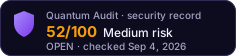
  • Ownership NOT renounced — strong Multisig (3-of-5)
  • Top-10 concentration > 70% (92.3% total → 90.6% effective; 89.5% in EOAs, 2.8% in contracts — extreme)
  • Liquidity not locked, but no owner/deployer address holds LP — market-depth risk, not rug risk
  • LP top1 unlocked holder = 100.0% (independent LP — depth risk)
  • LP top3 unlocked holders = 100.0% (independent LP — depth risk)
  • 2 Low finding(s) from audit

Each factor is an on-chain fact recorded at the time of this analysis. The score is computed from them by a deterministic function, so the same contract returns the same score for anyone who runs the audit. How scores are computed

Related Audits

ChainOpera AI (COAI)High RiskYooldo Games (ESPORTS)High RiskAKEHigh RiskSIXSEVEN (67)High RiskBaby Ansem (BABYANSEM)High RiskEVAAHigh Risk

Would You Like a More Detailed Audit of OPEN?

Our AI-powered scanner gives you a deeper, real-time smart contract analysis — free, with every scoring factor shown.

Get Detailed Audit