
Quantum Audit Logo

Is Mr. Miggles Safe?

On-chain security analysis — is it a scam or legit?

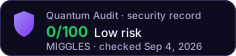
Mr. Miggles MIGGLES
0xb1a0…f25d
Base Not verifiedLast checked 3d ago 1 audit on record
Executive SummaryAI Copilot

The Erc20 token contract implements a standard ERC-20 interface with an Ownable access control pattern. It includes a unique 'launched' state mechanism that restricts transfers to/from contracts before launch, providing a controlled distribution phase. The contract utilizes Solidity 0.8.24, benefiting from built-in overflow/underflow protections. Identified issues primarily relate to the implications of the pre-launch transfer restrictions and a non-standard self-transfer prohibition.

1 High1 Medium1 Low1 Informational
Volume 24h
$63.9K
Liquidity
$528.0K
Price
$0.003008
Token Age
2y
Top 10 Holders
22.9%

Security Findings

High

Centralized Control and Pre-Launch Transfer Restrictions

H-01The `Erc20` contract implements a `launched` state, controlled by the `onlyOwner` function `launch()`. Before `launched` is true, the `_transferAllowed` function prevents transfers to or from any contract address (`from.isContract() || to.isContract()`). This mechanism, while potentially intended to prevent sniping or control initial distribution, significantly centralizes control in the owner's hands and can block legitimate interactions with DEXes, aggregators, multisigs, or other DeFi protocols until the owner calls `launch()`. The `transferFrom` function also includes a special path allowing the owner to move tokens from an approved address to themselves before launch, further highlight…
IssueThe `Erc20` contract implements a `launched` state, controlled by the `onlyOwner` function `launch()`. Before `launched` is true, the `_transferAllowed` function prevents transfers to or from any contract address (`from.isContract() || to.isContract()`). This mechanism, while potentially intended to prevent sniping or control initial distribution, significantly centralizes control in the owner's hands and can block legitimate interactions with DEXes, aggregators, multisigs, or other DeFi protocols until the owner calls `launch()`. The `transferFrom` function also includes a special path allowing the owner to move tokens from an approved address to themselves before launch, further highlight…
FixEnsure comprehensive documentation clearly outlines the pre-launch phase, its implications for token holders, and how it affects interactions with other smart contracts. Consider if the `isContract()` check is overly restrictive; if specific contract types (e.g., known DEX routers) are intended to be allowed, a whitelist mechanism could be explored. Communicate the owner's role and the timing of the `launch()` function transparently.
StatusUnresolved
Medium

Non-Standard Self-Transfer Restriction

M-01The `_transfer` function includes a `require(from != to, "you cannot transfer to yourself");` check. While seemingly a minor restriction, standard ERC-20 implementations typically allow transfers from an address to itself. Some protocols, dApps, or internal accounting systems might expect or rely on the ability to perform self-transfers for various reasons, such as gas optimization or re-triggering hooks. This deviation from the ERC-20 standard could lead to unexpected reverts or integration issues.
IssueThe `_transfer` function includes a `require(from != to, "you cannot transfer to yourself");` check. While seemingly a minor restriction, standard ERC-20 implementations typically allow transfers from an address to itself. Some protocols, dApps, or internal accounting systems might expect or rely on the ability to perform self-transfers for various reasons, such as gas optimization or re-triggering hooks. This deviation from the ERC-20 standard could lead to unexpected reverts or integration issues.
FixConsider removing the `require(from != to, "you cannot transfer to yourself");` check to align with standard ERC-20 behavior and improve compatibility with existing infrastructure. If this restriction is intentional, thoroughly document its purpose and potential implications for users and integrators.
StatusUnresolved
Low

Missing Event for `launch()` Function

L-01The `launch()` function, which transitions the token from a restricted pre-launch state to a fully transferable state, does not emit an event upon successful execution. This makes it challenging for off-chain systems, such as block explorers, dApps, and analytics tools, to programmatically monitor the token's launch status and react accordingly without constantly polling the `launched` state variable.
IssueThe `launch()` function, which transitions the token from a restricted pre-launch state to a fully transferable state, does not emit an event upon successful execution. This makes it challenging for off-chain systems, such as block explorers, dApps, and analytics tools, to programmatically monitor the token's launch status and react accordingly without constantly polling the `launched` state variable.
FixEmit an event (e.g., `event Launched(address indexed caller, uint256 timestamp);`) when the `launch()` function is successfully called. This provides a clear, auditable, and easily monitorable signal for off-chain services.
StatusUnresolved
Info

Assembly Usage in `_revert` Function

I-01The `_revert` function within the `Address` library uses inline assembly to handle reverts with custom error data. While this approach is functional and can be efficient for forwarding raw revert data, direct assembly usage can sometimes reduce code readability and increase the potential for subtle errors compared to higher-level Solidity constructs. In Solidity 0.8.x, `abi.decode` and `revert` can often achieve similar results for string error messages.
IssueThe `_revert` function within the `Address` library uses inline assembly to handle reverts with custom error data. While this approach is functional and can be efficient for forwarding raw revert data, direct assembly usage can sometimes reduce code readability and increase the potential for subtle errors compared to higher-level Solidity constructs. In Solidity 0.8.x, `abi.decode` and `revert` can often achieve similar results for string error messages.
FixReview if the assembly usage in `_revert` is strictly necessary for its intended purpose. If a more idiomatic Solidity approach can achieve the same functionality with improved readability and maintainability, consider refactoring. However, for a utility library function designed for precise error forwarding, the current implementation may be acceptable.
StatusUnresolved

Category Ratings

TechnicalLow9/10

The contract is written in Solidity 0.8.24, which includes built-in overflow/underflow checks, enhancing code security (7.2 Code Security). It uses the Address library for safe low-level calls. A key architectural feature is the 'launched' state, which restricts transfers to/from contracts before activation, potentially causing integration issues for dApps or DEXes (7.1 Architecture). Additionally, the contract explicitly disallows self-transfers, deviating from standard ERC-20 behavior (7.2 Code Security).

GovernanceLow9/10

The contract employs the Ownable pattern, granting the deployer significant control, particularly over the 'launch' function (7.3 Access Control). Before the token is 'launched', transfers to or from any contract address are prohibited, which is an economic control mechanism to manage initial distribution (7.4 Economic). The owner also has a special `transferFrom` privilege before launch. This centralized control over the launch phase introduces a medium governance risk, as the owner's action dictates the token's full functionality (7.5 Governance).

UpgradesLow10/10

The contract is not designed to be upgradeable; it does not implement any proxy patterns (7.7 Upgrades). This eliminates risks associated with upgrade mechanisms, such as proxy misconfigurations or logic errors during upgrades. The use of `immutable` for `totalSupply` and `decimals` confirms its non-upgradeable nature.

Security Checklist

Contract VerifiedPass
Ownership RenouncedPass
No Mint FunctionPass
Liquidity LockedPass
Not a ProxyPass

Holder Composition

13.2% in wallets9.7% in contracts
Effective Concentration17.1%

Share held by contracts — treasury, vesting, bridge or staking — is discounted against share held by wallets when the score is computed: a contract cannot decide to sell the way an anonymous holder can, though it can still be drained or voted to sell. Effective concentration is the figure the risk score is actually calculated from.

Liquidity Depth

Show 4 more pairsShow less

The 6 remaining pairs hold $374 between them and are not listed.

The risk score reads depth across every pair. The volume figure and the volume-to-liquidity ratio elsewhere on this page describe only the pair this audit analysed, so the two are not directly comparable.

LP Distribution

LP Burned100.0% · ≈ permanent lock
LP Locked100.0%

Key Addresses

Deployer
0xe656…97ac
Unlocked LP Held By
0xd505…797a0x9c4c…29dd0x2036…8d000x6ba3…d9ec0x9872…b4330x4423…9d3f0x65b0…e4650x26b7…597e0xab51…4e13

No privileged address appears among these holders: the unlocked liquidity sits with independent providers, not with the deployer.

What Raised This Score

  • 1 High finding(s) from audit
  • 1 Medium finding(s) from audit
  • 1 Low finding(s) from audit

Each factor is an on-chain fact recorded at the time of this analysis. The score is computed from them by a deterministic function, so the same contract returns the same score for anyone who runs the audit. How scores are computed

Related Audits

Unit 00 - Rei (REI)Low RiskKeyboard Cat (KEYCAT)Low Riskmfercoin ($MFER)Low RiskdoginmeLow RiskToshiLow RiskVEIL Token (VEIL)Low Risk

Would You Like a More Detailed Audit of Mr. Miggles?

Our AI-powered scanner gives you a deeper, real-time smart contract analysis — free, with every scoring factor shown.

Get Detailed Audit