
Quantum Audit Logo
Launch App

On-chain security analysis — is it a scam or legit?

Is doginme Safe?

DOGINMEBase
Not verified This record has not gone through deep verification and is not being monitored. The score is a dated snapshot — the token’s risk can change at any time.Own this token? Put it under verification →
Last checked Sep 4, 2026 · 1 audit on record
SummaryAI Copilot

The doginme token contract is a standard ERC20 implementation.

Read the full analysis
What raised the score
  • Ownership status UNKNOWN
  • Top-10 concentration > 30%
  • 1 Low finding(s) from audit
Exact factors
  • Ownership status UNKNOWN (owner could not be resolved)
  • Top-10 concentration > 30% (50.2% total → 44.0% effective; 39.8% in EOAs, 10.3% in contracts — moderate)
  • 1 Low finding(s) from audit

Each factor is an on-chain fact recorded at the time of this analysis. The score is computed from them by a deterministic function, so the same contract returns the same score for anyone who runs the audit. How scores are computed

Security Checklist

as of audit · Sep 44 of 5 checks passed
Contract verifiedVerified
OwnershipUnknown
MintNo mint
Liquidity lockLocked
UpgradeabilityFixed code

Holders

as of audit · Sep 4, 2026
10.3%Contracts39.8%Wallets49.8%Everyone else
10.3%39.8%Wallets49.8%Everyone else
ContractsWalletsEveryone elseBubble area = share of supply
50.2%of supply sits with the top 10 holders
  • Contractstreasury, vesting, bridge, staking10.3%
  • Walletsanonymous holders, free to sell39.8%
  • Everyone elsethe rest of the supply49.8%
Effective concentrationwhat the score reads44.0%
How holder types affect the score

Share held by contracts — treasury, vesting, bridge or staking — is discounted against share held by wallets when the score is computed: a contract cannot decide to sell the way an anonymous holder can, though it can still be drained or voted to sell. Effective concentration is the figure the risk score is actually calculated from.

Holder balances as recorded by the audit of Sep 4, 2026

Liquidity

as of audit · Sep 4$1.51M across 15 pairs
LP tokensLocked

The LP tokens of the analysed pool are locked or burned.

Analysed pool$1.38MShare of depth91.5%
LP Burned94.5%
LP Locked94.5% · Dead Address
Unlocked LP held by
0x5cc4…d4c50xb282…3ae90x8354…2bfe0x4365…30750x5b0d…74cc0xaa6f…3f9d0xc873…88a60x1782…fa9b0x27ca…9e29

No privileged address appears among these holders: the unlocked liquidity sits with independent providers, not with the deployer.

Security Findings

1 Low1 Info
Low

Lack of Emergency Control Mechanisms

The ERC20 implementation does not include common emergency control mechanisms such as pausability or blacklisting. In the event of a critical vulnerability, exploit, or regulatory requirement, there is no built-in way to halt transfers or freeze malicious accounts (7.8 Operations). While this design choice promotes immutability and censorship resistance, it limits the project's ability to respond to unforeseen circumstances or mitigate severe exploits.L-01

Issue

The ERC20 implementation does not include common emergency control mechanisms such as pausability or blacklisting. In the event of a critical vulnerability, exploit, or regulatory requirement, there is no built-in way to halt transfers or freeze malicious accounts (7.8 Operations). While this design choice promotes immutability and censorship resistance, it limits the project's ability to respond to unforeseen circumstances or mitigate severe exploits.

Fix

Evaluate the project's risk profile and potential need for emergency controls. If such mechanisms are deemed necessary, consider integrating battle-tested libraries like OpenZeppelin's Pausable or AccessControl contracts. Implement these features carefully, ensuring that control is vested in a secure, multi-signature wallet or a robust governance process to prevent abuse.

Status

Unresolved

Info

Centralized Initial Token Supply

All 69,000,000,000 tokens are minted to the contract deployer (msg.sender) during the doginme contract's construction. This design choice results in a highly centralized initial distribution, giving the deployer complete control over the entire token supply. While not a technical vulnerability in the code itself, this represents a significant economic and governance risk (7.4, 7.5) if the project aims for decentralization or broad community participation. The deployer could potentially manipulate market prices or control voting power if the token were used in a governance system.I-01

Issue

All 69,000,000,000 tokens are minted to the contract deployer (msg.sender) during the doginme contract's construction. This design choice results in a highly centralized initial distribution, giving the deployer complete control over the entire token supply. While not a technical vulnerability in the code itself, this represents a significant economic and governance risk (7.4, 7.5) if the project aims for decentralization or broad community participation. The deployer could potentially manipulate market prices or control voting power if the token were used in a governance system.

Fix

If decentralization is a goal, consider implementing a more distributed initial token supply. This could involve a multi-sig wallet for the initial supply, a vesting schedule, or a public sale/airdrop mechanism to distribute tokens more broadly from the outset. Clearly communicate this distribution strategy to the community.

Status

Unresolved

Analysis

AI Copilotas of audit · Sep 4
Executive SummaryWhat the contract is and what the review found

The doginme token contract is a standard ERC20 implementation. The code is well-structured and adheres to common Solidity best practices. No critical or high-severity technical vulnerabilities were identified. The primary risks are related to the highly centralized initial token distribution and the absence of emergency control mechanisms, which are design considerations rather than code flaws.

Technical10/10Low risk

The technical architecture (7.1) is a straightforward ERC20 token, inheriting from a custom base. Code security (7.2) is robust; unchecked blocks are correctly preceded by require statements, preventing integer underflows. Access control (7.3) is standard for ERC20, with no special roles beyond the initial deployer. The contract avoids complex external interactions, mitigating reentrancy and other common attack vectors. Overall, the implementation is clean and adheres to secure coding practices.

Governance5/10Medium risk

The economic model (7.4) involves minting the entire token supply (69 billion tokens) to the contract deployer during construction. This results in a highly centralized initial distribution, giving the deployer complete control over the token's initial supply and market dynamics. There are no explicit governance mechanisms (7.5) beyond this initial distribution. This centralization is a significant factor for the project's long-term decentralization goals and potential for manipulation.

Upgrades7/10Low risk

The contract is not designed with any upgradeability patterns (7.7), such as proxy contracts. This means its logic is immutable once deployed. While this eliminates upgrade-related risks, any future changes would require a new contract deployment and migration.

Final RecommendationWhat to do about this score

For projects aiming for decentralization, consider implementing a more distributed initial token supply or a vesting schedule for the deployer's tokens.

Evaluate the necessity of emergency control mechanisms like pausability or blacklisting based on the project's specific use case and risk tolerance. Ensure comprehensive testing, especially for edge cases in token transfers and allowances.

Contract & Record

1 audit on record
TypeToken
NetworkBase
Token age2y
Contract0x6921…b75b
Deployer0x3308…ee2d
Badge for your website
doginme security record badge

Free for any token on the record. It links to this page and always shows the current score and the date it was checked.

Audit History
  1. Sep 4, 20263Low
  2. Aug 16, 20260Low

Score changes are recorded as dated snapshots — history is append-only and cannot be edited.

Frequently Asked Questions

What is the DOGINME contract address?

The doginme contract on Base is 0x6921b130d297cc43754afba22e5eac0fbf8db75b. Compare it with the address the project itself publishes before trading: other contracts can carry the same name and ticker.

Is doginme a scam?

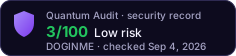
Quantum Audit's risk score for doginme is 3/100 (Low risk) as of Sep 4, 2026, computed by a deterministic function from on-chain facts — Contract verified: Verified; Mint: No mint; Liquidity lock: Locked; Upgradeability: Fixed code. A score is a dated snapshot of those facts, not a guarantee; each one is listed on this page.

Is DOGINME liquidity locked?

Liquidity lock: Locked (as of Sep 4, 2026). Total DEX liquidity: $1.51M.

Who holds DOGINME?

As of Sep 4, 2026, the 10 largest holders own 50.2% of the supply. The Holders section on this page shows who they are by holder type.

Would You Like a More Detailed Audit of doginme?

Our AI-powered scanner gives you a deeper, real-time smart contract analysis — free, with every scoring factor shown.

Get Detailed Audit Is this your token? Publish your own audit on this page