Quantum Audit Logo

Is Liability Vortex a Scam?

Early-stage security check — honeypot & rug-pull analysis

Is this your token? Publish your own audit on this page →

Liability Vortex LVTR
0x2dcb…631a
BNB Chain Not verifiedLast checked 3d ago 1 audit on record New Launch · 1d old
Executive SummaryAI Copilot

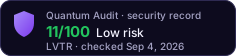
The LiabilityVortex contract is a standard ERC20 token implementation, inheriting from OpenZeppelin's battle-tested ERC20 and Ownable libraries. It features a fixed total supply, all of which is minted to a specified treasury address during deployment. The contract's simplicity and reliance on audited libraries contribute to a low technical risk profile. However, the centralized initial distribution of the entire token supply to a single treasury address introduces a medium economic risk.

1 Medium3 Informational
! Early-stage analysis. This token has limited on-chain history (1d old). New tokens carry elevated risk — data may change rapidly. Always verify independently before investing.
Volume 24h
$7.3K
Liquidity
$20.9K
Price
$0.6151
Token Age
1d
Top 10 Holders
67.2%

Security Findings

Medium

Centralized Initial Token Distribution

M-01The entire `TOTAL_SUPPLY` of 400,000e18 tokens is minted to a single `treasury` address during contract deployment. This means 100% of the token supply is controlled by this single address (7.4 Economic).
IssueThe entire `TOTAL_SUPPLY` of 400,000e18 tokens is minted to a single `treasury` address during contract deployment. This means 100% of the token supply is controlled by this single address (7.4 Economic).
FixEnsure the `treasury` address is a highly secure entity, such as a robust multi-signature wallet with a well-defined operational policy and geographically distributed signers. Consider distributing the initial supply across multiple addresses or vesting contracts if a single point of control is not desired long-term.
StatusUnresolved
Info

Immutability of Contract Logic

I-01The `LiabilityVortex` contract is deployed as a standard, non-upgradeable contract. Its logic cannot be modified after deployment (7.7 Upgrades).
IssueThe `LiabilityVortex` contract is deployed as a standard, non-upgradeable contract. Its logic cannot be modified after deployment (7.7 Upgrades).
FixAcknowledge the immutability. If future flexibility is desired, consider an upgradeable proxy pattern for future contracts. For this specific contract, ensure thorough testing before deployment, as its logic is fixed.
StatusUnresolved
Info

Limited Owner Privileges

I-02The `Ownable` role, assigned to `msg.sender` during deployment, only controls the ability to transfer or renounce ownership of the contract itself. It does not grant any special privileges over the token supply (e.g., minting, burning, pausing, blacklisting) beyond the initial mint to the treasury (7.3 Access Control, 7.5 Governance).
IssueThe `Ownable` role, assigned to `msg.sender` during deployment, only controls the ability to transfer or renounce ownership of the contract itself. It does not grant any special privileges over the token supply (e.g., minting, burning, pausing, blacklisting) beyond the initial mint to the treasury (7.3 Access Control, 7.5 Governance).
FixThis is a design choice. If emergency control or future administrative functions are desired, they must be explicitly added and carefully secured. For this contract, the limited scope of the owner role is a security strength against centralized control.
StatusUnresolved
Info

Reliance on OpenZeppelin Libraries

I-03The contract heavily relies on battle-tested OpenZeppelin contracts for ERC20 token functionality and access control (`ERC20.sol`, `Ownable.sol`). This significantly reduces the likelihood of common vulnerabilities (7.2 Code Security, 7.6 External).
IssueThe contract heavily relies on battle-tested OpenZeppelin contracts for ERC20 token functionality and access control (`ERC20.sol`, `Ownable.sol`). This significantly reduces the likelihood of common vulnerabilities (7.2 Code Security, 7.6 External).
FixRegularly monitor OpenZeppelin security advisories for the specific versions used (0.8.20+ for imports, 0.8.36 for the main contract). Ensure the project's dependency management is robust.
StatusUnresolved

Category Ratings

TechnicalLow10/10

The contract demonstrates strong technical security by utilizing battle-tested OpenZeppelin libraries for its ERC20 and Ownable functionalities (7.2 Code Security). There is no complex custom logic, which significantly reduces the attack surface and the likelihood of novel technical vulnerabilities. Standard ERC20 operations are robust, and the use of Solidity 0.8.36 with OpenZeppelin's 0.8.20+ imports ensures overflow/underflow protection. No reentrancy or other common technical vulnerabilities were identified.

GovernanceLow8/10

The primary economic risk stems from the initial token distribution: the entire fixed supply is minted to a single `treasury` address during deployment (7.4 Economic). This creates a single point of failure; compromise of this address would lead to the loss of all tokens. The contract owner, defined by the `Ownable` pattern, has no further control over the token supply (e.g., minting, burning, pausing) beyond the initial distribution (7.5 Governance). This limits potential for malicious owner actions but also restricts emergency response capabilities.

UpgradesLow10/10

The LiabilityVortex contract is deployed as a standard, non-upgradeable implementation (7.7 Upgrades). This design choice eliminates the complexities and risks associated with upgrade mechanisms, such as proxy pattern vulnerabilities or upgrade path issues. However, it also means that the contract's logic is immutable post-deployment, preventing any future bug fixes, feature enhancements, or parameter adjustments without a full redeployment and migration process.

Security Checklist

Contract VerifiedPass
Ownership RenouncedPass
No Mint FunctionPass
Liquidity LockedPass
Not a ProxyPass

Holder Composition

4.1% in wallets63.0% in contracts
Effective Concentration29.4%

Share held by contracts — treasury, vesting, bridge or staking — is discounted against share held by wallets when the score is computed: a contract cannot decide to sell the way an anonymous holder can, though it can still be drained or voted to sell. Effective concentration is the figure the risk score is actually calculated from.

Liquidity Depth

The risk score reads depth across every pair. The volume figure and the volume-to-liquidity ratio elsewhere on this page describe only the pair this audit analysed, so the two are not directly comparable.

LP Distribution

LP Locked99.4% · Null Address, PinkLock02
Top-1 Unlocked Holder4.0%

Key Addresses

Deployer
0x6f5a…c6e5
Unlocked LP Held By
0x03a6…a0c10x0ed9…9706

No privileged address appears among these holders: the unlocked liquidity sits with independent providers, not with the deployer.

What Raised This Score

  • Top-10 concentration > 20% (67.2% total → 29.4% effective; 4.1% in EOAs, 63.0% in contracts — mild)
  • Liquidity < $50k ($24,402 across 3 pairs — thin market)
  • Token age < 7 days (early, volatile)
  • 1 Medium finding(s) from audit

Each factor is an on-chain fact recorded at the time of this analysis. The score is computed from them by a deterministic function, so the same contract returns the same score for anyone who runs the audit. How scores are computed

Related Audits

Cubus Store Coin (CSC)Low RiskARIA.AI (ARIA)Low RiskWorld of Dypians (WOD)Low RiskFrippyLow RiskGiggle Mascot (MAX)Low RiskOKZOO (AIOT)Low Risk

Would You Like a More Detailed Audit of Liability Vortex?

This token is brand new. Run a deeper AI-powered analysis of the contract code — free and instant.

Get Detailed Audit