

Quantum Audit Logo

Is ARIA.AI Safe?

On-chain security analysis — is it a scam or legit?

Is this your token? Publish your own audit on this page →

ARIA.AI ARIA
0x5d3a…5238
BNB Chain Not verifiedLast checked 2d ago 1 audit on record
Executive SummaryAI Copilot

The Aria token contract is a standard ERC20 implementation leveraging OpenZeppelin libraries. The initial token supply is fully minted to the deployer. The `airdrop` function, while present, is effectively disabled due to the reported renunciation of ownership, limiting future administrative actions.
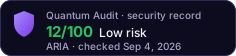

1 Low3 Informational
Volume 24h
$216.2K
Liquidity
$1.28M
Price
$0.03331
Token Age
11mo
Top 10 Holders
86.1%

Security Findings

Low

Centralized Initial Token Distribution

L-01The contract's constructor mints the entire `_tTotal` supply of 1,000,000,000 ARIA tokens (1 billion) to the contract deployer (`msg.sender`). This results in a highly centralized initial token distribution, where a single address holds 100% of the total supply (7.4 Economic, 7.5 Governance).
IssueThe contract's constructor mints the entire `_tTotal` supply of 1,000,000,000 ARIA tokens (1 billion) to the contract deployer (`msg.sender`). This results in a highly centralized initial token distribution, where a single address holds 100% of the total supply (7.4 Economic, 7.5 Governance).
FixWhile this is a common design choice for new tokens, it implies significant control by the initial owner over the token's early distribution. Projects should clearly communicate this distribution model to their community to manage expectations regarding decentralization.
StatusUnresolved
Info

Unusable `airdrop` Function After Ownership Renunciation

I-01The `airdrop` function is protected by the `onlyOwner` modifier. The provided prefill data indicates that ownership of the contract has been renounced (transferred to `address(0)`). When ownership is renounced, the `owner()` function returns `address(0)`, making the `onlyOwner` modifier always revert for any transaction sender. Consequently, the `airdrop` function becomes permanently inaccessible and unusable (7.3 Access Control, 7.8 Operations).
IssueThe `airdrop` function is protected by the `onlyOwner` modifier. The provided prefill data indicates that ownership of the contract has been renounced (transferred to `address(0)`). When ownership is renounced, the `owner()` function returns `address(0)`, making the `onlyOwner` modifier always revert for any transaction sender. Consequently, the `airdrop` function becomes permanently inaccessible and unusable (7.3 Access Control, 7.8 Operations).
FixConfirm if the permanent inaccessibility of the `airdrop` function was an intended consequence of ownership renunciation. If the `airdrop` functionality was critical, ownership should not have been renounced, or a different access control mechanism should have been used.
StatusUnresolved
Info

Potential High Gas Costs for Large Airdrop Arrays

I-02The `airdrop` function iterates through `recipients` and `amounts` arrays. If these arrays contain a very large number of elements, the transaction's gas cost could become prohibitively high, potentially exceeding the block gas limit. This would prevent the airdrop from being executed in a single transaction (7.1 Architecture, 7.2 Code Security). This issue is currently moot due to the `airdrop` function being unusable (I-01).
IssueThe `airdrop` function iterates through `recipients` and `amounts` arrays. If these arrays contain a very large number of elements, the transaction's gas cost could become prohibitively high, potentially exceeding the block gas limit. This would prevent the airdrop from being executed in a single transaction (7.1 Architecture, 7.2 Code Security). This issue is currently moot due to the `airdrop` function being unusable (I-01).
FixIf the `airdrop` function were to be made usable in a future iteration, consider implementing pagination or batching mechanisms to process large airdrops across multiple transactions, or limit the maximum array length to a reasonable number to ensure transactions remain within gas limits.
StatusUnresolved
Info

Leveraging Standard OpenZeppelin ERC20 Implementation

I-03The Aria token contract correctly inherits and utilizes the battle-tested `ERC20` and `Ownable` contracts from OpenZeppelin. This approach significantly reduces the risk of common vulnerabilities such as reentrancy, integer overflows/underflows, and standard ERC20 compliance issues, as these libraries have undergone extensive audits and community review (7.2 Code Security).
IssueThe Aria token contract correctly inherits and utilizes the battle-tested `ERC20` and `Ownable` contracts from OpenZeppelin. This approach significantly reduces the risk of common vulnerabilities such as reentrancy, integer overflows/underflows, and standard ERC20 compliance issues, as these libraries have undergone extensive audits and community review (7.2 Code Security).
FixContinue to rely on well-audited and widely adopted libraries like OpenZeppelin for core functionalities. Ensure that any custom logic built on top of these libraries maintains the same high security standards.
StatusUnresolved

Category Ratings

TechnicalLow10/10

The contract is a standard ERC20 token built upon OpenZeppelin's secure and audited libraries, minimizing common vulnerabilities like reentrancy and integer overflows (7.2 Code Security). The `airdrop` function correctly validates input lengths and ensures sufficient balance before transfers (7.1 Architecture). However, the `airdrop` function is only callable by the owner, and if ownership is renounced, this function becomes permanently inaccessible (7.3 Access Control).

GovernanceMedium5/10

The initial token distribution is highly centralized, with all 1 billion tokens minted to the deployer (7.4 Economic). However, the contract leverages the battle-tested OpenZeppelin Ownable contract, and the prefill indicates ownership has been renounced. This renunciation effectively disables the `airdrop` function and removes any further administrative control, decentralizing future operations but also making the `airdrop` function permanently unusable (7.5 Governance).

UpgradesLow9/10

The contract is not designed with upgradeability features, such as proxy patterns. This eliminates risks associated with upgrade mechanisms, ensuring the contract's logic is immutable post-deployment (7.7 Upgrades).

Security Checklist

Contract VerifiedPass
Ownership RenouncedPass
No Mint FunctionPass
Liquidity LockedFail
Not a ProxyPass

Holder Composition

75.3% in wallets10.8% in contracts
Effective Concentration79.6%

Share held by contracts — treasury, vesting, bridge or staking — is discounted against share held by wallets when the score is computed: a contract cannot decide to sell the way an anonymous holder can, though it can still be drained or voted to sell. Effective concentration is the figure the risk score is actually calculated from.

Liquidity Depth

The risk score reads depth across every pair. The volume figure and the volume-to-liquidity ratio elsewhere on this page describe only the pair this audit analysed, so the two are not directly comparable.

LP Distribution

Top-1 Unlocked Holder39.3%
Top-3 Unlocked79.4%

Key Addresses

Deployer
0x77ac…f211
Unlocked LP Held By
0xaaf2…a6010xbc7a…3e710x8a4a…0bf40x26b3…c34c0x4157…63e40x1a13…9ac2

No privileged address appears among these holders: the unlocked liquidity sits with independent providers, not with the deployer.

What Raised This Score

  • Top-10 concentration > 70% (86.1% total → 79.6% effective; 75.3% in EOAs, 10.8% in contracts — extreme)
  • Liquidity not locked, but no owner/deployer address holds LP — market-depth risk, not rug risk
  • 1 Low finding(s) from audit

Each factor is an on-chain fact recorded at the time of this analysis. The score is computed from them by a deterministic function, so the same contract returns the same score for anyone who runs the audit. How scores are computed

Related Audits

FrippyLow RiskGiggle Mascot (MAX)Low RiskOKZOO (AIOT)Low RiskCubus Store Coin (CSC)Low RiskLiability Vortex (LVTR)Low RiskBinance Cat (BNBCAT)Low Risk

Would You Like a More Detailed Audit of ARIA.AI?

Our AI-powered scanner gives you a deeper, real-time smart contract analysis — free, with every scoring factor shown.

Get Detailed Audit