
Quantum Audit Logo

Is Frippy Safe?

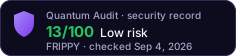
On-chain security analysis — is it a scam or legit?

Is this your token? Publish your own audit on this page →

Frippy FRIPPY
0xf3f7…8e46
BNB Chain Not verifiedLast checked 3d ago 1 audit on record
Executive SummaryAI Copilot

The Frippy contract is an ERC-20 token implementation that inherits from OpenZeppelin's `ERC20` and `Ownable` contracts. A key design decision is the immediate renunciation of ownership in the constructor, making the contract immutable and unmanageable after deployment. While this removes central points of control, it also eliminates the possibility of future upgrades, bug fixes, or emergency interventions. The core ERC-20 logic is standard and appears robust.

1 High1 Medium1 Low2 Informational
Volume 24h
$90.0400
Liquidity
$6.1K
Price
$0.0000102
Token Age
10mo
Top 10 Holders
54.7%

Security Findings

High

Renounced Ownership and Immutability

H-01The `FRIPPY` contract's constructor calls `renounceOwnership()`, setting the contract owner to the zero address. This design choice makes the contract completely immutable and unmanageable after deployment. While it removes central points of control and potential for malicious owner actions, it also eliminates any possibility for administrative intervention, bug fixes, or upgrades. This impacts 7.5 Governance, 7.8 Operations, and 7.7 Upgrades.
IssueThe `FRIPPY` contract's constructor calls `renounceOwnership()`, setting the contract owner to the zero address. This design choice makes the contract completely immutable and unmanageable after deployment. While it removes central points of control and potential for malicious owner actions, it also eliminates any possibility for administrative intervention, bug fixes, or upgrades. This impacts 7.5 Governance, 7.8 Operations, and 7.7 Upgrades.
FixThis is a deliberate design decision. If immutability is the explicit goal, no change is needed. However, if any future flexibility, emergency control, or upgradeability is desired, ownership should not be renounced, or a robust governance mechanism (e.g., a DAO or multi-signature wallet) should be implemented to manage the contract.
StatusUnresolved
Medium

Lack of Emergency Controls

M-01Due to the renounced ownership (H-01), the contract lacks any emergency control mechanisms such as pausing transfers, blacklisting malicious addresses, or recovering tokens sent to the contract address. In the event of a critical vulnerability, market manipulation, or a significant exploit, there would be no way to halt operations or mitigate damage. This impacts 7.8 Operations and 7.4 Economic.
IssueDue to the renounced ownership (H-01), the contract lacks any emergency control mechanisms such as pausing transfers, blacklisting malicious addresses, or recovering tokens sent to the contract address. In the event of a critical vulnerability, market manipulation, or a significant exploit, there would be no way to halt operations or mitigate damage. This impacts 7.8 Operations and 7.4 Economic.
FixIf emergency controls are deemed necessary for future projects, consider implementing functions like `pause()`/`unpause()` or `blacklist()` that are controlled by a trusted entity (e.g., a multi-signature wallet) or a decentralized governance system, and ensure these are in place before renouncing ownership.
StatusUnresolved
Low

Tokens Sent Directly to Contract Address May Be Locked

L-01As a standard ERC-20 token, if users mistakenly send tokens directly to the `FRIPPY` contract address via a standard `transfer` call (instead of `approve` then `transferFrom`), those tokens will become permanently locked within the contract. The contract has no mechanism to retrieve or forward these tokens. This impacts 7.8 Operations.
IssueAs a standard ERC-20 token, if users mistakenly send tokens directly to the `FRIPPY` contract address via a standard `transfer` call (instead of `approve` then `transferFrom`), those tokens will become permanently locked within the contract. The contract has no mechanism to retrieve or forward these tokens. This impacts 7.8 Operations.
FixEducate users to only interact with the token contract via its defined ERC-20 functions and to avoid sending tokens directly to the contract address. For future contracts, consider implementing a `recoverERC20()` function, callable by a trusted entity (if ownership is not renounced), to retrieve accidentally sent tokens.
StatusUnresolved
Info

Broad Solidity Pragma

I-01The contract uses a broad Solidity pragma `^0.8.0`. While the provided metadata indicates compilation with `0.8.26`, a broad pragma allows compilation with any future 0.8.x version, which might introduce breaking changes or unexpected behavior if not explicitly tested against. This impacts 7.2 Code Security.
IssueThe contract uses a broad Solidity pragma `^0.8.0`. While the provided metadata indicates compilation with `0.8.26`, a broad pragma allows compilation with any future 0.8.x version, which might introduce breaking changes or unexpected behavior if not explicitly tested against. This impacts 7.2 Code Security.
FixConsider pinning the Solidity pragma to a specific compiler version (e.g., `pragma solidity 0.8.26;`) to ensure consistent compilation behavior across different environments and to prevent accidental compilation with incompatible future versions.
StatusUnresolved
Info

Empty `_beforeTokenTransfer` and `_afterTokenTransfer` Hooks

I-02The `_beforeTokenTransfer` and `_afterTokenTransfer` internal virtual functions are present but empty. While this is not a vulnerability, it represents a missed opportunity to implement custom logic, such as fee mechanisms, blacklisting, or snapshotting, before or after token transfers. This impacts 7.1 Architecture.
IssueThe `_beforeTokenTransfer` and `_afterTokenTransfer` internal virtual functions are present but empty. While this is not a vulnerability, it represents a missed opportunity to implement custom logic, such as fee mechanisms, blacklisting, or snapshotting, before or after token transfers. This impacts 7.1 Architecture.
FixIf any custom logic or additional features are desired for token transfers in future iterations, these hooks provide a clean and secure way to integrate them without modifying the core ERC-20 logic.
StatusUnresolved

Category Ratings

TechnicalLow9/10

The contract implements a standard ERC-20 token following OpenZeppelin patterns (7.1 Architecture). It utilizes Solidity 0.8.x, which includes default overflow/underflow checks for arithmetic operations, enhancing code security (7.2 Code Security). Explicit `unchecked` blocks are correctly used after `require` statements, preventing unintended underflows in `transferFrom`, `decreaseAllowance`, `_transfer`, and `_burn`. The contract lacks complex external interactions, reducing reentrancy risks.

GovernanceMedium5/10

The contract's ownership is immediately renounced in the constructor (7.5 Governance). This design choice means no single entity can control or modify the contract post-deployment, eliminating centralized governance risks. However, it also implies a complete lack of administrative functions, such as pausing transfers, blacklisting malicious addresses, or adjusting economic parameters (7.4 Economic). This immutability prevents any emergency response or future protocol evolution, posing a high risk to adaptability and operational flexibility (7.8 Operations).

UpgradesLow10/10

The Frippy contract is not designed with upgradeability in mind (7.7 Upgrades). The immediate renunciation of ownership further solidifies its immutable nature. While this ensures the contract's logic cannot be altered, it also means that any discovered vulnerabilities or desired feature enhancements cannot be implemented without deploying an entirely new contract, which carries significant migration challenges.

Security Checklist

Contract VerifiedPass
Ownership RenouncedPass
No Mint FunctionPass
Liquidity LockedPass
Not a ProxyPass

Holder Composition

17.0% in wallets37.7% in contracts
Effective Concentration32.1%

Share held by contracts — treasury, vesting, bridge or staking — is discounted against share held by wallets when the score is computed: a contract cannot decide to sell the way an anonymous holder can, though it can still be drained or voted to sell. Effective concentration is the figure the risk score is actually calculated from.

Liquidity Depth

The risk score reads depth across every pair. The volume figure and the volume-to-liquidity ratio elsewhere on this page describe only the pair this audit analysed, so the two are not directly comparable.

LP Distribution

LP Burned100.0% · ≈ permanent lock
LP Locked100.0% · Null Address

Key Addresses

Deployer
0x2b71…768f
Unlocked LP Held By
0x28e2…e9df0x32cb…3968

No privileged address appears among these holders: the unlocked liquidity sits with independent providers, not with the deployer.

What Raised This Score

  • Top-10 concentration > 30% (54.7% total → 32.1% effective; 17.0% in EOAs, 37.7% in contracts — moderate)
  • Liquidity < $10k ($6,116 across 1 pairs — easily drained)
  • 1 High finding(s) from audit
  • 1 Medium finding(s) from audit
  • 1 Low finding(s) from audit

Each factor is an on-chain fact recorded at the time of this analysis. The score is computed from them by a deterministic function, so the same contract returns the same score for anyone who runs the audit. How scores are computed

Related Audits

Giggle Mascot (MAX)Low RiskOKZOO (AIOT)Low RiskBinance Cat (BNBCAT)Low RiskNianNianLow RiskARIA.AI (ARIA)Low RiskBuild On BNB (BOB)Low Risk

Would You Like a More Detailed Audit of Frippy?

Our AI-powered scanner gives you a deeper, real-time smart contract analysis — free, with every scoring factor shown.

Get Detailed Audit