
Quantum Audit Logo

Is Cubus Store Coin Safe?

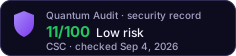
On-chain security analysis — is it a scam or legit?

Is this your token? Publish your own audit on this page →

Cubus Store Coin CSC
0x0296…ffff
BNB Chain Not verifiedLast checked 3d ago 1 audit on record
Executive SummaryAI Copilot

This audit covers the OpenZeppelin `Address` utility library. The library itself is a widely used and thoroughly audited component, providing safe wrappers for low-level address operations. The identified findings are primarily informational, highlighting important considerations and warnings explicitly documented within the library for its safe and secure integration into other contracts.

3 Informational
Volume 24h
$7.6K
Liquidity
$430.2K
Price
$0.01129
Token Age
24d
Top 10 Holders
197.1%

Security Findings

Info

Limitations of `isContract` for Security Checks

I-01The `isContract` function, while useful for certain checks, has known limitations and is explicitly warned against being used for security-critical checks, especially to prevent flash loan attacks or to reliably distinguish between Externally Owned Accounts (EOAs) and contracts. It returns `false` for contracts in construction, destroyed contracts, or addresses where a contract will be created, making it unreliable for strict access control or attack prevention.
IssueThe `isContract` function, while useful for certain checks, has known limitations and is explicitly warned against being used for security-critical checks, especially to prevent flash loan attacks or to reliably distinguish between Externally Owned Accounts (EOAs) and contracts. It returns `false` for contracts in construction, destroyed contracts, or addresses where a contract will be created, making it unreliable for strict access control or attack prevention.
FixDevelopers should not rely on `isContract` as a primary security mechanism to prevent calls from contracts or to protect against flash loan attacks. Instead, robust access control mechanisms (e.g., `Ownable`, `AccessControl`), reentrancy guards, and careful state management should be employed for security-sensitive operations.
StatusUnresolved
Info

Reentrancy Risk with External Calls (sendValue)

I-02The `sendValue` function, which uses a low-level `call` to transfer Ether, explicitly warns about the potential for reentrancy vulnerabilities if not handled correctly by the calling contract. While `sendValue` itself uses `require` before the call (adhering to checks-effects-interactions for its own balance), the recipient can still re-enter the *calling* contract, potentially leading to unexpected behavior or fund drains.
IssueThe `sendValue` function, which uses a low-level `call` to transfer Ether, explicitly warns about the potential for reentrancy vulnerabilities if not handled correctly by the calling contract. While `sendValue` itself uses `require` before the call (adhering to checks-effects-interactions for its own balance), the recipient can still re-enter the *calling* contract, potentially leading to unexpected behavior or fund drains.
FixAny contract utilizing `sendValue` or other external call functions must strictly adhere to the checks-effects-interactions pattern. Implement reentrancy guards (e.g., OpenZeppelin's `ReentrancyGuard`) on functions that perform external calls and modify state, especially when handling Ether or tokens, to prevent malicious re-entry.
StatusUnresolved
Info

Safe Usage of Low-Level Call Wrappers

I-03The `Address` library provides several wrappers for low-level calls (`functionCall`, `functionCallWithValue`, `functionStaticCall`, `functionDelegateCall`). While these wrappers improve safety by handling error propagation and checking for contract existence (in `verifyCallResultFromTarget`), they still transfer control to an external address. Improper use by the calling contract can lead to unexpected behavior, gas limit issues, or reentrancy.
IssueThe `Address` library provides several wrappers for low-level calls (`functionCall`, `functionCallWithValue`, `functionStaticCall`, `functionDelegateCall`). While these wrappers improve safety by handling error propagation and checking for contract existence (in `verifyCallResultFromTarget`), they still transfer control to an external address. Improper use by the calling contract can lead to unexpected behavior, gas limit issues, or reentrancy.
FixWhen using these low-level call wrappers, developers must ensure that the target contract's behavior is well-understood and trusted. Implement robust input validation, handle potential reverts gracefully, and be mindful of gas limits and reentrancy risks, especially with `functionCallWithValue` and `functionDelegateCall` which involve value transfers or delegate logic execution.
StatusUnresolved

Category Ratings

TechnicalLow10/10

The `Address` library (7.1 Architecture) is a robust and well-tested utility from OpenZeppelin, designed to provide safer interactions with addresses and low-level calls. It includes functions like `sendValue` and `functionCallWithValue` (7.2 Code Security) which abstract away common pitfalls of raw `call` operations, such as gas forwarding and error handling. The library explicitly warns users about potential reentrancy issues when using `sendValue` and the limitations of `isContract` (7.3 Access Control) for security purposes, demonstrating a strong focus on secure coding practices and user education.

GovernanceMedium6/10

The `Address` library is a foundational utility and does not incorporate any specific governance or economic mechanisms (7.4 Economic, 7.5 Governance). Its design is purely functional, providing low-level primitives without introducing complex protocol-level risks. Therefore, governance and economic risk levels are considered low, as these aspects are outside the scope of this library.

UpgradesLow10/10

As a Solidity library, `Address` is not designed to be an upgradeable contract (7.7 Upgrades). It is typically linked or embedded into other contracts at deployment. This design inherently avoids upgrade-related complexities and risks associated with proxy patterns or mutable logic, contributing to a low upgrade risk profile for the library itself.

Security Checklist

Contract VerifiedPass
Ownership RenouncedPass
No Mint FunctionPass
Liquidity LockedPass
Not a ProxyPass

Liquidity Depth

The risk score reads depth across every pair. The volume figure and the volume-to-liquidity ratio elsewhere on this page describe only the pair this audit analysed, so the two are not directly comparable.

LP Distribution

LP Burned80.7%
LP Locked80.7% · Null Address

Key Addresses

Deployer
0x01d8…7523
Unlocked LP Held By
0x81cb…797c0x0ed9…9706

No privileged address appears among these holders: the unlocked liquidity sits with independent providers, not with the deployer.

What Raised This Score

  • Top-10 concentration > 70% (197.1% total → 91.1% effective; 20.4% in EOAs, 176.7% in contracts — extreme)
  • Token age < 30 days (still settling)

Each factor is an on-chain fact recorded at the time of this analysis. The score is computed from them by a deterministic function, so the same contract returns the same score for anyone who runs the audit. How scores are computed

Related Audits

Liability Vortex (LVTR)Low RiskARIA.AI (ARIA)Low RiskWorld of Dypians (WOD)Low RiskFrippyLow RiskGiggle Mascot (MAX)Low RiskOKZOO (AIOT)Low Risk

Would You Like a More Detailed Audit of Cubus Store Coin?

Our AI-powered scanner gives you a deeper, real-time smart contract analysis — free, with every scoring factor shown.

Get Detailed Audit