
Quantum Audit Logo

Is KiboShib a Scam?

Honeypot, rug-pull and ownership checks

Is this your token? Publish your own audit on this page →

KiboShib KIBSHI
0x02e7…2361
Ethereum Not verifiedLast checked 2d ago 1 audit on record
Executive SummaryAI Copilot

The KiboShib contract implements a standard ERC20 token. The code is well-structured and largely adheres to common ERC20 patterns, including safe arithmetic for subtractions. Key areas of review included adherence to ERC20 standards, access control, and potential economic implications. The audit identified a low-severity issue regarding the lack of an emergency pause mechanism and informational findings related to the custom ERC20 implementation and centralized initial token distribution.

1 Low2 Informational
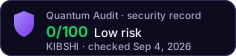
i Our automated scanner reviewed KiboShib (KIBSHI) on Ethereum. 4 of 5 security checks passed — see the full breakdown below.
Volume 24h
$42.6K
Liquidity
$360.3K
Price
$0.000002414
Age
3y
Top 10 Holders
22.3%

Security Findings

Low

Lack of Emergency Pausability

L-01The contract does not include a mechanism to pause token transfers in emergency situations. This could prevent mitigation of issues like critical vulnerabilities or unexpected market events, potentially leading to irreversible losses or exploits if a rapid response is required. While not a direct vulnerability, it limits the project's ability to react to crises.
IssueThe contract does not include a mechanism to pause token transfers in emergency situations. This could prevent mitigation of issues like critical vulnerabilities or unexpected market events, potentially leading to irreversible losses or exploits if a rapid response is required. While not a direct vulnerability, it limits the project's ability to react to crises.
FixConsider implementing a pausable mechanism, typically controlled by a multi-signature wallet or a trusted governance entity. This would allow for temporary suspension of critical operations in case of an emergency, providing a window to address severe issues.
StatusUnresolved
Info

Custom ERC20 Implementation

I-01The project utilizes a custom implementation of the ERC20 standard rather than leveraging battle-tested and widely audited libraries like OpenZeppelin. While the provided code appears to adhere to the standard, custom implementations carry a higher inherent risk of subtle bugs or non-standard behaviors compared to established libraries that have undergone extensive community review and formal audits.
IssueThe project utilizes a custom implementation of the ERC20 standard rather than leveraging battle-tested and widely audited libraries like OpenZeppelin. While the provided code appears to adhere to the standard, custom implementations carry a higher inherent risk of subtle bugs or non-standard behaviors compared to established libraries that have undergone extensive community review and formal audits.
FixFor future projects, it is generally recommended to use well-vetted and audited libraries such as OpenZeppelin Contracts for standard functionalities. If a custom implementation is necessary, ensure it undergoes thorough testing and independent security audits.
StatusUnresolved
Info

Centralized Initial Token Distribution

I-02The entire initial supply of 1,000,000,000,000 * 10^18 tokens is minted to the contract deployer's address. This grants the deployer significant control over the token's supply, liquidity, and potential market dynamics, posing a centralization risk. While common for new tokens, it concentrates power in a single entity.
IssueThe entire initial supply of 1,000,000,000,000 * 10^18 tokens is minted to the contract deployer's address. This grants the deployer significant control over the token's supply, liquidity, and potential market dynamics, posing a centralization risk. While common for new tokens, it concentrates power in a single entity.
FixEnsure that the deployer's address is secured with robust measures, such as a hardware wallet or a multi-signature wallet. For long-term decentralization, consider mechanisms for distributing token control or vesting schedules for large token allocations.
StatusUnresolved

Category Ratings

TechnicalLow10/10

The contract implements the ERC20 standard, providing basic token functionalities such as transfer, approval, and balance management (7.1 Architecture). Code security is generally good, with appropriate use of `require` statements and `unchecked` blocks for arithmetic operations where bounds are checked (7.2 Code Security). Access control (7.3 Access Control) is standard for an ERC20 token, with no additional privileged roles beyond the deployer receiving the initial supply. A minor concern is the absence of an emergency pause function, which could limit response capabilities during unforeseen events.

GovernanceMedium6/10

The economic model (7.4 Economic) involves a large initial supply minted entirely to the deployer, which centralizes control over the token's initial distribution and market dynamics. There are no explicit governance mechanisms (7.5 Governance) within the contract itself, as it functions as a simple token. External factors, such as liquidity provision and market behavior, will significantly influence the token's economic stability.

UpgradesLow7/10

The KiboShib contract is not designed to be upgradeable (7.7 Upgrades). It is deployed as a standard, immutable contract, which eliminates risks associated with upgrade mechanisms but also prevents future modifications or bug fixes to the contract logic.

Security Checklist

Contract VerifiedPass
Ownership Renounced?
No Mint FunctionPass
Liquidity LockedPass
Not a ProxyPass
HoneypotNoneBuy Tax0.0%Sell Tax0.0%

Holder Composition

9.5% in wallets12.8% in contracts
Effective Concentration14.6%

Share held by contracts — treasury, vesting, bridge or staking — is discounted against share held by wallets when the score is computed: a contract cannot decide to sell the way an anonymous holder can, though it can still be drained or voted to sell. Effective concentration is the figure the risk score is actually calculated from.

Liquidity Depth

The risk score reads depth across every pair. The volume figure and the volume-to-liquidity ratio elsewhere on this page describe only the pair this audit analysed, so the two are not directly comparable.

LP Distribution

LP Locked100.0% · DxLock, Null Address

Key Addresses

Deployer
0x1dc6…6c42
Unlocked LP Held By
0x1f2f…f387

No privileged address appears among these holders: the unlocked liquidity sits with independent providers, not with the deployer.

What Raised This Score

  • Ownership status UNKNOWN (owner could not be resolved)
  • 1 Low finding(s) from audit

Each factor is an on-chain fact recorded at the time of this analysis. The score is computed from them by a deterministic function, so the same contract returns the same score for anyone who runs the audit. How scores are computed

Related Audits

AsteroidLow RiskAmerica Pac (PAC)Low RiskJerry The Turtle By Matt Furie (JYAI)Low RiskNon-Playable Coin (NPC)Low RiskYee Token (YEE)Low RiskPikachuLow Risk

Would You Like a More Detailed Audit of KiboShib?

Paste the contract address into our AI-powered scanner for a deeper real-time report — free, with every scoring factor shown.

Get Detailed Audit