
Quantum Audit Logo

Is Cookie Safe?

On-chain security analysis — is it a scam or legit?

Is this your token? Publish your own audit on this page →

Cookie COOKIE
0xc004…265f
BNB Chain Not verifiedLast checked 3d ago 1 audit on record
Executive SummaryAI Copilot

The OmnichainCookie contract is an Omnichain Fungible Token (OFT) built on LayerZero, inheriting from OpenZeppelin's Ownable and LayerZero's OFT. The contract's core logic is minimal, primarily relying on well-audited external libraries. Key risks identified relate to the centralized administrative control via the owner/delegate address and the inherent dependencies on the LayerZero protocol for cross-chain functionality. The contract is not upgradeable, which implies immutability but also inflexibility for future changes.

1 High2 Medium1 Low1 Informational
Volume 24h
$34.4K
Liquidity
$236.0K
Price
$0.01159
Token Age
2y
Top 10 Holders
61.0%

Security Findings

High

Centralized Administrative Control via Delegate Address

H-01The `_delegate` address provided in the constructor serves a dual role: it becomes the `Ownable` owner and the LayerZero OFT delegate. This grants a single entity (or multisig) comprehensive control over both the standard `Ownable` functions (e.g., `transferOwnership`) and all LayerZero-specific administrative functions (e.g., `setTrustedRemote`, `setFeeManager`, `setMinDstGas`). A compromise of this address would lead to full control over the token's cross-chain operations and ownership, posing a significant centralization risk (7.3 Access Control, 7.5 Governance).
IssueThe `_delegate` address provided in the constructor serves a dual role: it becomes the `Ownable` owner and the LayerZero OFT delegate. This grants a single entity (or multisig) comprehensive control over both the standard `Ownable` functions (e.g., `transferOwnership`) and all LayerZero-specific administrative functions (e.g., `setTrustedRemote`, `setFeeManager`, `setMinDstGas`). A compromise of this address would lead to full control over the token's cross-chain operations and ownership, posing a significant centralization risk (7.3 Access Control, 7.5 Governance).
FixWhile the current owner is a multisig, consider implementing a time-lock mechanism for critical administrative functions (e.g., `transferOwnership`, `setTrustedRemote`) to provide a delay for review and potential intervention. Regularly audit and review the security posture of the multisig wallet controlling this address.
StatusUnresolved
Medium

Reliance on LayerZero Endpoint Security and Liveness

M-01The core functionality of the OmnichainCookie token, specifically its cross-chain transfers, is entirely dependent on the LayerZero protocol and its `_lzEndpoint`. Any vulnerabilities, operational failures, or compromises within the LayerZero endpoint, its relayers, or oracles could directly impact the ability to transfer tokens across chains, potentially leading to frozen funds or incorrect state (7.6 External, 7.4 Economic).
IssueThe core functionality of the OmnichainCookie token, specifically its cross-chain transfers, is entirely dependent on the LayerZero protocol and its `_lzEndpoint`. Any vulnerabilities, operational failures, or compromises within the LayerZero endpoint, its relayers, or oracles could directly impact the ability to transfer tokens across chains, potentially leading to frozen funds or incorrect state (7.6 External, 7.4 Economic).
FixImplement robust monitoring for the LayerZero endpoint's health, transaction finality, and any reported vulnerabilities. Establish an emergency response plan for potential LayerZero-related incidents. Consider diversifying cross-chain solutions in the future if the protocol's design allows.
StatusUnresolved
Medium

Lack of Emergency Pause Mechanism

M-02The OmnichainCookie contract does not include a direct, contract-level mechanism to pause token transfers or cross-chain operations. In the event of a critical vulnerability, an exploit, or a major issue with the LayerZero bridge, the absence of a pause function could prevent immediate mitigation, potentially leading to significant loss of funds or protocol disruption (7.8 Operations).
IssueThe OmnichainCookie contract does not include a direct, contract-level mechanism to pause token transfers or cross-chain operations. In the event of a critical vulnerability, an exploit, or a major issue with the LayerZero bridge, the absence of a pause function could prevent immediate mitigation, potentially leading to significant loss of funds or protocol disruption (7.8 Operations).
FixEvaluate the feasibility and necessity of integrating a pause mechanism (e.g., OpenZeppelin's `Pausable` module) into the contract. If implemented, ensure the pause functionality is controlled by a secure, multi-signature wallet with a clear activation policy and emergency procedures.
StatusUnresolved
Low

Constructor Delegate Parameter Importance

L-01The `_delegate` address passed to the constructor is critical as it initializes both the `OFT` delegate and the `Ownable` owner. While the prefill indicates this is a multisig, any misconfiguration or error in providing this address during deployment would result in an irreversible single point of failure or an inaccessible contract (7.3 Access Control, 7.8 Operations).
IssueThe `_delegate` address passed to the constructor is critical as it initializes both the `OFT` delegate and the `Ownable` owner. While the prefill indicates this is a multisig, any misconfiguration or error in providing this address during deployment would result in an irreversible single point of failure or an inaccessible contract (7.3 Access Control, 7.8 Operations).
FixEnsure rigorous pre-deployment checks and verification of the `_delegate` address, confirming it corresponds to a securely managed multi-signature wallet. Implement a robust deployment checklist and consider a dry-run deployment on a testnet to validate all constructor parameters.
StatusUnresolved
Info

Non-Upgradeable Contract Design

I-01The OmnichainCookie contract is implemented directly and does not utilize a proxy pattern, meaning it is not upgradeable. This design choice ensures immutability and predictability of the contract's logic (7.7 Upgrades). However, it also implies that any future bug fixes, security patches, or desired feature enhancements would necessitate deploying an entirely new contract and migrating existing token holders, which can be a complex and resource-intensive process.
IssueThe OmnichainCookie contract is implemented directly and does not utilize a proxy pattern, meaning it is not upgradeable. This design choice ensures immutability and predictability of the contract's logic (7.7 Upgrades). However, it also implies that any future bug fixes, security patches, or desired feature enhancements would necessitate deploying an entirely new contract and migrating existing token holders, which can be a complex and resource-intensive process.
FixAcknowledge the implications of non-upgradeability. Ensure the current contract logic is thoroughly audited and robust. Plan for potential future migrations by considering mechanisms to facilitate token transfers to a new contract if necessary, or accept the immutability as a core feature.
StatusUnresolved

Category Ratings

TechnicalLow8/10

The contract leverages battle-tested OpenZeppelin (Ownable, ERC20) and LayerZero (OFT) libraries, contributing to a strong technical foundation (7.1 Architecture, 7.2 Code Security). The custom logic is minimal and correctly implements the constructor for initializing both base contracts. However, the reliance on the LayerZero endpoint introduces an external dependency risk (7.6 External), and the single `_delegate` address controls both ownership and LayerZero-specific administrative functions (7.3 Access Control), posing a centralization risk.

GovernanceHigh3/10

The `_delegate` address, which also serves as the `Ownable` owner, holds significant administrative power over the token's cross-chain operations and general contract management (7.5 Governance). This includes setting LayerZero parameters like trusted remotes and fees, impacting the token's economic behavior (7.4 Economic). While the owner is a 2/3 multisig, this centralized control point remains a key consideration. The absence of a direct emergency pause mechanism could impact operational response during critical events (7.8 Operations).

UpgradesLow7/10

The OmnichainCookie contract is not designed as an upgradeable proxy (7.7 Upgrades). This means its logic is immutable once deployed, which can be a security strength by preventing unexpected changes. However, it also implies that any future bug fixes, feature enhancements, or necessary protocol adjustments would require a new contract deployment and a potentially complex token migration process, which could be costly and disruptive.

Security Checklist

Contract VerifiedPass
Ownership RenouncedFail
No Mint FunctionPass
Liquidity LockedFail
Not a ProxyPass

Holder Composition

34.4% in wallets26.6% in contracts
Effective Concentration45.1%

Share held by contracts — treasury, vesting, bridge or staking — is discounted against share held by wallets when the score is computed: a contract cannot decide to sell the way an anonymous holder can, though it can still be drained or voted to sell. Effective concentration is the figure the risk score is actually calculated from.

Liquidity Depth

The risk score reads depth across every pair. The volume figure and the volume-to-liquidity ratio elsewhere on this page describe only the pair this audit analysed, so the two are not directly comparable.

LP Distribution

Top-1 Unlocked Holder94.9%
Top-3 Unlocked100.0%

Key Addresses

Deployer
0x0c35…d3bc
Unlocked LP Held By
0x556b…d59e0x3d16…e5710x39c2…b1810x8e12…d6e10xd379…60d80x8e0a…76c10xcc24…a8fd0x5ad1…2cb00x5dba…a82a0x5e91…fac1

No privileged address appears among these holders: the unlocked liquidity sits with independent providers, not with the deployer.

What Raised This Score

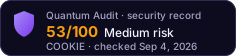
  • Ownership NOT renounced — Multisig (2-of-3)
  • Top-10 concentration > 30% (61.0% total → 45.1% effective; 34.4% in EOAs, 26.6% in contracts — moderate)
  • Liquidity not locked, but no owner/deployer address holds LP — market-depth risk, not rug risk
  • LP top1 unlocked holder = 94.9% (independent LP — depth risk, pool = 98% of DEX liquidity)
  • LP top3 unlocked holders = 100.0% (independent LP — depth risk, pool = 98% of DEX liquidity)
  • 1 High finding(s) from audit
  • 2 Medium finding(s) from audit
  • 1 Low finding(s) from audit

Each factor is an on-chain fact recorded at the time of this analysis. The score is computed from them by a deterministic function, so the same contract returns the same score for anyone who runs the audit. How scores are computed

Related Audits

CrossHigh RiskChainOpera AI (COAI)High RiskYooldo Games (ESPORTS)High RiskAKEHigh RiskVelvetHigh RiskSIXSEVEN (67)High Risk

Would You Like a More Detailed Audit of Cookie?

Our AI-powered scanner gives you a deeper, real-time smart contract analysis — free, with every scoring factor shown.

Get Detailed Audit