
The OToken contract serves as an upgradeable ERC-20 token, utilizing OpenZeppelin's battle-tested libraries for core functionalities, access control, and upgradeability. While technically sound, the contract design incorporates a centralized model for token supply management, where specific roles have exclusive minting and burning capabilities. The proxy administration is secured by a Timelock, enhancing upgrade safety.
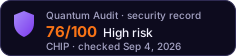

On-chain security analysis — is it a scam or legit?
Is Chip Safe?
Not verified
This record has not gone through deep verification and is not being monitored. The score is a dated snapshot — the token’s risk can change at any time.Own this token? Put it under verification →The OToken contract serves as an upgradeable ERC-20 token, utilizing OpenZeppelin's battle-tested libraries for core functionalities, access control, and upgradeability.
Read the full analysis- Ownership status UNKNOWN
- Mintable supply — no cap found, dilution unbounded
- Proxy contract
- Top-10 concentration > 70%
- Liquidity not locked, but no owner/deployer address holds LP — market-depth risk, not rug risk
- LP top1 unlocked holder = 100.0%
- LP top3 unlocked holders = 100.0%
- 1 High finding(s) from audit
- 1 Low finding(s) from audit
Exact factors
- Ownership status UNKNOWN (owner could not be resolved)
- Mintable supply — no cap found, dilution unbounded
- Proxy contract (upgradeable — admin can replace logic)
- Top-10 concentration > 70% (87.8% total → 79.2% effective; 73.5% in EOAs, 14.3% in contracts — extreme)
- Liquidity not locked, but no owner/deployer address holds LP — market-depth risk, not rug risk
- LP top1 unlocked holder = 100.0% (independent LP — depth risk)
- LP top3 unlocked holders = 100.0% (independent LP — depth risk)
- 1 High finding(s) from audit
- 1 Low finding(s) from audit
Each factor is an on-chain fact recorded at the time of this analysis. The score is computed from them by a deterministic function, so the same contract returns the same score for anyone who runs the audit. How scores are computed
Security Checklist
as of audit · Sep 4Holders
as of audit · Sep 4, 2026- Contractstreasury, vesting, bridge, staking14.3%
- Walletsanonymous holders, free to sell73.5%
- Everyone elsethe rest of the supply12.2%
How holder types affect the score
Share held by contracts — treasury, vesting, bridge or staking — is discounted against share held by wallets when the score is computed: a contract cannot decide to sell the way an anonymous holder can, though it can still be drained or voted to sell. Effective concentration is the figure the risk score is actually calculated from.
Holder balances as recorded by the audit of Sep 4, 2026
Liquidity
as of audit · Sep 4The risk score reads depth across every pair.
The LP tokens of the analysed pool are not locked or burned, so whoever holds them can withdraw that liquidity.
0xe776…cf78No privileged address appears among these holders: the unlocked liquidity sits with independent providers, not with the deployer.
Security Findings
HighCentralized Control of Critical Roles and Token Supply
The OToken contract relies heavily on AccessControlUpgradeable for managing critical operations. The DEFAULT_ADMIN_ROLE (assigned during initialization) has the power to grant and revoke any role, including the BRIDGE_ADMIN_ROLE. The BRIDGE_ADMIN_ROLE is solely responsible for mint and burn operations, directly controlling the token's total supply. A compromise of the DEFAULT_ADMIN_ROLE or BRIDGE_ADMIN_ROLE could lead to unauthorized minting, burning, or manipulation of token supply, severely impacting the token's value and integrity (7.3 Access Control, 7.4 Economic, 7.5 Governance).H-01
Issue
The OToken contract relies heavily on AccessControlUpgradeable for managing critical operations. The DEFAULT_ADMIN_ROLE (assigned during initialization) has the power to grant and revoke any role, including the BRIDGE_ADMIN_ROLE. The BRIDGE_ADMIN_ROLE is solely responsible for mint and burn operations, directly controlling the token's total supply. A compromise of the DEFAULT_ADMIN_ROLE or BRIDGE_ADMIN_ROLE could lead to unauthorized minting, burning, or manipulation of token supply, severely impacting the token's value and integrity (7.3 Access Control, 7.4 Economic, 7.5 Governance).
Fix
Implement robust multi-signature governance for the DEFAULT_ADMIN_ROLE to ensure no single entity can unilaterally control critical roles. For the BRIDGE_ADMIN_ROLE, consider a multi-signature setup or a more decentralized mechanism if feasible, and ensure its operational security is paramount.
Status
Unresolved
LowNo Dedicated Emergency Pause Mechanism
The contract lacks a dedicated Pausable mechanism to halt token transfers or mint/burn operations in an emergency (e.g., exploit, critical bug). While AccessControl can restrict mint/burn, it doesn't cover transfer or approve functions, which could be exploited in certain scenarios (7.2 Code Security, 7.8 Operations).L-01
Issue
The contract lacks a dedicated Pausable mechanism to halt token transfers or mint/burn operations in an emergency (e.g., exploit, critical bug). While AccessControl can restrict mint/burn, it doesn't cover transfer or approve functions, which could be exploited in certain scenarios (7.2 Code Security, 7.8 Operations).
Fix
Consider integrating OpenZeppelin's PausableUpgradeable for a global emergency stop functionality, controlled by a trusted multi-signature wallet. This would provide a rapid response capability to mitigate ongoing exploits or critical vulnerabilities.
Status
Unresolved
InfoUnnecessary nonReentrant Modifier
The mint and burn functions are protected by the nonReentrant modifier. However, these functions do not perform any external calls that could lead to reentrancy. While harmless, the modifier adds a small, unnecessary gas cost to these operations (7.2 Code Security).I-01
nonReentrant ModifierIssue
The mint and burn functions are protected by the nonReentrant modifier. However, these functions do not perform any external calls that could lead to reentrancy. While harmless, the modifier adds a small, unnecessary gas cost to these operations (7.2 Code Security).
Fix
Remove the nonReentrant modifier from mint and burn functions as they do not interact with external contracts. If future upgrades introduce external calls within these functions, the modifier can be re-added.
Status
Unresolved
Analysis
AI Copilotas of audit · Sep 4The OToken contract demonstrates strong technical foundations by inheriting from OpenZeppelin's ERC20Upgradeable, AccessControlUpgradeable, and ReentrancyGuardTransient (7.2 Code Security). The use of nonReentrant on mint and burn functions, although not strictly necessary given their current implementation, showcases a proactive approach to security. The contract correctly implements the initializer pattern for upgradeability and uses a recent Solidity compiler version (0.8.33).
The contract's economic model features centralized control over token supply (7.4 Economic). The BRIDGE_ADMIN_ROLE has exclusive rights to mint and burn tokens, with the DEFAULT_ADMIN_ROLE having the power to manage all roles, including the BRIDGE_ADMIN_ROLE (7.3 Access Control, 7.5 Governance). This design introduces a significant trust assumption, as a compromise of these roles could lead to arbitrary token supply manipulation. Robust multi-signature or decentralized governance for these critical roles is essential to mitigate this risk.
The OToken contract is deployed behind a TransparentUpgradeableProxy, leveraging OpenZeppelin's upgradeable patterns (7.7 Upgrades). The initialize function correctly uses the initializer modifier, and the constructor disables initializers to prevent re-initialization. Crucially, the proxy's admin is controlled by a Timelock with a 2-day delay, providing a window for review and reaction before any upgrade takes effect, significantly enhancing upgrade safety.
To enhance the security posture, it is strongly recommended to implement robust multi-signature governance for the DEFAULT_ADMIN_ROLE and BRIDGE_ADMIN_ROLE to prevent single points of failure and unauthorized control over token supply.
Additionally, consider the strategic benefit of a dedicated emergency pause mechanism for token transfers, controlled by a trusted multi-signature, to provide a rapid response capability in unforeseen circumstances.
Contract & Record
Free for any token on the record. It links to this page and always shows the current score and the date it was checked.
- Sep 4, 202676High
- Aug 17, 202677High
Score changes are recorded as dated snapshots — history is append-only and cannot be edited.
Would You Like a More Detailed Audit of Chip?
Our AI-powered scanner gives you a deeper, real-time smart contract analysis — free, with every scoring factor shown.
Get Detailed Audit Is this your token? Publish your own audit on this page