
On-chain security analysis — is it a scam or legit?
Is this your token? Publish your own audit on this page →
0x4ba0…7c00
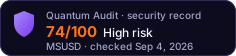
This audit covers an ERC1967Proxy contract, which is a standard UUPS proxy implementation from OpenZeppelin. While the proxy contract itself is well-vetted, the critical finding is that its associated implementation contract (0x96271bea7a9c4b8edd6c3a05e548f05f157ada46) is unverified on-chain. This prevents any meaningful security assessment of the protocol's core logic, access control, economic model, and upgrade mechanisms, introducing severe risks.
Share held by contracts — treasury, vesting, bridge or staking — is discounted against share held by wallets when the score is computed: a contract cannot decide to sell the way an anonymous holder can, though it can still be drained or voted to sell. Effective concentration is the figure the risk score is actually calculated from.
The risk score reads depth across every pair. The volume figure and the volume-to-liquidity ratio elsewhere on this page describe only the pair this audit analysed, so the two are not directly comparable.
0xe0f9…5c560xff0e…94a80x3377…882d0x7aba…01420xc7ec…d7da0xcf93…867eNo privileged address appears among these holders: the unlocked liquidity sits with independent providers, not with the deployer.
Each factor is an on-chain fact recorded at the time of this analysis. The score is computed from them by a deterministic function, so the same contract returns the same score for anyone who runs the audit. How scores are computed
Based on available data, Main Street USD exhibits high-risk characteristics, especially its highly concentrated token distribution where 99.2% is held by the top 10 wallets, and unlocked liquidity. While the contract is verified and ownership renounced, these don't mitigate the direct market manipulation or rug pull potential from concentrated holders and unprotected liquidity. It requires careful consideration.
Investing in Main Street USD carries significant risks. The extreme centralization, with 99.2% of tokens held by the top 10 addresses, makes it vulnerable to price manipulation. Additionally, liquidity is not locked, posing a risk of liquidity withdrawal (rug pull) that could leave investors unable to sell. These factors contribute to its high-risk score.
The Main Street USD contract has been verified on Ethereum, meaning its code is publicly visible and matches the deployed bytecode. However, "contract verified" is not the same as a comprehensive security audit by an independent third party. An audit typically involves deeper code analysis for vulnerabilities beyond just transparency.
Our AI-powered scanner gives you a deeper, real-time smart contract analysis — free, with every scoring factor shown.
Get Detailed Audit