Ethereum · Smart Contract Security · Updated Jun 09, 2026

Is Portal Safe? PORTAL

On-chain security analysis — is it a scam or legit?

Contract 0x1bbe…1fed DexScreener ↗
Medium Risk
Volume 24h
$42.2K
Liquidity
$9.9K
Price
$0.04034
Token Age
2y
Top 10 Holders
66.0%

Security Checklist

Contract VerifiedPass
Ownership RenouncedFail
No Mint FunctionPass
Liquidity LockedFail
Not a ProxyPass

Security Analysis

The PortalToken contract is an ERC20 token implementation with extensions for permit, pausable, and burnable functionalities, leveraging OpenZeppelin's battle-tested libraries. The contract features a fixed total supply and a custom `totalSupply()` override to reflect circulating supply based on a designated proxy address. Key administrative functions are controlled by a single owner, introducing centralization risks. The overall risk level is assessed as Medium due to these centralized controls and the non-standard interpretation of `totalSupply`.

The PortalToken contract provides a solid foundation for an ERC20 token with standard extensions. The primary areas for improvement involve mitigating the risks associated with centralized ownership and ensuring clear communication regarding the custom `totalSupply` logic. We recommend implementing a multi-signature wallet for the contract owner to enhance security and decentralize control over critical administrative functions. Additionally, thorough documentation and communication with integrators are crucial to ensure they understand the custom `totalSupply` calculation.

Audit Summary

The PortalToken contract is an ERC20 token implementation with extensions for permit, pausable, and burnable functionalities, leveraging OpenZeppelin's battle-tested libraries. The contract features a fixed total supply and a custom `totalSupply()` override to reflect circulating supply based on a designated proxy address. Key administrative functions are controlled by a single owner, introducing centralization risks. The overall risk level is assessed as Medium due to these centralized controls and the non-standard interpretation of `totalSupply`.

Final Recommendation: The PortalToken contract provides a solid foundation for an ERC20 token with standard extensions. The primary areas for improvement involve mitigating the risks associated with centralized ownership and ensuring clear communication regarding the custom `totalSupply` logic. We recommend implementing a multi-signature wallet for the contract owner to enhance security and decentralize control over critical administrative functions. Additionally, thorough documentation and communication with integrators are crucial to ensure they understand the custom `totalSupply` calculation.

Category Ratings

TechnicalMedium
6/10

The contract demonstrates good technical security by inheriting from well-audited OpenZeppelin libraries and using Solidity 0.8.20, which mitigates common integer overflow/underflow issues (7.2 Code Security). However, a notable design choice is the custom `totalSupply()` override, which subtracts t

GovernanceMedium
6/10

The token's economic model benefits from a fixed total supply, preventing inflationary attacks post-deployment (7.4 Economic). However, the `Ownable` pattern grants significant centralized control to a single owner, who can pause transfers, enable/disable permit functionality, and set the criti

UpgradesLow
6/10

The PortalToken contract is implemented as a standard, non-upgradeable token (7.7 Upgrades). This simplifies its architecture by avoiding the complexities and potential risks associated with proxy patterns. While this design choice means that any discovered critical vulnerabilities would necessitate

Security Findings

2 Medium 1 Low 1 Info
M-01MediumUnresolved

Centralized Control by Owner

The contract utilizes the OpenZeppelin `Ownable` pattern, granting a single owner exclusive control over critical administrative functions. These include `pause()`, `disablePermit()`, and `setProxyAddress()`. A compromise of the owner's private key or a malicious owner could lead to a denial of service (e.g., pausing all transfers indefinitely) or misconfiguration of the token's cross-chain functionality by setting an incorrect proxy address. This introduces a single point of failure for the token's operation (7.3 Access Control, 7.5 Governance).

Recommendation: Consider implementing a multi-signature wallet (e.g., Gnosis Safe) as the contract owner to distribute control and require multiple approvals for critical operations. This significantly reduces the risk associated with a single point of failure. Alternatively, implement a time-locked governance mechanism for sensitive actions.
M-02MediumUnresolved

Non-Standard `totalSupply` Calculation

The `totalSupply()` function is overridden to subtract the balance of a designated `proxy` address from the total minted supply. The contract comments state that tokens transferred to this proxy are 'considered as burned on a given chain' for 'X-chain functionality'. While documented, this deviates from the standard ERC20 definition of `totalSupply`, which typically represents the total number of tokens in existence. External integrations expecting standard ERC20 behavior might misinterpret the token's true supply, and the accuracy of 'circulating supply' relies entirely on the correct configuration and integrity of the `proxy` address (7.1 Architecture, 7.4 Economic).

Recommendation: Clearly document this custom `totalSupply` behavior in all external-facing documentation, including API specifications and integration guides. Consider renaming the function to `circulatingSupply()` and keeping `totalSupply()` as the standard OpenZeppelin implementation, or provide a separate `getCirculatingSupply()` function to avoid ambiguity for integrators. Ensure the `proxy` address is set securely and correctly reflects its intended role.
L-01LowUnresolved

Dependency on External Deployment Scripts for Initial Minting

The constructor takes an array of `InitialDeposits` for vesting. The comment states, 'potential address duplication is mitigated by the deployment scripts'. While the contract logic itself would simply mint to an address multiple times if duplicated, this implies a reliance on external scripts to ensure the uniqueness or correctness of initial distributions. An error in the deployment script could lead to unintended or incorrect initial token allocations (7.6 External, 7.8 Operations).

Recommendation: Ensure robust testing and verification of deployment scripts. Implement pre-deployment checks to validate the `vestingDeposits` array for uniqueness or expected behavior. While the contract handles duplicates by minting, explicit validation in the deployment process adds a layer of safety.
I-01InformationalUnresolved

Owner Can Renounce Ownership

The `Ownable` contract allows the owner to call `renounceOwnership()`. If executed, this action permanently removes the owner, disabling all functions protected by the `onlyOwner` modifier. This includes critical administrative controls such as `pause()`, `disablePermit()`, and `setProxyAddress()`. While a standard feature of `Ownable`, accidental or malicious renouncement would lead to a permanent denial of service for these administrative capabilities (7.3 Access Control).

Recommendation: Ensure that the owner address is managed securely and that the implications of `renounceOwnership()` are fully understood. If administrative control is intended to be permanent, consider removing the `renounceOwnership()` function or implementing a more controlled transfer of ownership to a governance contract.

Frequently Asked Questions

Is Portal a scam?

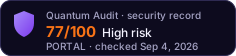
Based on the provided data, we cannot definitively label Portal a scam. However, it exhibits significant red flags often associated with high-risk projects. The high-risk score of 67/100, combined with unrenounced ownership, unlocked liquidity, and extreme token concentration, indicates a strong potential for investor losses due to developer action or market manipulation rather than a secure investment. Investors should proceed with extreme caution.

Is Portal safe to buy?

Portal is not considered safe to buy based on its current security profile and high-risk score of 67/100. Key risk factors include unrenounced contract ownership, allowing potential malicious changes, and unlocked liquidity, which enables a 'rug pull' by liquidity providers. The highly concentrated token supply, with 66.0% held by the top 10, also poses a significant risk of price manipulation. These factors indicate substantial investment risks.

Has Portal been audited?

The Portal token contract is verified, meaning its code is publicly available for anyone to review on the blockchain explorer. This transparency is beneficial. However, contract verification is not the same as a professional security audit. An independent security audit involves a thorough review by experts to identify vulnerabilities, logical flaws, and potential attack vectors beyond just code visibility. The provided data does not indicate that Portal has undergone such an audit.

Would You Like a More Detailed Audit of Portal?

Our AI-powered scanner gives you a deeper, real-time smart contract analysis — free, no signup required.

Get Detailed Audit
Run Free Audit →