
Quantum Audit Logo

Is Apu Apustaja Safe?

On-chain security analysis — is it a scam or legit?

Is this your token? Publish your own audit on this page →

Apu Apustaja APU
0x594d…5bfa
Ethereum Not verifiedLast checked 2d ago 1 audit on record
Executive SummaryAI Copilot

The ApusClubToken contract is a standard ERC20 token implementation, leveraging battle-tested OpenZeppelin libraries. The audit identified no critical or high-severity technical vulnerabilities. The primary considerations revolve around the centralized initial token distribution and ownership model, which are common for new token launches.

1 Low3 Informational
Volume 24h
$450.7K
Liquidity
$944.8K
Price
$0.00001921
Token Age
2y
Top 10 Holders
42.4%

Security Findings

Low

Centralized Initial Token Distribution and Ownership

L-01The entire token supply is minted to the deployer (`msg.sender`) in the constructor, establishing a highly centralized initial distribution (7.4 Economic). Additionally, the `Ownable` pattern grants the deployer exclusive control over the contract's ownership via `transferOwnership` (7.3 Access Control, 7.5 Governance), which could be a single point of failure if the owner's key is compromised. While `renounceOwnership` is available, it is not enforced, leaving the decision to the owner.
IssueThe entire token supply is minted to the deployer (`msg.sender`) in the constructor, establishing a highly centralized initial distribution (7.4 Economic). Additionally, the `Ownable` pattern grants the deployer exclusive control over the contract's ownership via `transferOwnership` (7.3 Access Control, 7.5 Governance), which could be a single point of failure if the owner's key is compromised. While `renounceOwnership` is available, it is not enforced, leaving the decision to the owner.
FixConsider renouncing ownership after all necessary administrative tasks are completed to enhance decentralization. If ownership is retained, implement robust security practices for the owner's private key (e.g., multi-signature wallet, hardware security module). Clearly communicate the initial distribution and ownership model to the community.
StatusUnresolved
Info

Reliance on Battle-Tested OpenZeppelin Contracts

I-01The contract leverages well-audited and widely adopted OpenZeppelin ERC20 and Ownable implementations. This significantly reduces the risk of common vulnerabilities associated with custom or less-tested code (7.2 Code Security). The use of standard libraries contributes to the overall robustness and security posture of the contract.
IssueThe contract leverages well-audited and widely adopted OpenZeppelin ERC20 and Ownable implementations. This significantly reduces the risk of common vulnerabilities associated with custom or less-tested code (7.2 Code Security). The use of standard libraries contributes to the overall robustness and security posture of the contract.
FixNo action required. Continue to monitor OpenZeppelin security advisories for any updates to the base contracts.
StatusUnresolved
Info

Fixed Token Supply

I-02The total supply of `ApusClubToken` is fixed at `420,690,000,000 * 10**18` upon deployment and cannot be altered thereafter. There are no minting or burning functions available to the owner or any other entity post-initialization (7.4 Economic). This design provides predictability regarding token inflation/deflation, as the supply is immutable.
IssueThe total supply of `ApusClubToken` is fixed at `420,690,000,000 * 10**18` upon deployment and cannot be altered thereafter. There are no minting or burning functions available to the owner or any other entity post-initialization (7.4 Economic). This design provides predictability regarding token inflation/deflation, as the supply is immutable.
FixNo action required. This is a design choice. Ensure this fixed supply model aligns with the project's long-term economic strategy and is clearly communicated to token holders.
StatusUnresolved
Info

Lack of Emergency Controls

I-03The contract does not include any emergency control mechanisms such as pausing transfers or blacklisting malicious addresses. While this enhances decentralization by preventing arbitrary intervention, it also means there is no way to stop transfers in the event of a major exploit, unforeseen market manipulation, or other critical circumstances (7.8 Operations).
IssueThe contract does not include any emergency control mechanisms such as pausing transfers or blacklisting malicious addresses. While this enhances decentralization by preventing arbitrary intervention, it also means there is no way to stop transfers in the event of a major exploit, unforeseen market manipulation, or other critical circumstances (7.8 Operations).
FixNo action required. This is a design choice that prioritizes immutability and censorship resistance over centralized emergency response capabilities. Project stakeholders should be aware of this trade-off.
StatusUnresolved

Category Ratings

TechnicalLow10/10

The ApusClubToken contract is built upon battle-tested OpenZeppelin ERC20 and Ownable implementations, significantly reducing the risk of common vulnerabilities (7.2 Code Security). The contract's custom logic is minimal, primarily involving the constructor's initial token mint. Solidity 0.8.20+ inherently prevents integer overflows/underflows, and `unchecked` blocks are used appropriately for gas optimization (e.g., in `_update` for balance adjustments). No reentrancy vectors were identified due to the absence of complex external interactions (7.1 Architecture). Access control is managed by the `Ownable` pattern, restricting administrative functions to the contract owner (7.3 Access Control).

GovernanceLow9/10

The `Ownable` contract provides clear access control for administrative functions like `transferOwnership` and `renounceOwnership`, allowing the owner to manage contract control (7.5 Governance). The `renounceOwnership` function offers a path towards decentralization of administrative control post-deployment. However, the entire token supply is minted to the deployer in the constructor, leading to a highly centralized initial distribution (7.4 Economic). This centralization means the owner holds significant influence over the token's market dynamics and could be a single point of failure if the owner's key is compromised.

UpgradesLow10/10

The ApusClubToken contract is not designed to be upgradeable, which eliminates the complexities and potential risks associated with upgrade mechanisms (7.7 Upgrades). This provides immutability and predictability for users, as the contract's logic cannot be altered post-deployment. As a non-upgradeable contract, any discovered vulnerabilities or desired feature changes would necessitate a redeployment and migration, which can be costly and disruptive for the community.

Security Checklist

Contract VerifiedPass
Ownership RenouncedPass
No Mint FunctionPass
Liquidity LockedPass
Not a ProxyPass
HoneypotNoneBuy Tax0.0%Sell Tax0.0%

Holder Composition

36.5% in wallets5.8% in contracts
Effective Concentration38.9%

Share held by contracts — treasury, vesting, bridge or staking — is discounted against share held by wallets when the score is computed: a contract cannot decide to sell the way an anonymous holder can, though it can still be drained or voted to sell. Effective concentration is the figure the risk score is actually calculated from.

Liquidity Depth

The risk score reads depth across every pair. The volume figure and the volume-to-liquidity ratio elsewhere on this page describe only the pair this audit analysed, so the two are not directly comparable.

LP Distribution

LP Burned98.7% · ≈ permanent lock
LP Locked98.7% · Null Address

Key Addresses

Deployer
0x918a…d84d
Unlocked LP Held By
0xb432…c1a00xc10a…59210xa49d…ef860xb3ac…68a00x826f…1e650xf385…5f850x918a…d84d0x0000…8a900x1f2f…f387

A privileged address — the deployer, the owner, or the token contract itself — is among these holders, so that party can withdraw liquidity.

What Raised This Score

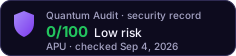
  • Top-10 concentration > 30% (42.4% total → 38.9% effective; 36.5% in EOAs, 5.8% in contracts — moderate)
  • 1 Low finding(s) from audit

Each factor is an on-chain fact recorded at the time of this analysis. The score is computed from them by a deterministic function, so the same contract returns the same score for anyone who runs the audit. How scores are computed

Related Audits

AsteroidLow RiskAmerica Pac (PAC)Low RiskJerry The Turtle By Matt Furie (JYAI)Low RiskNon-Playable Coin (NPC)Low RiskYee Token (YEE)Low RiskPikachuLow Risk

Would You Like a More Detailed Audit of Apu Apustaja?

Our AI-powered scanner gives you a deeper, real-time smart contract analysis — free, with every scoring factor shown.

Get Detailed Audit