
The Altura (ALU) token contract is a standard BEP20 implementation utilizing the Ownable pattern and SafeMath library. While the code initially allowed for centralized token minting by the owner, the provided operational data indicates that ownership has been renounced. This renunciation significantly mitigates the primary economic and governance risks associated with potential supply manipulation, resulting in an overall low-risk profile.

On-chain security analysis — is it a scam or legit?
Is Altura Safe?
Not verified
This record has not gone through deep verification and is not being monitored. The score is a dated snapshot — the token’s risk can change at any time.Own this token? Put it under verification →The Altura (ALU) token contract is a standard BEP20 implementation utilizing the Ownable pattern and SafeMath library.
Read the full analysis- Mintable supply — no cap found, dilution unbounded
- Top-10 concentration > 30%
- Liquidity not locked, but no owner/deployer address holds LP — market-depth risk, not rug risk
- LP top1 unlocked holder = 58.2%
- LP top3 unlocked holders = 100.0%
Exact factors
- Mintable supply — no cap found, dilution unbounded
- Top-10 concentration > 30% (54.9% total → 34.6% effective; 21.1% in EOAs, 33.8% in contracts — moderate)
- Liquidity not locked, but no owner/deployer address holds LP — market-depth risk, not rug risk
- LP top1 unlocked holder = 58.2% (independent LP — depth risk, pool = 94% of DEX liquidity)
- LP top3 unlocked holders = 100.0% (independent LP — depth risk, pool = 94% of DEX liquidity)
Security Checklist
as of audit · Sep 20Holders
as of audit · Sep 20, 2026- Contractstreasury, vesting, bridge, staking33.8%
- Walletsanonymous holders, free to sell21.1%
- Everyone elsethe rest of the supply45.1%
How holder types affect the score
Share held by contracts — treasury, vesting, bridge or staking — is discounted against share held by wallets when the score is computed: a contract cannot decide to sell the way an anonymous holder can, though it can still be drained or voted to sell. Effective concentration is the figure the risk score is actually calculated from.
Holder balances as recorded by the audit of Sep 20, 2026
Liquidity
as of audit · Sep 20- Pancakeswap v2WBNBAnalysed$314.0K93.8%
- BiswapWBNB$12.3K3.7%
- BabyswapUSDT$8.2K2.5%
- Pancakeswap v3WBNB$2900.1%
- Pancakeswap v2Cake$410.0%
- Pancakeswap v2BUSD$170.0%
Show 2 more pairs
The LP tokens of the analysed pool are not locked or burned, so whoever holds them can withdraw that liquidity.
0x6510…27350x3889…4f240xd08c…86ae0xc5da…73b80xbef8…ec3e0x8903…d3be0x02a3…6a570x27a9…47960x98ff…67730x3273…68d3No privileged address appears among these holders: the unlocked liquidity sits with independent providers, not with the deployer.
Security Findings
LowUse of Older Solidity Compiler Version (0.5.16)
Not confirmed by static analysis (the model's own reading of the source).L-01
Issue
Not confirmed by static analysis (the model's own reading of the source). The contract is compiled with Solidity version 0.5.16. While the SafeMath library is used to prevent integer overflows and underflows, newer compiler versions (e.g., 0.8.x) include built-in overflow checks by default, reducing reliance on external libraries for this specific safety measure. Newer compilers also offer various security improvements, bug fixes, and gas optimizations (7.2 Code Security).
Fix
For future deployments or upgrades, consider using the latest stable Solidity compiler version (e.g., 0.8.x). This provides enhanced security features, better gas efficiency, and improved developer tooling. Thorough testing should always accompany compiler version upgrades.
Status
Unresolved
InfoPotential for Centralized Supply Control (Mitigated by Renounced Ownership)
Not confirmed by static analysis (the model's own reading of the source).I-01
Issue
Not confirmed by static analysis (the model's own reading of the source). The Altura contract includes an onlyOwner mint function, allowing the contract owner to increase the total supply of tokens arbitrarily. This capability, if active, could lead to significant inflation and dilution of existing token holders, posing a substantial economic and governance risk (7.4, 7.5). However, the provided operational data indicates that ownership of the contract has been renounced. This action effectively disables the mint function, as there is no longer an owner to call it.
Fix
No action is required if ownership has indeed been permanently renounced. It is crucial to ensure that the renunciation is irreversible and transparently communicated to the community to build trust in the token's fixed supply post-renunciation.
Status
Resolved
InfoRedundant getOwner() Function
Not confirmed by static analysis (the model's own reading of the source).I-02
getOwner() FunctionIssue
Not confirmed by static analysis (the model's own reading of the source). The IBEP20 interface defines a getOwner() function. The Altura contract implements this by simply returning the result of the inherited owner() function from the Ownable contract. Since owner() is already a public function providing the same information, getOwner() is redundant and adds unnecessary code (7.1 Architecture).
Fix
Consider removing the getOwner() function from the IBEP20 interface and the Altura contract if it is not strictly required by external integrations that specifically call getOwner(). Relying solely on the owner() function is more concise.
Status
Unresolved
InfoInternal Burn Functions Not Publicly Exposed
Not confirmed by static analysis (the model's own reading of the source).I-03
Issue
Not confirmed by static analysis (the model's own reading of the source). The Altura contract includes internal _burn and _burnFrom functions, which are standard helpers for token burning. However, there are no public or onlyOwner functions that expose this burning functionality to external callers or the contract owner. This means that, by design, tokens cannot be burned after deployment (7.1 Architecture, 7.8 Operations). This might be an intentional design choice, but it's worth noting for clarity regarding tokenomics.
Fix
If token burning is intended to be a feature, consider adding a public or onlyOwner function that calls _burn or _burnFrom. If burning is not intended, no action is needed, but this design choice should be clearly documented.
Status
Unresolved
Analysis
AI Copilotas of audit · Sep 20The contract demonstrates good code security (7.2) by utilizing the SafeMath library to prevent integer overflows/underflows in all arithmetic operations. Its architecture (7.1) is a standard BEP20 token implementation, adhering to common patterns. A minor technical concern is the use of Solidity 0.5.16, an older compiler version, although SafeMath mitigates many associated risks. The contract's external interactions (7.6) are limited to standard token operations.
The contract initially included an onlyOwner mint function, posing a potential economic risk (7.4) of centralized supply control and governance (7.5) over token inflation. However, the operational data indicates that ownership has been renounced, effectively disabling this minting capability and mitigating this significant economic and governance risk. Access control (7.3) is managed via the Ownable pattern, and operational controls (7.8) are now decentralized due to ownership renunciation.
The contract is a standard, non-proxy implementation, meaning it is not upgradeable (7.7). This design choice eliminates any risks associated with upgrade mechanisms, such as proxy implementation bugs, upgrade path vulnerabilities, or malicious upgrade capabilities.
The Altura token contract is robust for a standard BEP20 implementation, especially with the renunciation of ownership.
The primary recommendation is to ensure that the renounced ownership status is immutable and clearly communicated to the community, reinforcing the token's decentralized supply. For future contracts, consider using the latest stable Solidity compiler versions to benefit from built-in safety features and optimizations.
Contract & Record
Free for any token on the record. It links to this page and always shows the current score and the date it was checked.
- Sep 20, 202635Medium
Score changes are recorded as dated snapshots — history is append-only and cannot be edited.
Frequently Asked Questions
What is the ALU contract address?
The Altura (ALU) contract on BNB Chain is 0x8263cd1601fe73c066bf49cc09841f35348e3be0. Compare it with the address the project itself publishes before trading: other contracts can carry the same name and ticker.
Is Altura a scam?
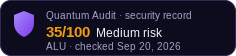
Quantum Audit's risk score for Altura is 35/100 (Medium risk) as of Sep 20, 2026, computed by a deterministic function from on-chain facts — Contract verified: Verified; Ownership: Renounced; Mint: Mintable; Liquidity lock: Not locked; Upgradeability: Fixed code; Honeypot: None found; Buy / sell tax: 0% / 0%. A score is a dated snapshot of those facts, not a guarantee; each one is listed on this page.
Is ALU liquidity locked?
Liquidity lock: Not locked (as of Sep 20, 2026). Total DEX liquidity: $334.9K.
Who holds ALU?
As of Sep 20, 2026, the 10 largest holders own 54.9% of the supply. The Holders section on this page shows who they are by holder type.
Would You Like a More Detailed Audit of Altura?
Our AI-powered scanner gives you a deeper, real-time smart contract analysis — free, with every scoring factor shown.
Get Detailed Audit Is this your token? Add your links and get it Verified