
The MAMEINU token contract implements an ERC-20 standard with reflection mechanics, dynamic transaction fees, and an automated swap-and-distribute mechanism for collected fees. While the contract utilizes modern Solidity features and includes reentrancy protection, a critical vulnerability was identified regarding the lack of slippage protection in its token swap function. Additionally, the contract exhibits high centralization of control under the owner, and its dynamic fee structure includes extremely high initial taxes, posing significant economic and governance risks.

Honeypot, rug-pull and ownership checks
Is Mame Inu a Scam?
Not verified
This record has not gone through deep verification and is not being monitored. The score is a dated snapshot — the token’s risk can change at any time.Own this token? Put it under verification →The MAMEINU token contract implements an ERC-20 standard with reflection mechanics, dynamic transaction fees, and an automated swap-and-distribute mechanism for collected fees.
Read the full analysis- Top-10 concentration > 50%
- 1 Critical finding(s) from audit
- 2 High finding(s) from audit
- 1 Medium finding(s) from audit
- 1 Low finding(s) from audit
Exact factors
- Top-10 concentration > 50% (59.5% total → 50.6% effective; 44.7% in EOAs, 14.8% in contracts — heavy)
- 1 Critical finding(s) from audit
- 2 High finding(s) from audit
- 1 Medium finding(s) from audit
- 1 Low finding(s) from audit
Each factor is an on-chain fact recorded at the time of this analysis. The score is computed from them by a deterministic function, so the same contract returns the same score for anyone who runs the audit. How scores are computed
Security Checklist
as of audit · Sep 4Holders
as of audit · Sep 4, 2026- Contractstreasury, vesting, bridge, staking14.8%
- Walletsanonymous holders, free to sell44.7%
- Everyone elsethe rest of the supply40.5%
How holder types affect the score
Share held by contracts — treasury, vesting, bridge or staking — is discounted against share held by wallets when the score is computed: a contract cannot decide to sell the way an anonymous holder can, though it can still be drained or voted to sell. Effective concentration is the figure the risk score is actually calculated from.
Holder balances as recorded by the audit of Sep 4, 2026
Liquidity
as of audit · Sep 4The risk score reads depth across every pair.
The LP tokens of the analysed pool are locked or burned.
Security Findings
CriticalLack of Slippage Protection in Token Swaps
The _swapTokensForEth function, responsible for converting collected fees into BNB, calls router.swapExactTokensForETHSupportingFeeOnTransferTokens without specifying an amountOutMin parameter. This omission means the swap can execute with arbitrary slippage, potentially resulting in a significant loss of value for the marketing and team wallets, especially during periods of high volatility or low liquidity. An attacker could front-run these transactions to cause extreme slippage and drain value.C-01
Issue
The _swapTokensForEth function, responsible for converting collected fees into BNB, calls router.swapExactTokensForETHSupportingFeeOnTransferTokens without specifying an amountOutMin parameter. This omission means the swap can execute with arbitrary slippage, potentially resulting in a significant loss of value for the marketing and team wallets, especially during periods of high volatility or low liquidity. An attacker could front-run these transactions to cause extreme slippage and drain value.
Fix
Implement a minimum output amount (amountOutMin) for swapExactTokensForETHSupportingFeeOnTransferTokens to protect against excessive slippage and front-running attacks. This value should be carefully calculated based on current market conditions or a reasonable tolerance, potentially configurable by the owner.
Status
Unresolved
HighHigh Centralization of Owner Privileges
The contract grants extensive control to the owner address, including the ability to set marketing and team wallets, change swap thresholds, enable/disable swaps, exclude/include addresses from fees and rewards, open trading, and rescue any foreign ERC20 tokens or stuck BNB. This high degree of centralization introduces a single point of failure and relies heavily on the owner's integrity and security. A compromised owner key could lead to significant fund loss or manipulation of the token's economic parameters (7.3 Access Control, 7.5 Governance).H-01
Issue
The contract grants extensive control to the owner address, including the ability to set marketing and team wallets, change swap thresholds, enable/disable swaps, exclude/include addresses from fees and rewards, open trading, and rescue any foreign ERC20 tokens or stuck BNB. This high degree of centralization introduces a single point of failure and relies heavily on the owner's integrity and security. A compromised owner key could lead to significant fund loss or manipulation of the token's economic parameters (7.3 Access Control, 7.5 Governance).
Fix
Consider implementing a multi-signature wallet for critical owner functions or introducing a time-lock mechanism for sensitive parameter changes to reduce the risk associated with a single point of control and enhance governance transparency.
Status
Unresolved
HighDynamic and High Initial Transaction Taxes
The token implements a dynamic fee structure where transaction taxes are extremely high during the initial phase (PHASE1_START_BPS is 90% for the first 300 seconds). While this might be intended as an anti-bot measure, such high taxes can severely deter legitimate trading, create significant price impact, and lead to user confusion or unexpected losses for early buyers who are unaware of the rapidly decreasing tax (7.4 Economic).H-02
Issue
The token implements a dynamic fee structure where transaction taxes are extremely high during the initial phase (PHASE1_START_BPS is 90% for the first 300 seconds). While this might be intended as an anti-bot measure, such high taxes can severely deter legitimate trading, create significant price impact, and lead to user confusion or unexpected losses for early buyers who are unaware of the rapidly decreasing tax (7.4 Economic).
Fix
Clearly communicate the dynamic fee structure and its implications to users through official documentation and interfaces. Evaluate if such an extreme initial tax is truly necessary, as it can negatively impact legitimate trading and user perception. Ensure the fee calculation logic is robust and thoroughly tested.
Status
Unresolved
MediumPotential for Manipulation of Excluded Addresses
The owner can exclude any address from fees (_isExcludedFromFee) and rewards (_isExcludedFromReward). While there's a MAX_EXCLUDED limit of 30 for the reward exclusion list, the fee exclusion list has no such explicit limit on its size. This power, if misused, could allow the owner to grant preferential treatment to certain addresses or manipulate the fee collection mechanism, potentially impacting the token's economics or creating an unfair advantage (7.3 Access Control, 7.4 Economic).M-01
Issue
The owner can exclude any address from fees (_isExcludedFromFee) and rewards (_isExcludedFromReward). While there's a MAX_EXCLUDED limit of 30 for the reward exclusion list, the fee exclusion list has no such explicit limit on its size. This power, if misused, could allow the owner to grant preferential treatment to certain addresses or manipulate the fee collection mechanism, potentially impacting the token's economics or creating an unfair advantage (7.3 Access Control, 7.4 Economic).
Fix
Review the necessity of excluding addresses from fees without a clear limit. If exclusions are critical, consider implementing a more transparent and auditable process for managing these lists, or further restricting the owner's ability to arbitrarily add/remove addresses.
Status
Unresolved
LowUnused _tFeeTotal Variable
The _tFeeTotal variable is incremented in the _reflectFee function, but its value is only exposed via the totalFees() view function and does not appear to be used in any core logic that affects token supply, reflection calculations, or fee distribution. This variable consumes storage without a clear functional purpose within the token's mechanics (7.2 Code Security).L-01
_tFeeTotal VariableIssue
The _tFeeTotal variable is incremented in the _reflectFee function, but its value is only exposed via the totalFees() view function and does not appear to be used in any core logic that affects token supply, reflection calculations, or fee distribution. This variable consumes storage without a clear functional purpose within the token's mechanics (7.2 Code Security).
Fix
Either remove the _tFeeTotal variable if it serves no functional purpose, or clarify its intended use and integrate it into the contract's logic if it is meant to play a role in the tokenomics.
Status
Unresolved
InfoHardcoded Router and Factory Addresses
The contract hardcodes the addresses for the PancakeSwap V2 Router (ROUTER) and Factory (FACTORY). While these are standard addresses on BSC, hardcoding them means the contract cannot adapt to potential future changes in the DEX infrastructure (e.g., if PancakeSwap upgrades its router to a new address or if the project decides to migrate to a different DEX) (7.6 External).I-01
Issue
The contract hardcodes the addresses for the PancakeSwap V2 Router (ROUTER) and Factory (FACTORY). While these are standard addresses on BSC, hardcoding them means the contract cannot adapt to potential future changes in the DEX infrastructure (e.g., if PancakeSwap upgrades its router to a new address or if the project decides to migrate to a different DEX) (7.6 External).
Fix
For future flexibility, consider making the router and factory addresses configurable by the owner (e.g., via an onlyOwner function) during deployment or post-deployment, while ensuring proper validation of new addresses.
Status
Unresolved
Analysis
AI Copilotas of audit · Sep 4The contract demonstrates good practices such as using Solidity 0.8.25 for checked arithmetic and implementing a reentrancy guard (_inSwap) for critical swap operations. The ERC-20 standard implementation, including reflection mechanics, appears generally sound. However, a critical vulnerability exists in the _swapTokensForEth function, which lacks slippage protection (amountOutMin) when interacting with the DEX router, exposing collected fees to potential significant value loss. Additionally, the _tFeeTotal variable is unused, indicating minor code inefficiency.
The MAMEINU token incorporates a dynamic fee structure with extremely high initial transaction taxes (up to 90%), designed to deter bots but potentially impacting legitimate users. The contract's economic model relies heavily on the owner address, which possesses extensive control over critical parameters such as fee exclusions, swap thresholds, and wallet addresses. This high degree of centralization introduces significant governance risk, as a compromised owner key could lead to severe economic manipulation or fund loss.
The MAMEINU contract is not designed with an upgrade mechanism, meaning its logic is immutable once deployed. This eliminates upgrade-related risks such as proxy implementation vulnerabilities or administrative key compromises affecting future contract behavior. However, it also means that any discovered vulnerabilities or desired feature enhancements cannot be patched or implemented without a complete redeployment and migration.
It is critical to address the lack of slippage protection in the token swap function to prevent significant value loss during fee processing.
Implementing a minimum output amount for swaps is essential. Furthermore, consider decentralizing control over critical contract parameters by adopting multi-signature wallets or time-lock mechanisms for sensitive operations to mitigate the risks associated with a single point of failure. Clearly communicate the dynamic fee structure to users to manage expectations and avoid confusion.
Contract & Record
Free for any token on the record. It links to this page and always shows the current score and the date it was checked.
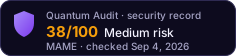
- Sep 4, 202638Medium
- Jul 27, 202630Low
- Jul 26, 202667High
Score changes are recorded as dated snapshots — history is append-only and cannot be edited.
Frequently Asked Questions
Is Mame Inu a scam?
Based on automated analysis, Mame Inu scores 67/100 (High Risk) on our risk scale. No honeypot was detected, but always verify independently before investing.
Is Mame Inu safe to buy?
Our scanner flagged a risk score of 67/100. Ownership has not been renounced, which is a risk factor. DYOR before purchasing any token.
Has Mame Inu been audited?
The contract has not been verified on-chain. Verification is not the same as a full security audit. Use Quantum Audit's free tool to run a deeper analysis of the contract code.
Would You Like a More Detailed Audit of Mame Inu?
Paste the contract address into our AI-powered scanner for a deeper real-time report — free, with every scoring factor shown.
Get Detailed Audit Is this your token? Publish your own audit on this page