
The 'would' (WOULD) token mint exhibits a low-risk profile based on the available on-chain data. Both the mint authority and freeze authority have been revoked, indicating a fixed supply and immutable account states. Holder concentration is low, and liquidity is substantial, suggesting a healthy market. Third-party risk registry data reported no adverse flags, though detailed holder distribution data was unavailable.
On-chain security analysis — is it a scam or legit?
Is would Safe?
Not verified
This record has not gone through deep verification and is not being monitored. The score is a dated snapshot — the token’s risk can change at any time.Own this token? Put it under verification →The 'would' (WOULD) token mint exhibits a low-risk profile based on the available on-chain data.
Read the full analysis- LP lock status UNKNOWN — the pool's LP could not be read
Exact factors
- LP lock status UNKNOWN — the pool's LP could not be read
Each factor is an on-chain fact recorded at the time of this analysis. The score is computed from them by a deterministic function, so the same contract returns the same score for anyone who runs the audit. How scores are computed
Security Checklist
as of audit · Sep 22Holders
as of audit · Sep 22, 2026- Top 10 holdersthe ten largest balances13.1%
- Everyone elsethe rest of the supply86.9%
Holder balances as recorded by the audit of Sep 22, 2026
Liquidity
as of audit · Sep 22The risk score reads depth across every pair.
Whether the LP tokens are locked could not be determined.
Security Findings
InfoNo code-level findings — an SPL mint exposes no auditable program source
This token is an SPL token mint, not a deployed program: there is no contract source code on-chain for a line-by-line review, so no code-level vulnerability could be identified either way. The assessment on this page therefore rests on mint/owner authority, mint capability, holder concentration, which are read directly from chain state and from third-party risk registries.I-01
Issue
This token is an SPL token mint, not a deployed program: there is no contract source code on-chain for a line-by-line review, so no code-level vulnerability could be identified either way. The assessment on this page therefore rests on mint/owner authority, mint capability, holder concentration, which are read directly from chain state and from third-party risk registries.
Fix
Read the risk score breakdown below as the substance of this audit. For a code-level review, the token would need an accompanying verified program.
Status
Acknowledged
Analysis
AI Copilotas of audit · Sep 22The 'would' token is implemented using the standard spl-token program (v3). Key administrative authorities, including the mint authority and freeze authority, are both revoked (None), ensuring no new tokens can be minted and no accounts can be frozen post-launch. The token does not utilize any Token-2022 extensions that would introduce mutable states or special permissions, such as balance mutability or default frozen accounts, as indicated by all relevant flags being 'False'. This configuration aligns with a secure, immutable token design (7.1 Architecture, 7.3 Access Control).
The economic profile of the WOULD token appears stable. Holder concentration is low, with the top 10 token accounts holding only 12.21% of the total supply, mitigating risks associated with whale manipulation (7.4 Economic). Total DEX liquidity is robust at $1,013,021, supporting efficient trading. The 24-hour volume of $151,713 results in a healthy Volume/Liquidity Ratio of 0.15, which does not suggest wash trading. The DEX pair has been active for 772 days, indicating a well-established market presence (7.6 External).
The token's upgradeability and mutability aspects are minimal, contributing to a low-risk profile. Both the mint authority and freeze authority are revoked, preventing any future changes to the token's supply or account freeze status. Furthermore, the metadata_mutable flag is 'False', meaning the token's name, symbol, or image cannot be altered post-launch. There are no active Token-2022 extensions that would allow for future upgradability of features like transfer fees or transfer hooks (7.7 Upgrades).
Given the revoked mint and freeze authorities, the token's supply is fixed and accounts cannot be frozen.
Holders should verify on-chain that these authorities remain null to confirm the immutability of the token's core properties. Monitor the token's liquidity and trading volume for any significant changes that could impact market stability. While current holder concentration is low, continuous monitoring of distribution is advisable for any asset.
Contract & Record
Free for any token on the record. It links to this page and always shows the current score and the date it was checked.
- Sep 22, 20260Low
- Sep 4, 202613Low
Score changes are recorded as dated snapshots — history is append-only and cannot be edited.
Frequently Asked Questions
What is the WOULD contract address?
The would contract on Solana is J1Wpmugrooj1yMyQKrdZ2vwRXG5rhfx3vTnYE39gpump. Compare it with the address the project itself publishes before trading: other contracts can carry the same name and ticker.
Is would a scam?
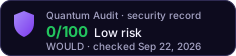
Quantum Audit's risk score for would is 0/100 (Low risk) as of Sep 22, 2026, computed by a deterministic function from on-chain facts — Contract verified: Verified; Mint: No mint; Upgradeability: Fixed code; Honeypot: None found; Buy / sell tax: 0% / 0%. A score is a dated snapshot of those facts, not a guarantee; each one is listed on this page.
Who holds WOULD?
As of Sep 22, 2026, the 10 largest holders own 13.1% of the supply. The Holders section on this page shows who they are by holder type.
Would You Like a More Detailed Audit of would?
Our AI-powered scanner gives you a deeper, real-time smart contract analysis — free, with every scoring factor shown.
Get Detailed Audit Is this your token? Publish your own audit on this page