

The OETHBase contract implements a rebasing token mechanism with complex yield delegation features. The architecture relies heavily on privileged roles (Governor, Vault) to manage supply and balance adjustments. While the core logic for transfers is standard, the administrative functions grant significant control over user balances and supply parameters, necessitating high trust in the governance process.
On-chain security analysis — is it a scam or legit?
Is Super OETH Safe?
Not verified
This record has not gone through deep verification and is not being monitored. The score is a dated snapshot — the token’s risk can change at any time.Own this token? Put it under verification →The OETHBase contract implements a rebasing token mechanism with complex yield delegation features.
Read the full analysis- Issuer controls retained
Exact factors
- Issuer controls retained (admin key, mint, upgrade, seize balances) — counterparty risk on a known issuer, not a rug vector
Each factor is an on-chain fact recorded at the time of this analysis. The score is computed from them by a deterministic function, so the same contract returns the same score for anyone who runs the audit. How scores are computed
Security Checklist
as of audit · Nov 15Holders
as of audit · Nov 15, 2026- Contractstreasury, vesting, bridge, staking43.1%
- Walletsanonymous holders, free to sell47.0%
- Everyone else19,596 holders10.0%
How holder types affect the score
Share held by contracts — treasury, vesting, bridge or staking — is discounted against share held by wallets when the score is computed: a contract cannot decide to sell the way an anonymous holder can, though it can still be drained or voted to sell. Effective concentration is the figure the risk score is actually calculated from.
Holder balances as recorded by the audit of Nov 15, 2026
Liquidity
as of audit · Nov 15The risk score reads depth across every pair.
The LP tokens of the analysed pool are not locked or burned, so whoever holds them can withdraw that liquidity.
0xe4d4…c413No privileged address appears among these holders: the unlocked liquidity sits with independent providers, not with the deployer.
Security Findings
InfoPrivileged Minting Capability
The changeSupply function allows the Vault to increase the total supply of tokens, which can dilute the value of existing holdings.CP-01
Issue
The changeSupply function allows the Vault to increase the total supply of tokens, which can dilute the value of existing holdings.
Fix
Restrict the use of this function to strictly defined protocol expansion events and ensure it is governed by a multi-sig or DAO.
Status
Unresolved
InfoAdministrative Balance Manipulation
Functions like governanceRebaseOptIn, delegateYield, and undelegateYield allow privileged roles to directly modify user balances, effectively enabling the burning or movement of tokens from any address.CP-02
Issue
Functions like governanceRebaseOptIn, delegateYield, and undelegateYield allow privileged roles to directly modify user balances, effectively enabling the burning or movement of tokens from any address.
Fix
Implement strict off-chain verification or a time-lock for these functions to prevent abuse of the ability to move user funds.
Status
Unresolved
InfoTransfer Fee Modification
The initialize and changeSupply functions allow privileged roles to modify the transfer fee structure, which directly impacts the cost of moving tokens.CP-07
Issue
The initialize and changeSupply functions allow privileged roles to modify the transfer fee structure, which directly impacts the cost of moving tokens.
Fix
Document the fee structure clearly and limit the maximum fee that can be set by the Governor to protect users.
Status
Unresolved
InfoGlobal Balance Rebasing
Privileged roles can trigger a rebase that scales every holder's balance, which is a core feature but carries the risk of unexpected balance changes if triggered incorrectly.CP-09
Issue
Privileged roles can trigger a rebase that scales every holder's balance, which is a core feature but carries the risk of unexpected balance changes if triggered incorrectly.
Fix
Ensure that rebase triggers are automated and based on verifiable on-chain yield data to maintain user trust.
Status
Unresolved
InfoWho holds the supply
The ten largest holders own 90.0% of supply. What remains: 47.0% in wallets, 43.1% in other contracts. 19,606 holders in total. For a verified reference asset the largest holders are custodians, exchanges and bridges; concentration is reported, not scored.QA-HOLDERS
Issue
The ten largest holders own 90.0% of supply. What remains: 47.0% in wallets, 43.1% in other contracts. 19,606 holders in total. For a verified reference asset the largest holders are custodians, exchanges and bridges; concentration is reported, not scored.
Fix
Watch the largest wallets that are not exchanges, pools or locks — those are the ones that can move the price.
Status
Acknowledged
InfoIdentity verified by independent sources
Listed on CoinGecko as Super OETH (SUPEROETHB), market cap $20M. 19,606 holders. Verified by: CoinGecko.QA-IDENTITY
Issue
Listed on CoinGecko as Super OETH (SUPEROETHB), market cap $20M. 19,606 holders. Verified by: CoinGecko.
Fix
Match the contract address against the project's official channels before trading.
Status
Acknowledged
InfoThe market for this token
Liquidity $57K (DexScreener, all pools). 24h trading volume $734K (CoinGecko, all markets, daily snapshot). 24h trading volume $37K (DexScreener, all pools).QA-MARKET
Issue
Liquidity $57K (DexScreener, all pools). 24h trading volume $734K (CoinGecko, all markets, daily snapshot). 24h trading volume $37K (DexScreener, all pools).
Fix
Size any position to the liquidity and daily volume shown — they set how much you can sell and at what price.
Status
Acknowledged
InfoAsset class: Liquid staking token
A receipt for staked native tokens that keeps earning staking rewards. Its value depends on the staking protocol and its validators. Scored as an established reference asset: its identity is verified, so the issuer's or protocol's controls (listed as findings) are real and are priced once as counterparty risk, and LP locks and holder concentration are not scored — its pools belong to market makers and its largest holders are exchanges, bridges and custody. Basis: CoinGecko category: Liquid Staking Tokens. Tokenomics — Supply: mintable with no on-chain cap found. Control: governor — a timelock with a 48h delay; vaultaddress — a contract. Code: upgradeable proxy. Fees: no buy or sell tax. Market: $57K of DEX liquidity across 3 pools. Launch: 781 days of market history.QA-PROFILE
Issue
A receipt for staked native tokens that keeps earning staking rewards. Its value depends on the staking protocol and its validators. Scored as an established reference asset: its identity is verified, so the issuer's or protocol's controls (listed as findings) are real and are priced once as counterparty risk, and LP locks and holder concentration are not scored — its pools belong to market makers and its largest holders are exchanges, bridges and custody. Basis: CoinGecko category: Liquid Staking Tokens. Tokenomics — Supply: mintable with no on-chain cap found. Control: governor — a timelock with a 48h delay; vaultaddress — a contract. Code: upgradeable proxy. Fees: no buy or sell tax. Market: $57K of DEX liquidity across 3 pools. Launch: 781 days of market history.
Fix
Check the staking protocol's validator set, withdrawal queue and governance.
Status
Acknowledged
Analysis
AI Copilotas of audit · Nov 15The contract uses a credit-based system to track rebasing balances, which is a robust approach for gas efficiency. 7.1 Architecture is well-structured for a rebasing asset, though 7.2 Code Security is impacted by the high number of privileged state-changing functions. 7.3 Access Control is strictly enforced via modifiers, but the scope of these roles is broad. 7.6 External interactions are minimal, reducing the attack surface for flash loan exploits.
7.4 Economic stability is maintained by the Vault, which controls minting and supply changes. 7.5 Governance is centralized, allowing the Governor to modify user balances and fee structures. This centralization is a design choice but introduces significant trust requirements for token holders. The system is designed to be transparent, but the impact of administrative actions on individual balances is high.
7.7 Upgrades are handled via a standard UUPS proxy pattern, which is a secure and industry-standard approach. The implementation contract is immutable once deployed, and the proxy pattern allows for future logic updates. 7.8 Operations are supported by clear governance transfer mechanisms, ensuring continuity of control.
Implement a multi-signature wallet or a time-locked governance contract to manage the privileged roles (Governor, Vault).
This will mitigate the risk of a single compromised key performing unauthorized balance or supply changes. Ensure that all administrative actions are emitted as events and monitored by an off-chain security service to provide transparency and early warning to the community regarding significant state changes.
Contract & Record
Free for any token on the record. It links to this page and always shows the current score and the date it was checked.
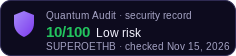
- Nov 15, 202610Low
Score changes are recorded as dated snapshots — history is append-only and cannot be edited.
Would You Like a More Detailed Audit of Super OETH?
Our AI-powered scanner gives you a deeper, real-time smart contract analysis — free, with every scoring factor shown.
Get Detailed Audit Is this your token? Add your links and get it Verified