
Quantum Audit Logo

Is KellyClaude Safe?

On-chain security analysis — is it a scam or legit?

KellyClaude KELLYCLAUDE
0x50d2…cb07
Base Not verifiedLast checked 3d ago 1 audit on record
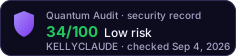
How is this score calculated? → Medium Risk
Executive SummaryAI Copilot

The ClankerToken contract is an ERC-20 token with extensions for burning, permits, and voting, designed for cross-chain functionality via a Superchain Token Bridge. The contract exhibits a robust foundation using OpenZeppelin standards. Key risks include the centralized control held by the `_admin` address over critical token parameters and the inherent dependency on the security of the external Superchain Token Bridge for supply management. The contract is not upgradeable, which simplifies its security profile but limits future flexibility.

1 High2 Medium1 Low1 Informational
Volume 24h
$20.0K
Liquidity
$241.4K
Price
$0.000007263
Token Age
6mo
Top 10 Holders
61.8%

Security Findings

High

Centralized Control of Admin Role

H-01The `_admin` address has extensive control over critical contract functions, including the ability to update the token's `_image`, `_metadata`, and, most significantly, to transfer the `_admin` role to any other address via `updateAdmin()`. This centralized control (7.3) creates a single point of failure; if the `_admin` key is compromised, an attacker could seize control of these parameters, potentially impacting the token's branding, perceived value, and future operational integrity (7.8).
IssueThe `_admin` address has extensive control over critical contract functions, including the ability to update the token's `_image`, `_metadata`, and, most significantly, to transfer the `_admin` role to any other address via `updateAdmin()`. This centralized control (7.3) creates a single point of failure; if the `_admin` key is compromised, an attacker could seize control of these parameters, potentially impacting the token's branding, perceived value, and future operational integrity (7.8).
FixConsider implementing a multi-signature wallet for the `_admin` role to require multiple approvals for sensitive operations like `updateAdmin()`, `updateImage()`, and `updateMetadata()`. Alternatively, introduce a timelock mechanism for admin role transfers to provide a window for community or team intervention in case of a compromised key.
StatusUnresolved
Medium

Dependency on External Superchain Token Bridge

M-01The `crosschainMint` and `crosschainBurn` functions, which directly affect the token's total supply, are exclusively callable by `Predeploys.SUPERCHAIN_TOKEN_BRIDGE`. This design (7.6) makes the token's supply management entirely dependent on the security and correct functioning of this external bridge. Any vulnerability or compromise within the Superchain Token Bridge could lead to unauthorized minting or burning of ClankerTokens, directly impacting the token's economic stability (7.4).
IssueThe `crosschainMint` and `crosschainBurn` functions, which directly affect the token's total supply, are exclusively callable by `Predeploys.SUPERCHAIN_TOKEN_BRIDGE`. This design (7.6) makes the token's supply management entirely dependent on the security and correct functioning of this external bridge. Any vulnerability or compromise within the Superchain Token Bridge could lead to unauthorized minting or burning of ClankerTokens, directly impacting the token's economic stability (7.4).
FixEnsure a thorough understanding and ongoing monitoring of the security posture of the `Predeploys.SUPERCHAIN_TOKEN_BRIDGE`. While direct control over the bridge's security may be limited, awareness of its audit status, operational procedures, and any reported vulnerabilities is crucial for assessing the overall risk to ClankerToken.
StatusUnresolved
Medium

Admin Control Over Token Metadata and Image

M-02The `_admin` address has the authority to unilaterally change the token's `_metadata` and `_image` strings via `updateMetadata()` and `updateImage()` functions. While these are typically off-chain representations, malicious or accidental changes to these publicly visible attributes could negatively impact user perception, trust, and the token's branding (7.4). This centralized control (7.3) over mutable data could be exploited to misrepresent the token.
IssueThe `_admin` address has the authority to unilaterally change the token's `_metadata` and `_image` strings via `updateMetadata()` and `updateImage()` functions. While these are typically off-chain representations, malicious or accidental changes to these publicly visible attributes could negatively impact user perception, trust, and the token's branding (7.4). This centralized control (7.3) over mutable data could be exploited to misrepresent the token.
FixConsider whether these metadata fields truly require mutable control by a single admin. If mutability is necessary, implement a timelock for changes or a multi-signature approval process to add a layer of security and transparency before updates are finalized. Clearly communicate the implications of these mutable fields to token holders.
StatusUnresolved
Low

Conditional Initial Supply Minting Logic

L-01The constructor's initial minting of `maxSupply_` to `msg.sender` is conditional on `block.chainid == initialSupplyChainId_`. If the contract is deployed on a chain where this condition is false, the `msg.sender` (deployer) will receive zero tokens, potentially leading to an unexpected empty initial supply for the deployer (7.8). While this might be an intentional design for multi-chain deployment strategies, it introduces a subtle point of failure if the `initialSupplyChainId_` is misconfigured or misunderstood during deployment (7.1).
IssueThe constructor's initial minting of `maxSupply_` to `msg.sender` is conditional on `block.chainid == initialSupplyChainId_`. If the contract is deployed on a chain where this condition is false, the `msg.sender` (deployer) will receive zero tokens, potentially leading to an unexpected empty initial supply for the deployer (7.8). While this might be an intentional design for multi-chain deployment strategies, it introduces a subtle point of failure if the `initialSupplyChainId_` is misconfigured or misunderstood during deployment (7.1).
FixEnsure that the `initialSupplyChainId_` parameter is carefully chosen and verified during deployment to match the intended chain for initial supply distribution. Document this behavior clearly to prevent deployment errors or misunderstandings regarding the initial token allocation.
StatusUnresolved
Info

Lack of Upgradeability

I-01The ClankerToken contract is deployed as a standard, non-upgradeable contract. This means there is no built-in mechanism (e.g., proxy pattern) to modify the contract's logic after deployment (7.7). While this simplifies the contract's architecture and removes upgrade-related risks, it also implies that any future bug fixes, feature enhancements, or changes to the token's core functionality would require a complete redeployment of the contract and a potentially complex migration of existing token holders and associated liquidity.
IssueThe ClankerToken contract is deployed as a standard, non-upgradeable contract. This means there is no built-in mechanism (e.g., proxy pattern) to modify the contract's logic after deployment (7.7). While this simplifies the contract's architecture and removes upgrade-related risks, it also implies that any future bug fixes, feature enhancements, or changes to the token's core functionality would require a complete redeployment of the contract and a potentially complex migration of existing token holders and associated liquidity.
FixAcknowledge the implications of non-upgradeability. For a token contract, this is often a desired security feature, as it guarantees immutability of core logic. If future flexibility is ever considered critical, a new contract would need to be deployed. Ensure all current functionality is thoroughly tested and deemed final.
StatusUnresolved

Category Ratings

TechnicalLow9/10

The contract is built upon well-audited OpenZeppelin ERC-20 standards, including extensions for burning, permits, and voting, which enhances its code security (7.2). The architecture (7.1) clearly defines roles for `_admin` and `_originalAdmin` and integrates cross-chain mint/burn functionality. However, the `_admin` role has significant control over mutable token metadata and can transfer the admin role, presenting a centralized point of failure if compromised (7.3). No reentrancy or integer overflow vulnerabilities were identified.

GovernanceMedium5/10

The economic model (7.4) relies on a fixed `maxSupply_` for initial minting, contingent on the deployment chain ID, and allows for dynamic supply adjustments via `crosschainMint`/`crosschainBurn` by the Superchain Token Bridge. Governance (7.5) is highly centralized, with the `_admin` address controlling key operational parameters like metadata, image, and the ability to transfer the admin role. This centralization, while simplifying operations (7.8), introduces a single point of failure. The contract's external dependency (7.6) on the Superchain Token Bridge for cross-chain operations means its economic integrity is tied to the bridge's security.

UpgradesLow9/10

The ClankerToken contract is implemented as a standard, non-upgradeable contract (7.7). This design choice eliminates the complexities and potential risks associated with upgrade mechanisms (e.g., proxy patterns), such as storage collisions or faulty upgrade logic. However, it also means that any future bug fixes, feature enhancements, or changes to the token's core logic would necessitate a complete redeployment of the contract and a migration of token holders, which can be a complex and disruptive process.

Security Checklist

Contract VerifiedPass
Ownership RenouncedPass
No Mint FunctionPass
Liquidity LockedFail
Not a ProxyPass

Holder Composition

28.8% in wallets33.0% in contracts
Effective Concentration42.0%

Share held by contracts — treasury, vesting, bridge or staking — is discounted against share held by wallets when the score is computed: a contract cannot decide to sell the way an anonymous holder can, though it can still be drained or voted to sell. Effective concentration is the figure the risk score is actually calculated from.

Liquidity Depth

Show 4 more pairsShow less

The risk score reads depth across every pair. The volume figure and the volume-to-liquidity ratio elsewhere on this page describe only the pair this audit analysed, so the two are not directly comparable.

LP Distribution

Top-1 Unlocked Holder100.0%
Top-3 Unlocked100.0%

Key Addresses

Deployer
0x2112…f3f9
Unlocked LP Held By
0x63d2…34960xb525…ae5e

No privileged address appears among these holders: the unlocked liquidity sits with independent providers, not with the deployer.

What Raised This Score

  • Top-10 concentration > 30% (61.8% total → 42.0% effective; 28.8% in EOAs, 33.0% in contracts — moderate)
  • Liquidity not locked, but no owner/deployer address holds LP — market-depth risk, not rug risk
  • LP top1 unlocked holder = 100.0% (independent LP — depth risk, pool = 99% of DEX liquidity)
  • LP top3 unlocked holders = 100.0% (independent LP — depth risk, pool = 99% of DEX liquidity)
  • 1 High finding(s) from audit
  • 2 Medium finding(s) from audit
  • 1 Low finding(s) from audit

Each factor is an on-chain fact recorded at the time of this analysis. The score is computed from them by a deterministic function, so the same contract returns the same score for anyone who runs the audit. How scores are computed

Related Audits

Moltbook (MOLT)Medium RiskElonRWAMedium RiskOWBMedium RiskVirtual Protocol (VIRTUAL)Medium RiskFlowerMedium RiskCookieMedium Risk

Would You Like a More Detailed Audit of KellyClaude?

Our AI-powered scanner gives you a deeper, real-time smart contract analysis — free, with every scoring factor shown.

Get Detailed Audit