
Quantum Audit Logo
Launch App

On-chain security analysis — is it a scam or legit?

Is Stockify Safe?

STFYBase
Not verified This record has not gone through deep verification and is not being monitored. The score is a dated snapshot — the token’s risk can change at any time.Own this token? Put it under verification →
Last checked Sep 4, 2026 · 1 audit on record
SummaryAI Copilot

The StockifyToken contract implements an ERC20 token with a custom holder tracking mechanism.

Read the full analysis
What raised the score
  • Ownership not renounced — owner is an EOA
  • Token age < 30 days
  • 1 High finding(s) from audit
  • 1 Low finding(s) from audit
Exact factors
  • Ownership NOT renounced — owner is an EOA (single private key)
  • Token age < 30 days (still settling)
  • 1 High finding(s) from audit
  • 1 Low finding(s) from audit

Each factor is an on-chain fact recorded at the time of this analysis. The score is computed from them by a deterministic function, so the same contract returns the same score for anyone who runs the audit. How scores are computed

Security Checklist

as of audit · Sep 46 of 7 checks passed
Contract verifiedVerified
OwnershipRetained
MintNo mint
Liquidity lockLocked
UpgradeabilityFixed code
HoneypotNone found
Buy / sell tax0% / 0%

Holders

as of audit · Sep 4, 2026
20.0%Contracts6.2%73.8%Everyone else
ContractsWalletsEveryone elseBubble area = share of supply
26.2%of supply sits with the top 10 holders
  • Contractstreasury, vesting, bridge, staking20.0%
  • Walletsanonymous holders, free to sell6.2%
  • Everyone elsethe rest of the supply73.8%
Effective concentrationwhat the score reads14.2%
How holder types affect the score

Share held by contracts — treasury, vesting, bridge or staking — is discounted against share held by wallets when the score is computed: a contract cannot decide to sell the way an anonymous holder can, though it can still be drained or voted to sell. Effective concentration is the figure the risk score is actually calculated from.

Holder balances as recorded by the audit of Sep 4, 2026

Liquidity

as of audit · Sep 4$96.5K across 6 pairs
LP tokensLocked

The LP tokens of the analysed pool are locked or burned.

Analysed pool$92.1KShare of depth95.4%
LP Locked86.2% · UNCX V4 Lock
Top-1 Unlocked Holder13.8%
Unlocked LP held by
0x2a20…4c710x8984…202f0xb3f8…1a140xed21…f033

A privileged address — the deployer, the owner, or the token contract itself — is among these holders, so that party can withdraw liquidity.

Security Findings

1 High1 Low1 Info
High

Centralized Control over Holder List Parameters

The contract owner has the ability to set minShareBalance and manually rewardsExcluded addresses. These functions directly influence which addresses are included in the _holders array. If this array is used for critical functions such as reward distribution, voting, or whitelisting, the owner possesses significant centralized control over these mechanisms, which could be abused to exclude legitimate holders or include favored addresses.H-01

Issue

The contract owner has the ability to set minShareBalance and manually rewardsExcluded addresses. These functions directly influence which addresses are included in the _holders array. If this array is used for critical functions such as reward distribution, voting, or whitelisting, the owner possesses significant centralized control over these mechanisms, which could be abused to exclude legitimate holders or include favored addresses.

Fix

Consider decentralizing control over these parameters, perhaps through a multi-signature wallet, a time-locked contract, or a robust governance mechanism. Clearly document the intended use of the _holders array and the implications of owner control for all stakeholders.

Status

Unresolved

Low

Owner EOA Risk

The contract owner is an Externally Owned Account (EOA). If the private key for this EOA is compromised, an attacker could gain full control over the setMinShareBalance and setRewardsExcluded functions, potentially manipulating the holder list and any associated protocol mechanics.L-01

Issue

The contract owner is an Externally Owned Account (EOA). If the private key for this EOA is compromised, an attacker could gain full control over the setMinShareBalance and setRewardsExcluded functions, potentially manipulating the holder list and any associated protocol mechanics.

Fix

Transfer ownership to a multi-signature wallet or a robust governance contract to mitigate the single point of failure risk associated with an EOA owner.

Status

Unresolved

Info

Fixed MIN_SHARE_BALANCE_FLOOR and MIN_SHARE_BALANCE_CEILING

The MIN_SHARE_BALANCE_FLOOR and MIN_SHARE_BALANCE_CEILING constants are hardcoded in the contract. While this provides a bounded range for minShareBalance, it means the range itself cannot be adjusted without a contract redeployment. If future protocol needs require a different range, a new contract deployment would be necessary.I-01

Issue

The MIN_SHARE_BALANCE_FLOOR and MIN_SHARE_BALANCE_CEILING constants are hardcoded in the contract. While this provides a bounded range for minShareBalance, it means the range itself cannot be adjusted without a contract redeployment. If future protocol needs require a different range, a new contract deployment would be necessary.

Fix

If flexibility is desired in the future, consider making these bounds configurable by the owner or governance. Otherwise, acknowledge that any changes to these limits would necessitate a new contract deployment.

Status

Unresolved

Analysis

AI Copilotas of audit · Sep 4
Executive SummaryWhat the contract is and what the review found

The StockifyToken contract implements an ERC20 token with a custom holder tracking mechanism. The contract is generally well-structured and uses OpenZeppelin libraries. Key functionalities include owner-controlled adjustments to minimum share balance and exclusion from rewards. The primary risks identified relate to the centralized control over key parameters and the use of an EOA for ownership.

Technical8/10Low risk

The StockifyToken contract demonstrates strong technical foundations, leveraging battle-tested OpenZeppelin ERC20 and Ownable implementations. The custom _syncHolder logic for managing the _holders array is efficiently implemented using a 'swap-with-last' method, preventing gas-related denial-of-service issues (7.2 Code Security). Robust zero-address checks and custom error handling are present. However, the owner's EOA introduces a single point of failure for critical functions (7.3 Access Control, 7.8 Operations).

Governance5/10Medium risk

The economic model is based on a fixed total supply ERC20 token. The owner has significant control over parameters that define who is considered a 'holder' (7.4 Economic). Specifically, the minShareBalance can be adjusted within a predefined range, and addresses can be manually rewardsExcluded by the owner (7.5 Governance). This centralization introduces a potential single point of failure and could be exploited if the owner's key is compromised or acts maliciously, impacting the integrity of any reward or governance mechanisms tied to the holder list.

Upgrades7/10Low risk

The contract is not designed as an upgradeable proxy, meaning its logic cannot be modified post-deployment. This design choice eliminates upgrade-related risks such as proxy misconfigurations or logic bugs introduced during upgrades (7.7 Upgrades). Any future changes would require a new deployment, ensuring immutability of the current implementation.

Final RecommendationWhat to do about this score

To enhance the security posture, consider transitioning the contract ownership from an EOA to a multi-signature wallet or a robust governance contract.

This decentralizes control and mitigates the risk associated with a single point of failure. Additionally, clearly document the intended use and implications of the _holders array and the owner's control over its parameters to ensure transparency for users and stakeholders.

Contract & Record

1 audit on record
TypeStockifyToken
NetworkBase
Token age10d
Contract0xc640…7bf5
Deployer0x2a20…4c71
Badge for your website
Stockify security record badge

Free for any token on the record. It links to this page and always shows the current score and the date it was checked.

Audit History
  1. Sep 4, 202635Medium
  2. Aug 30, 202637Medium

Score changes are recorded as dated snapshots — history is append-only and cannot be edited.

Frequently Asked Questions

What is the STFY contract address?

The Stockify (STFY) contract on Base is 0xc6405d7a226e1c18e559be2f335f74c01ad07bf5. Compare it with the address the project itself publishes before trading: other contracts can carry the same name and ticker.

Is Stockify a scam?

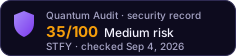
Quantum Audit's risk score for Stockify is 35/100 (Medium risk) as of Sep 4, 2026, computed by a deterministic function from on-chain facts — Contract verified: Verified; Ownership: Retained; Mint: No mint; Liquidity lock: Locked; Upgradeability: Fixed code; Honeypot: None found; Buy / sell tax: 0% / 0%. A score is a dated snapshot of those facts, not a guarantee; each one is listed on this page.

Is STFY liquidity locked?

Liquidity lock: Locked (as of Sep 4, 2026). Total DEX liquidity: $96.5K.

Who holds STFY?

As of Sep 4, 2026, the 10 largest holders own 26.2% of the supply. The Holders section on this page shows who they are by holder type.

Would You Like a More Detailed Audit of Stockify?

Our AI-powered scanner gives you a deeper, real-time smart contract analysis — free, with every scoring factor shown.

Get Detailed Audit Is this your token? Publish your own audit on this page