
Quantum Audit Logo
Launch App

On-chain security analysis — is it a scam or legit?

Is Solaxy Safe?

SOLXEthereum
Not verified This record has not gone through deep verification and is not being monitored. The score is a dated snapshot — the token’s risk can change at any time.Own this token? Put it under verification →
Last checked Oct 10, 2026 · 1 audit on record
SummaryAI Copilot

This audit covers an ERC-20 token contract. The contract's ownership has been renounced, eliminating central control risks.

Read the full analysis
What raised the score
  • Liquidity not locked
  • Top-10 concentration > 30%
  • Code: Risk from `tx.origin` usage in transfer logic
Exact factors
  • Liquidity NOT locked (100% of the pool; this pool is 100% of DEX liquidity) — held by independent providers — market-depth risk
  • Top-10 concentration > 30% (80.7% total → 42.8% effective; 22.1% in EOAs, 51.6% in contracts; 7.0% burned, locked or in pools excluded)
  • Code: Risk from `tx.origin` usage in transfer logic (Medium, static analysis)

How scores are computed

Security Checklist

as of audit · Oct 106 of 7 checks passed
Contract verifiedVerified
OwnershipRenounced
MintNo mint
Liquidity lockNot locked
UpgradeabilityFixed code
HoneypotNone found
Buy / sell tax0% / 0%

Holders

as of audit · Oct 10, 202652,754 holders
51.6%Contracts22.1%Wallets7.0%19.3%Everyone else
ContractsWalletsDEX poolsEveryone elseBubble area = share of supply
80.7%of supply sits with the top 10 holders
  • Contractstreasury, vesting, bridge, staking51.6%
  • Walletsanonymous holders, free to sell22.1%
  • DEX poolsthe pools' own liquidity7.0%
  • Everyone else52,744 holders19.3%
Effective concentrationwhat the score reads42.8%
How holder types affect the score

Share held by contracts — treasury, vesting, bridge or staking — is discounted against share held by wallets when the score is computed: a contract cannot decide to sell the way an anonymous holder can, though it can still be drained or voted to sell. Effective concentration is the figure the risk score is actually calculated from.

Holder balances as recorded by the audit of Oct 10, 2026

Liquidity

as of audit · Oct 10$223.0K across 4 pairs
LP tokensNot locked

The LP tokens of the analysed pool are not locked or burned, so whoever holds them can withdraw that liquidity.

Analysed pool$222.7KShare of depth99.8%
LP Locked100.0% · UNCX Locker
Top-1 Unlocked Holder0.0%
Unlocked LP held by
0x6ad0…330e

No privileged address appears among these holders: the unlocked liquidity sits with independent providers, not with the deployer.

Security Findings

1 High1 Medium4 Info
High

Liquidity lock has expired

0.0% of the pool's LP is burned or time-locked. 100.0% still sits in UNCX Locker, but that lock expired on 23 Jun 2026 — its owner can withdraw it at any moment.QA-LIQUIDITY

Issue

0.0% of the pool's LP is burned or time-locked. 100.0% still sits in UNCX Locker, but that lock expired on 23 Jun 2026 — its owner can withdraw it at any moment. Some pools are concentrated-liquidity (V3/V4) positions; shares above are by position as GoPlus reports them.

Fix

Check the lock's end date and beneficiary on the locker's own page before relying on it.

Status

Acknowledged

Medium

Risk from tx.origin usage in transfer logic

The _transfer function, which is central to moving tokens, uses tx.origin to determine a rule.CD-01

Issue

The _transfer function, which is central to moving tokens, uses tx.origin to determine a rule. This means that if a user interacts with a malicious contract, that contract could potentially trick the token contract into performing actions on behalf of the original user (tx.origin), even if the malicious contract is the direct caller (msg.sender). This is a known vulnerability pattern that can lead to phishing attacks.

Fix

It is recommended to replace tx.origin with msg.sender in the _transfer function's rule-making logic. msg.sender reliably identifies the immediate caller, preventing intermediate contracts from manipulating authorization or rules intended for the direct user.

Status

Unresolved

Info

Who holds the supply

The ten largest holders own 80.7% of supply. Of that, 7.0% in DEX pools — not holders that can sell, so excluded from the concentration score.QA-HOLDERS

Issue

The ten largest holders own 80.7% of supply. Of that, 7.0% in DEX pools — not holders that can sell, so excluded from the concentration score. What remains: 22.1% in wallets, 51.6% in other contracts. 52,754 holders in total.

Fix

Watch the largest wallets that are not exchanges, pools or locks — those are the ones that can move the price.

Status

Acknowledged

Info

Listed, but not independently verified

Listed on CoinGecko as Solaxy (SOLX), market cap $2M, rank #2490. 52,754 holders.QA-IDENTITY

Issue

Listed on CoinGecko as Solaxy (SOLX), market cap $2M, rank #2490. 52,754 holders.

Fix

Match the contract address against the project's official channels before trading.

Status

Acknowledged

Info

The market for this token

Liquidity $223K (DexScreener, all pools). 24h trading volume $102K (CoinGecko, all markets, daily snapshot).QA-MARKET

Issue

Liquidity $223K (DexScreener, all pools). 24h trading volume $102K (CoinGecko, all markets, daily snapshot). 24h trading volume $53K (DexScreener, all pools). CoinGecko's record for this coin: all-time high $0.0014 on 2025-07-01; the price is now 98.486% below it.

Fix

Size any position to the liquidity and daily volume shown — they set how much you can sell and at what price.

Status

Acknowledged

Info

Asset class: Project token

A token issued by a project for use, governance or fundraising.QA-PROFILE

Issue

A token issued by a project for use, governance or fundraising. Basis: no class-specific evidence. Tokenomics — Supply: fixed — the contract has no mint function. Control: nobody (ownership renounced). Code: not upgradeable (no proxy). Fees: no buy or sell tax. Market: $223K of DEX liquidity across 4 pools. Launch: 473 days of market history.

Fix

Check the project's own documentation for what the token is used for; this report covers what the contract allows.

Status

Acknowledged

Analysis

AI Copilotas of audit · Oct 10
Executive SummaryWhat the contract is and what the review found

This audit covers an ERC-20 token contract. The contract's ownership has been renounced, eliminating central control risks. One medium-severity issue was identified related to the use of tx.origin in the token transfer logic, which could potentially be exploited in phishing scenarios.

Technical10/10Low risk

The contract implements the ERC-20 standard, providing standard token functionalities such as transfer and transferFrom. A medium-severity issue (7.2 Code Security) was identified where the _transfer function uses tx.origin to decide a rule, which could be manipulated by an intermediate contract. All privileged functions, including setUniswapPool (7.3 Access Control), are dormant due to renounced ownership, preventing any changes to transfer rules by an owner.

Governance8/10Low risk

The contract's ownership has been renounced on-chain (7.5 Governance), meaning no single entity can control or alter the contract's core parameters or transfer rules, such as uniswapPool. This significantly reduces central point of failure and governance risks. There are no active economic mechanisms or external dependencies that introduce significant economic risk (7.4 Economic, 7.6 External).

Upgrades9/10Low risk

The contract is not designed with any upgradeability mechanisms (7.7 Upgrades). This means its logic is immutable once deployed, providing certainty but also preventing future bug fixes or feature enhancements. There are no operational risks related to upgrades (7.8 Operations).

Final RecommendationWhat to do about this score

It is crucial to address the identified tx.origin vulnerability by replacing its usage with msg.sender in the _transfer function's rule-making logic.

This change will ensure that authorization and critical decisions are based on the immediate caller, mitigating potential phishing and re-entrancy attack vectors. Although ownership is renounced, ensuring the core transfer logic is robust against such patterns is vital for user security.

Contract & Record

1 audit on record
TypeToken
NetworkEthereum
Token age1y
Contract0xe0b7…cf48
Deployer0x51f8…eefd
Badge for your website
Solaxy security record badge

Free for any token on the record. It links to this page and always shows the current score and the date it was checked.

Audit History
  1. Oct 10, 202631Low

Score changes are recorded as dated snapshots — history is append-only and cannot be edited.

Frequently Asked Questions

What is the SOLX contract address?

The Solaxy (SOLX) contract on Ethereum is 0xe0b7ad7f8f26e2b00c8b47b5df370f15f90fcf48. Compare it with the address the project itself publishes before trading: other contracts can carry the same name and ticker.

Is Solaxy a scam?

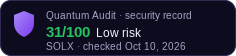
Quantum Audit's risk score for Solaxy is 31/100 (Low risk) as of Oct 10, 2026, computed by a deterministic function from on-chain facts — Contract verified: Verified; Ownership: Renounced; Mint: No mint; Liquidity lock: Not locked; Upgradeability: Fixed code; Honeypot: None found; Buy / sell tax: 0% / 0%. A score is a dated snapshot of those facts, not a guarantee; each one is listed on this page.

Is SOLX liquidity locked?

Liquidity lock: Not locked (as of Oct 10, 2026). Total DEX liquidity: $223.0K.

Who holds SOLX?

As of Oct 10, 2026, the 10 largest holders own 80.7% of the supply across 52,754 holders. The Holders section on this page shows who they are by holder type.

Would You Like a More Detailed Audit of Solaxy?

Our AI-powered scanner gives you a deeper, real-time smart contract analysis — free, with every scoring factor shown.

Get Detailed Audit Is this your token? Add your links and get it Verified