
Quantum Audit Logo

Is Slap Cat a Scam?

Honeypot, rug-pull and ownership checks

Is this your token? Publish your own audit on this page →

Slap Cat SLAP
0xd82f…bfad
BNB Chain Not verifiedLast checked 3d ago 1 audit on record
Executive SummaryAI Copilot

The TokenV2 contract is an upgradeable ERC20 token utilizing OpenZeppelin's upgradeable contracts. It implements a unique transfer constraint mechanism to restrict transfers to/from specific Uniswap pools, which can be disabled by the owner. While the core ERC20 functionality is robust due to OpenZeppelin's audited libraries, a critical vulnerability related to upgradeability was identified, along with concerns regarding centralized control and initial token distribution.

1 High1 Medium1 Low1 Informational
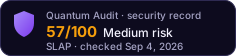
i Our automated scanner reviewed Slap Cat (SLAP) on BNB Chain. 3 of 5 security checks passed — see the full breakdown below.
Volume 24h
$46.8K
Liquidity
$37.7K
Price
$0.0001405
Age
8d
Top 10 Holders
100.0%

Security Findings

High

Missing `_disableInitializers()` in Constructor of Upgradeable Contract

H-01The `TokenV2` contract is an upgradeable implementation designed to be deployed behind a proxy. It correctly uses an `initialize` function with the `initializer` modifier. However, its constructor is empty and does not call `_disableInitializers()`. If this implementation contract is ever deployed directly (not through a proxy), its `initialize` function could be called multiple times by anyone, leading to re-initialization of state variables and potential exploits, such as re-minting tokens or changing critical parameters.
IssueThe `TokenV2` contract is an upgradeable implementation designed to be deployed behind a proxy. It correctly uses an `initialize` function with the `initializer` modifier. However, its constructor is empty and does not call `_disableInitializers()`. If this implementation contract is ever deployed directly (not through a proxy), its `initialize` function could be called multiple times by anyone, leading to re-initialization of state variables and potential exploits, such as re-minting tokens or changing critical parameters.
FixAdd `_disableInitializers()` to the constructor of the `TokenV2` contract. This prevents the `initialize` function from being called on the implementation contract directly, mitigating the risk of re-initialization.
StatusUnresolved
Medium

Centralized Control over Transfer Constraints

M-01The `transferConstraints` mechanism, which restricts token transfers to or from specified Uniswap V2 and V3 pools, can be entirely removed by the contract owner via the `removeTransferConstraints()` function. This grants significant centralized control to a single entity, allowing them to unilaterally alter a core token transfer behavior that could impact liquidity or trading strategies.
IssueThe `transferConstraints` mechanism, which restricts token transfers to or from specified Uniswap V2 and V3 pools, can be entirely removed by the contract owner via the `removeTransferConstraints()` function. This grants significant centralized control to a single entity, allowing them to unilaterally alter a core token transfer behavior that could impact liquidity or trading strategies.
FixConsider implementing a multi-signature wallet or a time-locked governance mechanism for critical functions like `removeTransferConstraints()`. This would distribute control, increase transparency, and provide a delay for community review before significant changes are enacted.
StatusUnresolved
Low

Single Point of Failure for Owner Role

L-01The contract relies on a single `owner` address for critical administrative functions, such as `removeTransferConstraints()`. If the owner's private key is compromised, or the owner becomes malicious, the protocol could be at risk of unauthorized changes or manipulation.
IssueThe contract relies on a single `owner` address for critical administrative functions, such as `removeTransferConstraints()`. If the owner's private key is compromised, or the owner becomes malicious, the protocol could be at risk of unauthorized changes or manipulation.
FixImplement a multi-signature wallet for the owner role to distribute control and enhance security. This requires multiple trusted parties to approve transactions, significantly reducing the risk associated with a single point of failure.
StatusUnresolved
Info

All Tokens Minted to Initializer

I-01During the `initialize` function call, the entire `maxSupply` of tokens is minted to `msg.sender` (the address that calls `initialize`). This design choice means the deployer or the address responsible for initialization will initially hold the entire token supply.
IssueDuring the `initialize` function call, the entire `maxSupply` of tokens is minted to `msg.sender` (the address that calls `initialize`). This design choice means the deployer or the address responsible for initialization will initially hold the entire token supply.
FixEnsure that the address performing the initialization is a secure, controlled entity (e.g., a multi-sig wallet or a trusted contract) and that this initial distribution model aligns with the project's intended tokenomics and distribution strategy. Clearly communicate this distribution to stakeholders.
StatusUnresolved

Category Ratings

TechnicalLow8/10

The contract leverages well-audited OpenZeppelin Upgradeable libraries for ERC20, ERC20Permit, and Ownable functionalities, contributing to a strong foundation (7.2 Code Security). The custom `_beforeTokenTransfer` logic for `transferConstraints` is straightforward and does not introduce reentrancy or complex external calls. However, a significant technical risk is the omission of `_disableInitializers()` in the constructor, which could allow re-initialization if the implementation contract is directly deployed (7.7 Upgrades).

GovernanceMedium4/10

The contract design grants the owner significant control, particularly over the `transferConstraints` mechanism, which can be unilaterally removed (7.3 Access Control). This centralized control introduces a single point of failure risk (7.5 Governance). Economically, the entire `maxSupply` is minted to the initializer, which is a design choice that centralizes initial token distribution (7.4 Economic).

UpgradesHigh3/10

The contract is designed as an upgradeable implementation using OpenZeppelin's `Upgradeable` pattern, which is a standard and generally secure approach (7.1 Architecture). The `initialize` function correctly uses the `initializer` modifier. However, the absence of `_disableInitializers()` in the constructor of the implementation contract poses a high risk, as it could allow for multiple initializations if the implementation is ever called directly (7.7 Upgrades).

Security Checklist

Contract VerifiedPass
Ownership RenouncedPass
No Mint FunctionPass
Liquidity LockedFail
Not a ProxyFail

Proxy Upgrade Controls

Proxy TypeEtherscan Detected Custom
ImplementationVerified source

Holder Composition

0.0% in wallets100.0% in contracts
Effective Concentration40.0%

Share held by contracts — treasury, vesting, bridge or staking — is discounted against share held by wallets when the score is computed: a contract cannot decide to sell the way an anonymous holder can, though it can still be drained or voted to sell. Effective concentration is the figure the risk score is actually calculated from.

Liquidity Depth

The risk score reads depth across every pair. The volume figure and the volume-to-liquidity ratio elsewhere on this page describe only the pair this audit analysed, so the two are not directly comparable.

Key Addresses

Deployer
0x01db…d845

What Raised This Score

  • Proxy contract (upgradeable — admin can replace logic)
  • Non-standard proxy storage (Etherscan-confirmed)
  • Top-10 concentration > 30% (100.0% total → 40.0% effective; 0.0% in EOAs, 100.0% in contracts — moderate)
  • Liquidity NOT locked (owner can withdraw — rug-pull risk)
  • Liquidity < $50k ($37,741 across 2 pairs — thin market)
  • Token age < 30 days (still settling)
  • 1 High finding(s) from audit
  • 1 Medium finding(s) from audit
  • 1 Low finding(s) from audit

Each factor is an on-chain fact recorded at the time of this analysis. The score is computed from them by a deterministic function, so the same contract returns the same score for anyone who runs the audit. How scores are computed

Related Audits

Unitas (UP)High RiskniulaiHigh RiskRICE AI (RICE)High RiskPrometeus (PROM)High RiskDAPPOS (DOS)High RiskDeAgentAI (AIA)High Risk

Would You Like a More Detailed Audit of Slap Cat?

Paste the contract address into our AI-powered scanner for a deeper real-time report — free, with every scoring factor shown.

Get Detailed Audit