
Quantum Audit Logo

Is DeAgentAI Safe?

On-chain security analysis — is it a scam or legit?

Is this your token? Publish your own audit on this page →

DeAgentAI AIA
0x53ec…55cc
BNB Chain Not verifiedLast checked 3d ago 1 audit on record
Executive SummaryAI Copilot

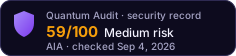
The AIA token contract is a standard ERC20 implementation leveraging OpenZeppelin's audited libraries. It features a custom `decimals` value of 9 and mints a fixed total supply to the deployer during construction. The contract is simple, well-structured, and primarily relies on battle-tested components, resulting in a low overall risk profile. Key considerations include the centralized ownership and the non-standard decimal configuration.

1 Low1 Informational
Volume 24h
$427.4K
Liquidity
$740.6K
Price
$0.07889
Token Age
8mo
Top 10 Holders
95.3%

Security Findings

Low

Centralized Ownership

L-01The `AIA` contract inherits from OpenZeppelin's `Ownable` contract, granting the deployer (owner) exclusive control over critical administrative functions such as `transferOwnership` and `renounceOwnership`. This centralization introduces a single point of failure; if the owner's private key is compromised, a malicious actor could gain control over the contract's ownership, potentially leading to unauthorized actions or loss of control.
IssueThe `AIA` contract inherits from OpenZeppelin's `Ownable` contract, granting the deployer (owner) exclusive control over critical administrative functions such as `transferOwnership` and `renounceOwnership`. This centralization introduces a single point of failure; if the owner's private key is compromised, a malicious actor could gain control over the contract's ownership, potentially leading to unauthorized actions or loss of control.
FixFor enhanced security and decentralization, consider transferring ownership to a multi-signature wallet (e.g., Gnosis Safe) or a time-locked contract. This would require multiple approvals or a waiting period for ownership changes, significantly reducing the risk associated with a single compromised key. If decentralization is not a primary goal, ensure the owner's private key is stored with the highest security standards.
StatusUnresolved
Info

Custom Decimals Value

I-01The `AIA` token contract explicitly overrides the default ERC20 `decimals()` function, setting its value to 9 instead of the common 18. While this is a valid design choice, it deviates from the widely adopted standard for many ERC20 tokens. This non-standard decimal value can lead to misinterpretation of token amounts, display errors in wallets or exchanges, and incorrect calculations in integrated DeFi protocols if they implicitly assume 18 decimals.
IssueThe `AIA` token contract explicitly overrides the default ERC20 `decimals()` function, setting its value to 9 instead of the common 18. While this is a valid design choice, it deviates from the widely adopted standard for many ERC20 tokens. This non-standard decimal value can lead to misinterpretation of token amounts, display errors in wallets or exchanges, and incorrect calculations in integrated DeFi protocols if they implicitly assume 18 decimals.
FixEnsure that all users, exchanges, wallets, and any integrated platforms are explicitly aware of and correctly configured for the token's 9-decimal value. Clear documentation and communication are essential to prevent user confusion and potential financial discrepancies. Thoroughly test all integrations to confirm correct handling of the token's decimal precision.
StatusUnresolved

Category Ratings

TechnicalLow8/10

The technical architecture (7.1) is robust, implementing a basic ERC20 token by inheriting from OpenZeppelin's `ERC20` and `Ownable` contracts. Code security (7.2) is high due to the extensive use of battle-tested OpenZeppelin libraries, which mitigate common vulnerabilities like reentrancy and integer overflows. The contract correctly overrides the `decimals` function to 9 (7.2), a deliberate design choice. No complex external interactions (7.6) or novel logic introduce significant technical risks.

GovernanceHigh1/10

The economic model (7.4) is straightforward: a fixed supply of 200,000,000 tokens (with 9 decimals) is minted entirely to the deployer at contract creation, with no further minting or burning mechanisms. Governance (7.5) is centralized, with the deployer acting as the `Ownable` owner. This owner can transfer or renounce ownership, representing a single point of control. While standard for simple tokens, this centralization requires careful management of the owner's private key.

UpgradesMedium6/10

The contract is not designed with an upgradeability mechanism (7.7), meaning its logic is immutable once deployed. This eliminates the risks associated with proxy patterns, implementation changes, or upgradeability misconfigurations. However, it also implies that any future feature enhancements or critical bug fixes would necessitate a new contract deployment and a token migration process.

Security Checklist

Contract VerifiedPass
Ownership RenouncedFail
No Mint FunctionPass
Liquidity LockedFail
Not a ProxyPass
HoneypotNoneBuy Tax0.0%Sell Tax0.0%

Holder Composition

69.8% in wallets25.5% in contracts
Effective Concentration80.0%

Share held by contracts — treasury, vesting, bridge or staking — is discounted against share held by wallets when the score is computed: a contract cannot decide to sell the way an anonymous holder can, though it can still be drained or voted to sell. Effective concentration is the figure the risk score is actually calculated from.

Liquidity Depth

The risk score reads depth across every pair. The volume figure and the volume-to-liquidity ratio elsewhere on this page describe only the pair this audit analysed, so the two are not directly comparable.

LP Distribution

Top-1 Unlocked Holder100.0%
Top-3 Unlocked100.0%

Key Addresses

Deployer
0x4fd2…f1e9
Unlocked LP Held By
0xd70a…b0e00x6ce1…24e20xa3b0…5aa2

No privileged address appears among these holders: the unlocked liquidity sits with independent providers, not with the deployer.

What Raised This Score

  • Ownership NOT renounced — owner is an EOA (single private key)
  • Top-10 concentration > 70% (95.3% total → 80.0% effective; 69.8% in EOAs, 25.5% in contracts — extreme)
  • Liquidity not locked, but no owner/deployer address holds LP — market-depth risk, not rug risk
  • LP top1 unlocked holder = 100.0% (independent LP — depth risk, pool = 99% of DEX liquidity)
  • LP top3 unlocked holders = 100.0% (independent LP — depth risk, pool = 99% of DEX liquidity)
  • 1 Low finding(s) from audit

Each factor is an on-chain fact recorded at the time of this analysis. The score is computed from them by a deterministic function, so the same contract returns the same score for anyone who runs the audit. How scores are computed

Related Audits

Slap Cat (SLAP)High RiskUnitas (UP)High RiskniulaiHigh RiskRICE AI (RICE)High RiskPrometeus (PROM)High RiskDAPPOS (DOS)High Risk

Would You Like a More Detailed Audit of DeAgentAI?

Our AI-powered scanner gives you a deeper, real-time smart contract analysis — free, with every scoring factor shown.

Get Detailed Audit