
The protocol implements a standard Arbitrum L2 gateway token pattern. The architecture relies on a centralized gateway to manage supply via minting and burning. While the implementation follows standard patterns, the high level of privilege granted to the gateway address presents a significant centralization risk.
On-chain security analysis — is it a scam or legit?
Is Rocket Pool ETH Safe?
Not verified
This record has not gone through deep verification and is not being monitored. The score is a dated snapshot — the token’s risk can change at any time.Own this token? Put it under verification →The protocol implements a standard Arbitrum L2 gateway token pattern.
Read the full analysis- Issuer controls retained
- Liquidity < $50k
Exact factors
- Issuer controls retained (mint, upgrade, seize balances) — counterparty risk on a known issuer, not a rug vector
- Liquidity < $50k ($45,864 across 5 pairs — thin market)
Each factor is an on-chain fact recorded at the time of this analysis. The score is computed from them by a deterministic function, so the same contract returns the same score for anyone who runs the audit. How scores are computed
Security Checklist
as of audit · Nov 20Holders
as of audit · Nov 20, 2026- Contractstreasury, vesting, bridge, staking31.3%
- Walletsanonymous holders, free to sell10.5%
- Everyone else10,446 holders58.2%
How holder types affect the score
Share held by contracts — treasury, vesting, bridge or staking — is discounted against share held by wallets when the score is computed: a contract cannot decide to sell the way an anonymous holder can, though it can still be drained or voted to sell. Effective concentration is the figure the risk score is actually calculated from.
Holder balances as recorded by the audit of Nov 20, 2026
Liquidity
as of audit · Nov 20- UniswapWETHAnalysed$38.3K83.5%
- UniswapWETH$4.7K10.2%
- UniswapWETH$2.9K6.2%
- Ramses v2WETH$70.0%
- UniswapUSDC$00.0%
The risk score reads depth across every pair.
The LP tokens of the analysed pool are not locked or burned, so whoever holds them can withdraw that liquidity.
0xfaf9…491c0x69f0…562d0x98ec…250a0x0ba0…c30b0x2726…cc3d0xddb7…6b5d0x4313…1ae20x12ba…a00e0x517d…f7a20x0329…5568No privileged address appears among these holders: the unlocked liquidity sits with independent providers, not with the deployer.
Security Findings
InfoPrivileged Minting Capability
The bridgeMint function allows the designated gateway address to create new tokens at will, which increases the total supply and dilutes the value of existing holdings.CP-01
Issue
The bridgeMint function allows the designated gateway address to create new tokens at will, which increases the total supply and dilutes the value of existing holdings.
Fix
Restrict the gateway address to a highly secure multi-signature wallet and implement a hard cap on the total supply if possible.
Status
Unresolved
InfoPrivileged Balance Modification
The bridgeBurn function allows the designated gateway address to remove tokens from any user's balance, effectively granting the gateway full control over user funds.CP-02
Issue
The bridgeBurn function allows the designated gateway address to remove tokens from any user's balance, effectively granting the gateway full control over user funds.
Fix
Ensure the gateway contract logic is audited and immutable to prevent malicious or accidental burning of user assets.
Status
Unresolved
InfoWho holds the supply
The ten largest holders own 41.8% of supply. What remains: 10.5% in wallets, 31.3% in other contracts. 10,456 holders in total. For a verified reference asset the largest holders are custodians, exchanges and bridges; concentration is reported, not scored.QA-HOLDERS
Issue
The ten largest holders own 41.8% of supply. What remains: 10.5% in wallets, 31.3% in other contracts. 10,456 holders in total. For a verified reference asset the largest holders are custodians, exchanges and bridges; concentration is reported, not scored.
Fix
Watch the largest wallets that are not exchanges, pools or locks — those are the ones that can move the price.
Status
Acknowledged
InfoIdentity verified by independent sources
Listed on CoinGecko as Rocket Pool ETH (RETH), market cap $622M. 10,456 holders. Verified by: CoinGecko.QA-IDENTITY
Issue
Listed on CoinGecko as Rocket Pool ETH (RETH), market cap $622M. 10,456 holders. Verified by: CoinGecko.
Fix
Match the contract address against the project's official channels before trading.
Status
Acknowledged
InfoThe market for this token
Liquidity $46K (DexScreener, all pools). 24h trading volume $681K (CoinGecko, all markets, daily snapshot). 24h trading volume $61K (DexScreener, all pools).QA-MARKET
Issue
Liquidity $46K (DexScreener, all pools). 24h trading volume $681K (CoinGecko, all markets, daily snapshot). 24h trading volume $61K (DexScreener, all pools).
Fix
Size any position to the liquidity and daily volume shown — they set how much you can sell and at what price.
Status
Acknowledged
InfoAsset class: Liquid staking token
A receipt for staked native tokens that keeps earning staking rewards. Its value depends on the staking protocol and its validators. Scored as an established reference asset: its identity is verified, so the issuer's or protocol's controls (listed as findings) are real and are priced once as counterparty risk, and LP locks and holder concentration are not scored — its pools belong to market makers and its largest holders are exchanges, bridges and custody. Basis: CoinGecko category: Liquid Staking Tokens. Tokenomics — Supply: mintable with no on-chain cap found. Control: an owner that could not be resolved. Code: upgradeable proxy. Fees: no buy or sell tax. Market: $46K of DEX liquidity across 5 pools. Launch: 1825 days of market history.QA-PROFILE
Issue
A receipt for staked native tokens that keeps earning staking rewards. Its value depends on the staking protocol and its validators. Scored as an established reference asset: its identity is verified, so the issuer's or protocol's controls (listed as findings) are real and are priced once as counterparty risk, and LP locks and holder concentration are not scored — its pools belong to market makers and its largest holders are exchanges, bridges and custody. Basis: CoinGecko category: Liquid Staking Tokens. Tokenomics — Supply: mintable with no on-chain cap found. Control: an owner that could not be resolved. Code: upgradeable proxy. Fees: no buy or sell tax. Market: $46K of DEX liquidity across 5 pools. Launch: 1825 days of market history.
Fix
Check the staking protocol's validator set, withdrawal queue and governance.
Status
Acknowledged
Analysis
AI Copilotas of audit · Nov 20The contract utilizes a robust, battle-tested inheritance structure including ERC20Permit and L2GatewayToken. 7.1 Architecture follows the standard Arbitrum bridge pattern, while 7.2 Code Security is maintained through standard OpenZeppelin-like implementations. 7.3 Access Control is strictly enforced via the onlyGateway modifier, ensuring only authorized bridge contracts can execute supply changes.
7.4 Economic and 7.5 Governance risks are centered on the gateway's authority. The ability to mint and burn tokens allows the gateway to unilaterally alter the circulating supply and individual balances. 7.6 External dependencies are limited to the Arbitrum bridge infrastructure, which is considered a trusted component of the ecosystem.
7.7 Upgrades are managed via a Beacon Proxy pattern, allowing for consistent implementation updates across cloned instances. 7.8 Operations are stable, with no complex state migration logic required for standard token transfers. The upgrade mechanism is standard for the Arbitrum ecosystem.
The protocol is functionally sound but inherently centralized due to the bridge gateway's control.
Users should be aware that the gateway address holds the power to mint and burn tokens, which is a necessary feature for cross-chain interoperability but represents a single point of failure. Ensure that the gateway address is secured by a multi-signature wallet or a decentralized governance contract to mitigate the risk of unauthorized supply manipulation. Regular monitoring of the gateway's activity is recommended to detect any anomalous minting or burning events.
Contract & Record
Free for any token on the record. It links to this page and always shows the current score and the date it was checked.
- Nov 20, 202626Low
Score changes are recorded as dated snapshots — history is append-only and cannot be edited.
Frequently Asked Questions
What is the RETH contract address?
The Rocket Pool ETH (RETH) contract on Arbitrum is 0xec70dcb4a1efa46b8f2d97c310c9c4790ba5ffa8. Compare it with the address the project itself publishes before trading: other contracts can carry the same name and ticker.
Is Rocket Pool ETH a scam?
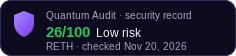
Quantum Audit's risk score for Rocket Pool ETH is 26/100 (Low risk) as of Nov 20, 2026, computed by a deterministic function from on-chain facts — Contract verified: Verified; Mint: Mintable; Liquidity lock: Not locked; Upgradeability: Upgradeable; Honeypot: None found; Buy / sell tax: 0% / 0%. A score is a dated snapshot of those facts, not a guarantee; each one is listed on this page.
Is RETH liquidity locked?
Liquidity lock: Not locked (as of Nov 20, 2026). Total DEX liquidity: $45.9K.
Who holds RETH?
As of Nov 20, 2026, the 10 largest holders own 41.8% of the supply across 10,456 holders. The Holders section on this page shows who they are by holder type.
Would You Like a More Detailed Audit of Rocket Pool ETH?
Our AI-powered scanner gives you a deeper, real-time smart contract analysis — free, with every scoring factor shown.
Get Detailed Audit Is this your token? Add your links and get it Verified