
The ApeOFT contract is an Omnichain Fungible Token (OFT) built on LayerZero, inheriting from OpenZeppelin's Ownable. The contract's primary function is to allow the owner to perform a one-time initialization, minting an initial supply to a specified lockbox address. The audit identified a High-severity issue related to centralized owner control, a Medium-severity issue concerning irreversible initialization parameters, and a Low-severity issue regarding external dependency on the LayerZero protocol. The contract's code quality is high, utilizing established libraries and clear logic. The owner is a multisig, which mitigates some centralization risks.
On-chain security analysis — is it a scam or legit?
Is ApeCoin Safe?
Not verified
This record has not gone through deep verification and is not being monitored. The score is a dated snapshot — the token’s risk can change at any time.Own this token? Put it under verification →The ApeOFT contract is an Omnichain Fungible Token (OFT) built on LayerZero, inheriting from OpenZeppelin's Ownable.
Read the full analysis- Ownership not renounced — strong Multisig
- Top-10 concentration > 30%
- Liquidity not locked, but no owner/deployer address holds LP — market-depth risk, not rug risk
- LP top1 unlocked holder = 100.0%
- LP top3 unlocked holders = 100.0%
Exact factors
- Ownership NOT renounced — strong Multisig (4-of-7)
- Top-10 concentration > 30% (99.9% total → 40.0% effective; 0.1% in EOAs, 99.9% in contracts — moderate)
- Liquidity not locked, but no owner/deployer address holds LP — market-depth risk, not rug risk
- LP top1 unlocked holder = 100.0% (independent LP — depth risk, pool = 56% of DEX liquidity)
- LP top3 unlocked holders = 100.0% (independent LP — depth risk, pool = 56% of DEX liquidity)
Security Checklist
as of audit · Sep 23Holders
as of audit · Sep 23, 2026- Contractstreasury, vesting, bridge, staking99.9%
- Walletsanonymous holders, free to sell0.1%
- Everyone elsethe rest of the supply0.1%
How holder types affect the score
Share held by contracts — treasury, vesting, bridge or staking — is discounted against share held by wallets when the score is computed: a contract cannot decide to sell the way an anonymous holder can, though it can still be drained or voted to sell. Effective concentration is the figure the risk score is actually calculated from.
Holder balances as recorded by the audit of Sep 23, 2026
Liquidity
as of audit · Sep 23The LP tokens of the analysed pool are not locked or burned, so whoever holds them can withdraw that liquidity.
0x4d09…ad40No privileged address appears among these holders: the unlocked liquidity sits with independent providers, not with the deployer.
Security Findings
MediumIrreversible Initialization Parameters
Not confirmed by static analysis (the model's own reading of the source).M-01
Issue
Not confirmed by static analysis (the model's own reading of the source). The initialize function, callable only once by the owner, sets the _l2LockBox address and _initialSupply. Once executed, these parameters are immutable. Any error in these values during the initial call cannot be corrected without redeploying the contract, which could lead to significant operational issues or loss of funds if the initial supply is minted to an incorrect address or with an incorrect amount.
Fix
Implement a rigorous pre-deployment checklist and conduct thorough testing on a testnet to verify the correctness of _l2LockBox and _initialSupply before deploying and initializing on the mainnet. Consider a timelock for the initialize call if feasible, allowing for a grace period to detect and react to misconfigurations.
Status
Unresolved
MediumCentralized Control by Owner
Not confirmed by static analysis (the model's own reading of the source).M-02
Issue
Not confirmed by static analysis (the model's own reading of the source). The ApeOFT contract inherits Ownable, granting the deployer (or the specified _delegate in the constructor) exclusive control over critical functions, including the one-time initialize function that mints the initial token supply. This centralization introduces a single point of failure; if the owner's private keys or multisig are compromised, an attacker could potentially misuse these privileges.
Fix
Ensure the owner address is a robustly secured multi-signature wallet with a high threshold and geographically distributed signers. Regularly review and audit the multisig's operational procedures and key management. Consider implementing a timelock for critical administrative actions if the protocol's design allows for it, providing a delay for detection and intervention.
Status
Unresolved
LowExternal Dependency on LayerZero Protocol
Not confirmed by static analysis (the model's own reading of the source).L-01
Issue
Not confirmed by static analysis (the model's own reading of the source). The ApeOFT contract is built upon the LayerZero OFT standard, making its cross-chain functionality and overall security dependent on the LayerZero protocol's integrity, security, and operational stability. Any vulnerabilities, misconfigurations, or disruptions within the LayerZero ecosystem could potentially impact the ApeOFT token's functionality or security.
Fix
Monitor LayerZero protocol announcements, security audits, and operational status closely. Be prepared to react to any potential issues or upgrades within the LayerZero ecosystem that might affect the ApeOFT token. Maintain clear communication channels with the LayerZero team.
Status
Unresolved
InfoLack of Explicit Event for Initial Owner/Delegate
Not confirmed by static analysis (the model's own reading of the source).I-01
Issue
Not confirmed by static analysis (the model's own reading of the source). While the Ownable contract emits an OwnershipTransferred event upon ownership changes, the ApeOFT contract itself does not emit a specific event during its constructor or initialize function to explicitly log the initial owner or the _delegate address set in the constructor. This can make historical tracking of the initial owner less straightforward for off-chain tools.
Fix
Consider emitting a custom event in the constructor or initialize function to explicitly log the initial owner or delegate address for enhanced transparency and easier historical tracking. For example: event InitialOwnerSet(address indexed owner);
Status
Unresolved
Analysis
AI Copilotas of audit · Sep 23The contract exhibits good code quality (7.2 Code Security), leveraging battle-tested OpenZeppelin and LayerZero libraries. The architecture (7.1 Architecture) is straightforward, extending standard OFT functionality with a single initialization step. Access control (7.3 Access Control) is primarily managed by the Ownable pattern, ensuring that critical functions like initialize are restricted to the owner. However, the centralized nature of this control introduces a single point of failure, as highlighted by the High-severity finding.
The economic model (7.4 Economic) involves a one-time initial minting of tokens to a specified lockbox, which is a critical setup step. Governance (7.5 Governance) is centralized, with the owner (a multisig) having exclusive control over initialization and other administrative functions inherited from OFT and Ownable. While the use of a multisig for the owner (7.8 Operations) is a positive operational security practice, the irreversible nature of the initialization parameters presents a moderate risk if incorrect values are used.
The ApeOFT contract is not designed as an upgradeable proxy (7.7 Upgrades). Therefore, it does not inherit the specific upgrade-related risks associated with proxy patterns. Any changes to the contract's logic would require a new deployment and migration.
To enhance the security posture of the ApeOFT contract, it is crucial to maintain robust operational security for the owner's multisig wallet.
This includes regular audits of multisig procedures, secure key management, and a high threshold for critical transactions. Given the irreversible nature of the initialize function, a meticulous pre-deployment checklist and thorough testing on a testnet are essential to verify all parameters before mainnet deployment.
Contract & Record
Free for any token on the record. It links to this page and always shows the current score and the date it was checked.
- Sep 23, 202627Low
Score changes are recorded as dated snapshots — history is append-only and cannot be edited.
Frequently Asked Questions
What is the APE contract address?
The ApeCoin (APE) contract on Arbitrum is 0x7f9fbf9bdd3f4105c478b996b648fe6e828a1e98. Compare it with the address the project itself publishes before trading: other contracts can carry the same name and ticker.
Is ApeCoin a scam?
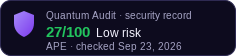
Quantum Audit's risk score for ApeCoin is 27/100 (Low risk) as of Sep 23, 2026, computed by a deterministic function from on-chain facts — Contract verified: Verified; Ownership: Retained; Mint: No mint; Liquidity lock: Not locked; Upgradeability: Fixed code; Honeypot: None found; Buy / sell tax: 0% / 0%. A score is a dated snapshot of those facts, not a guarantee; each one is listed on this page.
Is APE liquidity locked?
Liquidity lock: Not locked (as of Sep 23, 2026). Total DEX liquidity: $86.1K.
Who holds APE?
As of Sep 23, 2026, the 10 largest holders own 99.9% of the supply. The Holders section on this page shows who they are by holder type.
Would You Like a More Detailed Audit of ApeCoin?
Our AI-powered scanner gives you a deeper, real-time smart contract analysis — free, with every scoring factor shown.
Get Detailed Audit Is this your token? Add your links and get it Verified