The target contract is not verified on the Base block explorer. Consequently, the source code is unavailable for security analysis. Investors should exercise extreme caution as the lack of transparency prevents verification of ownership, minting capabilities, tax mechanisms, or liquidity lock status.
Early-stage security check — honeypot & rug-pull analysis
Is Private Inu a Scam?
Not verified
This record has not gone through deep verification and is not being monitored. The score is a dated snapshot — the token’s risk can change at any time.Own this token? Put it under verification →The target contract is not verified on the Base block explorer.
Read the full analysis- Mint capability UNKNOWN
- Ownership status UNKNOWN
- Liquidity not locked
- Contract source not verified — its logic cannot be read
Exact factors
- Mint capability UNKNOWN (implementation ABI unreadable)
- Ownership status UNKNOWN (owner could not be resolved)
- Liquidity NOT locked (100% of the pool) — withdrawable by the owner/deployer — rug-pull risk
- Contract source NOT verified — its logic cannot be read
Each factor is an on-chain fact recorded at the time of this analysis. The score is computed from them by a deterministic function, so the same contract returns the same score for anyone who runs the audit. How scores are computed
Security Checklist
as of audit · Nov 22Holders
as of audit · Nov 22, 2026- Contractstreasury, vesting, bridge, staking22.7%
- Walletsanonymous holders, free to sell5.3%
- Everyone else602 holders72.0%
How holder types affect the score
Share held by contracts — treasury, vesting, bridge or staking — is discounted against share held by wallets when the score is computed: a contract cannot decide to sell the way an anonymous holder can, though it can still be drained or voted to sell. Effective concentration is the figure the risk score is actually calculated from.
Holder balances as recorded by the audit of Nov 22, 2026
Liquidity
as of audit · Nov 22The risk score reads depth across every pair.
The LP tokens of the analysed pool are not locked or burned, so whoever holds them can withdraw that liquidity.
0x0148…d99dA privileged address — the deployer, the owner, or the token contract itself — is among these holders, so that party can withdraw liquidity.
Security Findings
CriticalUnverified Source Code
The contract source code is not published on the block explorer, making it impossible to verify the logic, security, or safety of the token.C-01
Issue
The contract source code is not published on the block explorer, making it impossible to verify the logic, security, or safety of the token.
Fix
Publish the source code on the block explorer to allow for community and security review.
Status
Unresolved
HighOpaque Administrative Privileges
Without code access, it is impossible to determine if the owner has the ability to mint tokens, pause trading, or blacklist addresses.H-01
Issue
Without code access, it is impossible to determine if the owner has the ability to mint tokens, pause trading, or blacklist addresses.
Fix
Renounce ownership or provide a transparent audit of administrative functions.
Status
Unresolved
HighLiquidity withdrawable by the owner/deployer
0.0% of the pool's LP is burned or time-locked. 100.0% is held, unlocked, by the token's owner/deployer (0x0148…d99d) — they can pull that liquidity at any moment. This is the rug-pull path. Some pools are concentrated-liquidity (V3/V4) positions; shares above are by position as GoPlus reports them.QA-LIQUIDITY
Issue
0.0% of the pool's LP is burned or time-locked. 100.0% is held, unlocked, by the token's owner/deployer (0x0148…d99d) — they can pull that liquidity at any moment. This is the rug-pull path. Some pools are concentrated-liquidity (V3/V4) positions; shares above are by position as GoPlus reports them.
Fix
Check the lock's end date and beneficiary on the locker's own page before relying on it.
Status
Acknowledged
MediumUnknown Economic Risks
The absence of code prevents the identification of hidden taxes, honeypot mechanisms, or transfer restrictions.M-01
Issue
The absence of code prevents the identification of hidden taxes, honeypot mechanisms, or transfer restrictions.
Fix
Perform a thorough analysis of the contract bytecode or wait for official verification.
Status
Unresolved
InfoWho holds the supply
The ten largest holders own 28.0% of supply. What remains: 5.3% in wallets, 22.7% in other contracts. 612 holders in total.QA-HOLDERS
Issue
The ten largest holders own 28.0% of supply. What remains: 5.3% in wallets, 22.7% in other contracts. 612 holders in total.
Fix
Watch the largest wallets that are not exchanges, pools or locks — those are the ones that can move the price.
Status
Acknowledged
InfoNot listed by any independent source
612 holders. Not listed by CoinGecko or any exchange GoPlus tracks. Nothing independent confirms who is behind this token, so every power its contract grants is scored at face value.QA-IDENTITY
Issue
612 holders. Not listed by CoinGecko or any exchange GoPlus tracks. Nothing independent confirms who is behind this token, so every power its contract grants is scored at face value.
Fix
Match the contract address against the project's official channels before trading.
Status
Acknowledged
InfoThe market for this token
Liquidity $87K (DexScreener, all pools). 24h trading volume $657K (DexScreener, all pools).QA-MARKET
Issue
Liquidity $87K (DexScreener, all pools). 24h trading volume $657K (DexScreener, all pools).
Fix
Size any position to the liquidity and daily volume shown — they set how much you can sell and at what price.
Status
Acknowledged
InfoAsset class: Meme token
A community token whose value comes from attention rather than a product. Being a meme is not a risk in itself: it is scored on exactly the same contract and market facts as any other token. The class itself adds no points; the contract and market facts decide the score. Basis: meme vocabulary in name/ticker (inu). Tokenomics — Supply: mint capability could not be read. Control: an owner that could not be resolved. Code: not upgradeable (no proxy). Fees: no buy or sell tax. Market: $87K of DEX liquidity across 1 pools. Launch: under a day of market history.QA-PROFILE
Issue
A community token whose value comes from attention rather than a product. Being a meme is not a risk in itself: it is scored on exactly the same contract and market facts as any other token. The class itself adds no points; the contract and market facts decide the score. Basis: meme vocabulary in name/ticker (inu). Tokenomics — Supply: mint capability could not be read. Control: an owner that could not be resolved. Code: not upgradeable (no proxy). Fees: no buy or sell tax. Market: $87K of DEX liquidity across 1 pools. Launch: under a day of market history.
Fix
Expect attention-driven volatility; the facts in this report say whether the contract itself can be used against holders.
Status
Acknowledged
InfoRecently launched — less than a day of market history
The token's oldest DEX pool is less than a day old. Age is not part of the risk score — a new token is not a risky one by default — but a short history means fewer trades and holder changes behind the facts in this report.QA-RECENT
Issue
The token's oldest DEX pool is less than a day old. Age is not part of the risk score — a new token is not a risky one by default — but a short history means fewer trades and holder changes behind the facts in this report.
Fix
Re-check ownership, liquidity and holder distribution as the token matures; those are the facts that move early.
Status
Acknowledged
Analysis
AI Copilotas of audit · Nov 227.1 Architecture: Unknown. 7.2 Code Security: Cannot be audited due to lack of source code. 7.3 Access Control: Cannot verify if administrative functions exist. 7.6 External: Interactions with DEX routers remain unverified.
7.4 Economic: Tokenomics are opaque and cannot be validated. 7.5 Governance: Potential for hidden minting or blacklisting functions exists. 7.8 Operations: No evidence of liquidity locking or ownership renouncement.
7.7 Upgrades: Cannot determine if the contract is a proxy or immutable. Without source code, any potential upgradeability mechanism remains hidden from the user.
Do not interact with or provide liquidity to this contract until the source code is verified on the block explorer.
Verify the contract creator's identity and ensure that ownership has been renounced or transferred to a multi-sig wallet if the project claims to be decentralized.
Contract & Record
Free for any token on the record. It links to this page and always shows the current score and the date it was checked.
- Nov 22, 202681High
Score changes are recorded as dated snapshots — history is append-only and cannot be edited.
Frequently Asked Questions
What is the PI contract address?
The Private Inu (PI) contract on Base is 0x2bc99e8089def93b9d16c6cfa27c7287d10ccdb5. Compare it with the address the project itself publishes before trading: other contracts can carry the same name and ticker.
Is Private Inu a scam?
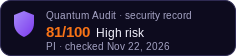
Quantum Audit's risk score for Private Inu is 81/100 (High risk) as of Nov 22, 2026, computed by a deterministic function from on-chain facts — Contract verified: Not verified; Liquidity lock: Not locked; Upgradeability: Fixed code; Honeypot: None found; Buy / sell tax: 0% / 0%. A score is a dated snapshot of those facts, not a guarantee; each one is listed on this page.
Is PI liquidity locked?
Liquidity lock: Not locked (as of Nov 22, 2026). Total DEX liquidity: $87.1K.
Who holds PI?
As of Nov 22, 2026, the 10 largest holders own 28.0% of the supply across 612 holders. The Holders section on this page shows who they are by holder type.
Would You Like a More Detailed Audit of Private Inu?
This token is brand new. Run a deeper AI-powered analysis of the contract code — free and instant.
Get Detailed Audit Is this your token? Add your links and get it Verified