
The protocol implements a standard ERC-20 token with bridging capabilities and a centralized minting mechanism. The codebase follows established OpenZeppelin patterns, ensuring robust standard compliance. The primary risk is the centralized control over token supply, which is managed by a multisig wallet.
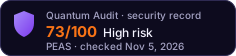
On-chain security analysis — is it a scam or legit?
Is Peapods Safe?
Not verified
This record has not gone through deep verification and is not being monitored. The score is a dated snapshot — the token’s risk can change at any time.Own this token? Put it under verification →The protocol implements a standard ERC-20 token with bridging capabilities and a centralized minting mechanism.
Read the full analysis- Owner can change any holder's balance
- Hidden owner — control survives an apparent renounce
- Mintable supply — no cap found, dilution unbounded
- Liquidity not locked
- Top-10 concentration > 30%
Exact factors
- Owner can change any holder's balance (seize or credit tokens)
- Hidden owner — control survives an apparent renounce
- Mintable supply — no cap found, dilution unbounded
- Liquidity NOT locked (100% of the pool; this pool is 97% of DEX liquidity) — withdrawable by the owner/deployer — rug-pull risk
- Top-10 concentration > 30% (70.3% total → 45.5% effective; 39.5% in EOAs, 14.9% in contracts; 15.9% burned, locked or in pools excluded)
Each factor is an on-chain fact recorded at the time of this analysis. The score is computed from them by a deterministic function, so the same contract returns the same score for anyone who runs the audit. How scores are computed
Security Checklist
as of audit · Nov 5Holders
as of audit · Nov 5, 2026- Contractstreasury, vesting, bridge, staking14.9%
- Walletsanonymous holders, free to sell39.5%
- DEX poolsthe pools' own liquidity15.9%
- Everyone else1,056 holders29.7%
How holder types affect the score
Share held by contracts — treasury, vesting, bridge or staking — is discounted against share held by wallets when the score is computed: a contract cannot decide to sell the way an anonymous holder can, though it can still be drained or voted to sell. Effective concentration is the figure the risk score is actually calculated from.
Holder balances as recorded by the audit of Nov 5, 2026
Liquidity
as of audit · Nov 5- UniswapWETHAnalysed$140.7K96.6%
- Camelot v3apOHM$2.1K1.5%
- CamelotapUMP$1.4K1.0%
- Camelot v3USDC$1.2K0.8%
- CamelotapUSD$1330.1%
- CamelotapETHPEAS$780.1%
Show 1 more pair
The risk score reads depth across every pair.
The LP tokens of the analysed pool are not locked or burned, so whoever holds them can withdraw that liquidity.
0xc64b…362b0x7a4d…b0850x1913…c8f90xeb2e…acbe0xd508…4a29A privileged address — the deployer, the owner, or the token contract itself — is among these holders, so that party can withdraw liquidity.
Security Findings
HighLiquidity withdrawable by the owner/deployer
0.0% of the pool's LP is burned or time-locked. 99.6% is held, unlocked, by the token's owner/deployer (0xc64b…362b) — they can pull that liquidity at any moment. This is the rug-pull path. 0.4% is held, unlocked, by 1 address(es) other than the owner/deployer. No single one holds a majority: their exits thin the market rather than hand anyone the pool. Some pools are concentrated-liquidity (V3/V4) positions; shares above are by position as GoPlus reports them.QA-LIQUIDITY
Issue
0.0% of the pool's LP is burned or time-locked. 99.6% is held, unlocked, by the token's owner/deployer (0xc64b…362b) — they can pull that liquidity at any moment. This is the rug-pull path. 0.4% is held, unlocked, by 1 address(es) other than the owner/deployer. No single one holds a majority: their exits thin the market rather than hand anyone the pool. Some pools are concentrated-liquidity (V3/V4) positions; shares above are by position as GoPlus reports them.
Fix
Check the lock's end date and beneficiary on the locker's own page before relying on it.
Status
Acknowledged
MediumCentralized Minting Authority
The mint(address,uint256) function allows a privileged minter address to create new tokens at will. This increases the total supply and dilutes the value held by existing token holders.CP-01
Issue
The mint(address,uint256) function allows a privileged minter address to create new tokens at will. This increases the total supply and dilutes the value held by existing token holders.
Fix
Implement a timelock on the minter role or require a multi-step governance process before new tokens can be minted to prevent unauthorized or sudden supply inflation.
Status
Unresolved
InfoWho holds the supply
The ten largest holders own 70.3% of supply. Of that, 15.9% in DEX pools — not holders that can sell, so excluded from the concentration score. What remains: 39.5% in wallets, 14.9% in other contracts. The deployer/owner wallet itself holds 3.6%. 1,066 holders in total.QA-HOLDERS
Issue
The ten largest holders own 70.3% of supply. Of that, 15.9% in DEX pools — not holders that can sell, so excluded from the concentration score. What remains: 39.5% in wallets, 14.9% in other contracts. The deployer/owner wallet itself holds 3.6%. 1,066 holders in total.
Fix
Watch the largest wallets that are not exchanges, pools or locks — those are the ones that can move the price.
Status
Acknowledged
InfoListed, but not independently verified
Listed on CoinGecko as Peapods Finance (PEAS), market cap $18M, rank #904. 1,066 holders.QA-IDENTITY
Issue
Listed on CoinGecko as Peapods Finance (PEAS), market cap $18M, rank #904. 1,066 holders.
Fix
Match the contract address against the project's official channels before trading.
Status
Acknowledged
InfoThe market for this token
Liquidity $146K (DexScreener, all pools). 24h trading volume $104K (CoinGecko, all markets, daily snapshot). 24h trading volume $59K (DexScreener, all pools).QA-MARKET
Issue
Liquidity $146K (DexScreener, all pools). 24h trading volume $104K (CoinGecko, all markets, daily snapshot). 24h trading volume $59K (DexScreener, all pools).
Fix
Size any position to the liquidity and daily volume shown — they set how much you can sell and at what price.
Status
Acknowledged
InfoAsset class: Project token
A token issued by a project for use, governance or fundraising. Scored on its contract and market facts. The class itself adds no points; the contract and market facts decide the score. Basis: no class-specific evidence. Tokenomics — Supply: mintable with no on-chain cap found. Control: a 2-of-6 multisig. Code: not upgradeable (no proxy). Fees: no buy or sell tax. Market: $146K of DEX liquidity across 7 pools. Launch: 964 days of market history.QA-PROFILE
Issue
A token issued by a project for use, governance or fundraising. Scored on its contract and market facts. The class itself adds no points; the contract and market facts decide the score. Basis: no class-specific evidence. Tokenomics — Supply: mintable with no on-chain cap found. Control: a 2-of-6 multisig. Code: not upgradeable (no proxy). Fees: no buy or sell tax. Market: $146K of DEX liquidity across 7 pools. Launch: 964 days of market history.
Fix
Check the project's own documentation for what the token is used for; this report covers what the contract allows.
Status
Acknowledged
Analysis
AI Copilotas of audit · Nov 5The architecture utilizes standard OpenZeppelin libraries for ERC-20 and EIP-712 compliance, ensuring 7.1 Architecture and 7.2 Code Security standards are met. 7.3 Access Control is implemented via Ownable, restricting sensitive functions to authorized addresses. 7.6 External dependencies are limited to audited standard libraries, reducing the attack surface. No reentrancy or overflow vulnerabilities were identified in the core logic.
7.4 Economic and 7.5 Governance risks are centered on the minting authority. While the multisig requirement (2/6) provides a layer of protection, the ability to mint tokens creates potential for supply dilution. The protocol lacks on-chain governance mechanisms, relying on off-chain multisig coordination.
7.7 Upgrades are not supported as the contract is not a proxy. 7.8 Operations are handled via standard ownership transfers. The lack of upgradeability ensures immutability but prevents rapid patching of logic errors.
The protocol should implement a timelock contract for the minter role to provide transparency and a delay period for any supply changes.
Additionally, consider documenting the off-chain criteria used by the multisig signers to authorize minting events to increase community trust.
Contract & Record
Free for any token on the record. It links to this page and always shows the current score and the date it was checked.
- Nov 5, 202673High
Score changes are recorded as dated snapshots — history is append-only and cannot be edited.
Frequently Asked Questions
What is the PEAS contract address?
The Peapods (PEAS) contract on Arbitrum is 0x02f92800f57bcd74066f5709f1daa1a4302df875. Compare it with the address the project itself publishes before trading: other contracts can carry the same name and ticker.
Is Peapods a scam?
Quantum Audit's risk score for Peapods is 73/100 (High risk) as of Nov 5, 2026, computed by a deterministic function from on-chain facts — Contract verified: Verified; Ownership: Retained; Mint: Mintable; Liquidity lock: Not locked; Upgradeability: Fixed code; Honeypot: None found; Buy / sell tax: 0% / 0%. A score is a dated snapshot of those facts, not a guarantee; each one is listed on this page.
Is PEAS liquidity locked?
Liquidity lock: Not locked (as of Nov 5, 2026). Total DEX liquidity: $145.7K.
Who holds PEAS?
As of Nov 5, 2026, the 10 largest holders own 70.3% of the supply across 1,066 holders. The Holders section on this page shows who they are by holder type.
Would You Like a More Detailed Audit of Peapods?
Our AI-powered scanner gives you a deeper, real-time smart contract analysis — free, with every scoring factor shown.
Get Detailed Audit Is this your token? Add your links and get it Verified