
Quantum Audit Logo

Is DGrid AI Safe?

On-chain security analysis — is it a scam or legit?

DGrid AI DGAI
0x12c2…19c7
Arbitrum Not verifiedLast checked 3d ago 1 audit on record
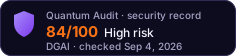
How is this score calculated? → Critical Risk
Executive SummaryAI Copilot

The DGAIPeer contract implements an ERC20 token with minting and burning capabilities. It utilizes OpenZeppelin's battle-tested libraries for core functionalities and access control. The contract features a `maxSupply` to cap total token issuance and a dedicated `minter` role. The audit identified a High-severity risk related to the centralized minter role, alongside a Low-severity and an Informational finding.

1 High1 Low1 Informational
Volume 24h
$76.2K
Liquidity
$242.0K
Price
$0.78
Token Age
9d
Top 10 Holders
100.0%

Security Findings

High

Centralized Minter Role Poses Inflation Risk

H-01The `minter` role has the exclusive authority to mint new tokens up to the `maxSupply`. While the `setMinter` function is restricted to the contract owner (a multisig, per prefill), the `minter` address itself represents a single point of failure for token supply control. A compromise of the `minter`'s private key could lead to unauthorized and rapid inflation of the token supply, devaluing existing tokens.
IssueThe `minter` role has the exclusive authority to mint new tokens up to the `maxSupply`. While the `setMinter` function is restricted to the contract owner (a multisig, per prefill), the `minter` address itself represents a single point of failure for token supply control. A compromise of the `minter`'s private key could lead to unauthorized and rapid inflation of the token supply, devaluing existing tokens.
FixImplement robust operational security for the `minter` address. This could involve using a multi-signature wallet for the `minter` role itself, or a hardware security module. Additionally, consider adding a timelock mechanism to the `setMinter` function, allowing for a delay before a new minter becomes active, providing a window to react to malicious changes.
StatusUnresolved
Low

Hardcoded Initial Authority Address

L-01The `INITIAL_AUTHORITY` address (0xE3bd…ED92) is hardcoded in the contract's constructor. While this is a standard practice for `Ownable` contracts, it means the initial ownership is fixed at deployment. If the intention was for a different entity (e.g., a specific multisig) to immediately take ownership, a transfer of ownership would be required post-deployment. The prefill data indicates the current owner is a different multisig address (0x27b7…b5b0), suggesting this transfer likely occurred.
IssueThe `INITIAL_AUTHORITY` address () is hardcoded in the contract's constructor. While this is a standard practice for `Ownable` contracts, it means the initial ownership is fixed at deployment. If the intention was for a different entity (e.g., a specific multisig) to immediately take ownership, a transfer of ownership would be required post-deployment. The prefill data indicates the current owner is a different multisig address (), suggesting this transfer likely occurred.
FixEnsure that the hardcoded `INITIAL_AUTHORITY` is the intended initial owner. If the final desired owner is different, verify that the ownership transfer to the correct entity (e.g., a secure multisig) was successfully executed immediately after deployment. Document this post-deployment step clearly in operational procedures.
StatusUnresolved
Info

High Maximum Token Supply

I-01The `maxSupply` is set to 1,000,000,000 ether (1e27 wei). While this value acts as a hard cap on the total token supply, it is a very large number. This allows for significant potential inflation if the `minter` role is actively used to mint tokens up to this limit. The economic implications of such a large potential supply should be clearly understood and communicated to token holders.
IssueThe `maxSupply` is set to 1,000,000,000 ether (1e27 wei). While this value acts as a hard cap on the total token supply, it is a very large number. This allows for significant potential inflation if the `minter` role is actively used to mint tokens up to this limit. The economic implications of such a large potential supply should be clearly understood and communicated to token holders.
FixEnsure that the economic model and implications of a potentially very large token supply are well-documented and transparently communicated to the community and token holders. Consider if this `maxSupply` aligns with the long-term vision and utility of the token, and if a smaller, more constrained supply might be more appropriate for certain economic models.
StatusUnresolved

Category Ratings

TechnicalMedium6/10

The technical architecture (7.1) is a standard ERC20 implementation, leveraging well-audited OpenZeppelin contracts, which enhances code security (7.2). The `mint` function includes a `maxSupply` check, preventing over-issuance beyond the defined limit. However, the `minter` role, while protected by `onlyMinter` (7.3), holds significant power to inflate the supply up to the maximum, posing a centralization risk if compromised.

GovernanceHigh1/10

The contract employs an `Ownable` pattern (7.5), with the owner (a multisig, per prefill) having control over setting the `minter`. This centralized control over the `minter` role introduces an economic risk (7.4) as a compromised minter could rapidly inflate the token supply up to the `maxSupply`. The `maxSupply` itself is a very large value (1 billion ether), allowing for substantial potential inflation if the minter is misused.

UpgradesMedium4/10

The DGAIPeer contract is not designed to be upgradeable (7.7), which eliminates risks associated with proxy patterns, upgradeability logic, and potential upgrade path vulnerabilities. This provides a fixed and immutable contract logic post-deployment, ensuring predictable behavior and reducing future operational overhead for upgrades.

Security Checklist

Contract VerifiedPass
Ownership RenouncedFail
No Mint FunctionFail
Liquidity LockedFail
Not a ProxyPass
HoneypotNoneBuy Tax0.0%Sell Tax0.0%

Holder Composition

50.4% in wallets49.6% in contracts
Effective Concentration70.3%

Share held by contracts — treasury, vesting, bridge or staking — is discounted against share held by wallets when the score is computed: a contract cannot decide to sell the way an anonymous holder can, though it can still be drained or voted to sell. Effective concentration is the figure the risk score is actually calculated from.

Liquidity Depth

The risk score reads depth across every pair. The volume figure and the volume-to-liquidity ratio elsewhere on this page describe only the pair this audit analysed, so the two are not directly comparable.

LP Distribution

Top-1 Unlocked Holder100.0%
Top-3 Unlocked100.0%

Key Addresses

Deployer
0xe3bd…ed92
Unlocked LP Held By
0xe21a…6183

No privileged address appears among these holders: the unlocked liquidity sits with independent providers, not with the deployer.

What Raised This Score

  • Ownership NOT renounced — Multisig (2-of-3)
  • Mintable supply, nominal cap 542545%/year — effectively unbounded
  • Top-10 concentration > 70% (100.0% total → 70.3% effective; 50.4% in EOAs, 49.6% in contracts — extreme)
  • Liquidity not locked, but no owner/deployer address holds LP — market-depth risk, not rug risk
  • LP top1 unlocked holder = 100.0% (independent LP — depth risk)
  • LP top3 unlocked holders = 100.0% (independent LP — depth risk)
  • Token age < 30 days (still settling)
  • 1 High finding(s) from audit
  • 1 Low finding(s) from audit

Each factor is an on-chain fact recorded at the time of this analysis. The score is computed from them by a deterministic function, so the same contract returns the same score for anyone who runs the audit. How scores are computed

Related Audits

Vangrid (VAN)Critical RiskMORCritical RiskAxelar Wrapped LAVA (LAVA)Critical RiskUnicity Labs (UNYLA)Critical RiskCatena Labs (CATE)Critical RiskVision (VSN)Critical Risk

Would You Like a More Detailed Audit of DGrid AI?

Our AI-powered scanner gives you a deeper, real-time smart contract analysis — free, with every scoring factor shown.

Get Detailed Audit